
Shocking Volatility. Get Used to It.
From our CIO Group Outlook 2026 issued in October:
-
Will leaders including Trump, Putin, Xi or others fundamentally break the detente of the past 80 years?
-
Will government control overwhelm free enterprise and innovation?
-
Will macroeconomic policy fail to cushion destabilizing technological change?
These are large questions to be answered in coming years. Yet, merely facing such critical questions does not tell us how to invest.”
Fireworks: Pricing Risk in a Bi-Polar World
The fireworks in the precious metals market this past week reflect the tumultuous state of global politics and economics. Gold surged to nearly $5,600 per ounce Thursday before crashing nearly 9% intraday. Silver – a far more volatile and speculative metal - saw a 12% intra-day trading range. Gold then fell another 9% Friday. Silver – a far more volatile and speculative metal - crashed a daily record 27% on Friday. The market volatility in precious metals is greater than we experienced as the COVID pandemic was rapidly spreading across the world, a time when central banks intervened to a avoid a catastrophic structural breakdown in capital markets.
Today, the world watches as an American armada approaches Iran. In China, President Xi has consolidated control over China’s military. After Davos, European leaders wonder if the US commitment to NATO is concrete. From their perspective, President Trump’s unilateral attitudes now parallel those of China and Russia.
The same is true in US markets. This administration is willing to intervene in corporate transactions by buying equity in companies or influencing who wins and loses in M&A (rare earths, Tik Tok, Time Warner). They have also directly impacted mortgage rates by directing the GSE’s under conservatorship purchase bonds, disrupting mortgage pricing. This is reflected in PennyMac’s poor earnings report even as mortgage applications rose.
As a backdrop, Apple, Microsoft, Meta and Tesla reported earnings beats this week and affirmed strong capital spending plans. Some were punished (Microsoft had its worst daily decline since 2020_ and others rewarded (Meta). The underlying question of how these and other companies will earn a sustainable return on their AI investments remains uncertain.
Speaking of “emergency action,” Trump chose to nominate a Fed Chairman historically opposed to strong central bank intervention in markets and the economy in former Governor Kevin Warsh. Will there be a new clash between the President and his eventual new Fed Chairman? It seems ironic that of all of Trump's publicly discussed picks, Warsh's comments lean the most hawkish. The USD dollar and bond yields rose on the Warsh announcement. His choice served as the catalyst for the crash in precious metals after leveraged speculators drove prices to record highs. We believe Warsh’s strong historical emphasis on price stability can be stabilizing at this moment. However, the true test will come in a future crisis period where his reluctance to act may create new risks.
As the Economy Rebounds, So Does Uncertainty
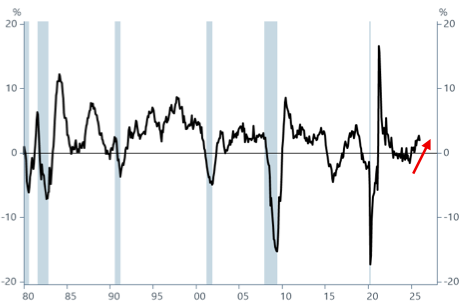
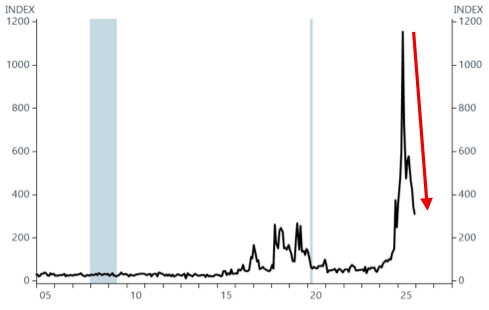
Economic growth is poised to strengthen in the US and world. Trade and production are poised to rise more strongly after business confidence took a hit from tariff uncertainty last year (Figure 1) In the second half of 2025, as the US struck deals with allies who refrained from retaliation, trade policy uncertainty wanned. Yet with new US tariff threats made (and withdrawn) with the EU, Canada and South Korea in just the past week, trade policy uncertainty is surely set to rise again (Figure 2).
Consumer confidence surveys may be starting to pick up public concern about the deadly clashes over immigration enforcement televised from Minneapolis. In contrast, economic data are firm and encouraging. Partial data for 4Q 2025 show real consumer spending rise at a strong 3.5% pace. New shipments of US capital goods rose at an 8% pace last quarter. This will likely vault US GDP to another near 4% annualized gain in 4Q 2025 despite a wider trade deficit.
Markets also view any US-led attacks on foreign targets – particularly Iran – in a similar vein to risks the US faced in past interventions in the Middle East. The 2002 invasion of Iraq was particularly costly for the US and impactful to global security through the present day.
For Investors in 2026, a Repeat of Market Action in 2025 is Likely
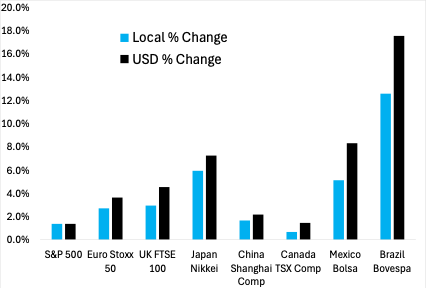
Facing a variety of greater US policy uncertainties, markets year-to-date are seeing asset performance similar to 2025 (Figure 3). Even US leadership in corporate profit gains is not generating similar outperformance for US equities. The record 15 year run of US outperformance through 2024 made this possible.
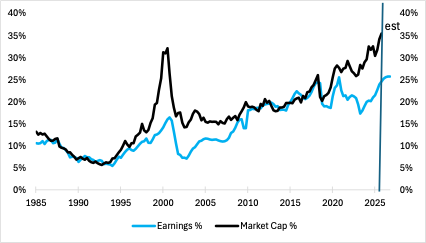
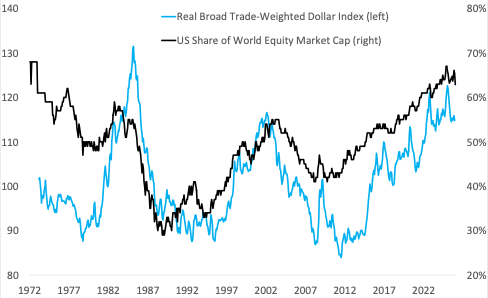
As we highlighted in our Outlook, investors face an intense conflict in asset allocation. US leadership in tech innovation and its commercialization suggests even further US equity outperformance. Yet the valuation of US assets, including the dollar’s relative value, suggests greater opportunity abroad (See Figures 4-5).
Tech Leadership at the Center of US/China Policy Conflicts
Technological progress is the key driver of economic growth in the long run and we are living through a moment of unusually strong, disruptive change that we believe is consistent with stronger corporate profits. Therefore, while we don’t want to exaggerate the importance of government policy. However, the consolidation of power under US and Chinese Presidents leaves more room for trade disruption and less room for maximizing returns on investment. Investors in China know the government accounts for a great share of the success or failure of particular investments. US interventions under Biden and Trump are now raising that share in the US.
And Wherefore the Dollar?
This past week, the Fed held US rates steady and sent an optimistic message about the US economy’s durability. Trump has also shown sensitivity to US step back from the policies that have harmed US markets. With near-record US dollar short positions, it suggests a chance for US assets to rebound in our view. With that said, markets over the past week still suggest a net loss of global confidence in the US. As we discussed in early January, and will address further in coming weeks, this is resulting in a changing return outlook for various assets and changes in our portfolios. This is even with a historic Fed hawk at the helm in the form of future-Chairman Warsh.