Don’t Believe January Data…Weak Industries Have Yet to Recover
CIO Group’s Mad Magazine Edition: The End of Software, US Manufacturing Goes Boom, Friends with Iran, More Jobs in January and “Real” Recommendations
Another Quiet Week on the Street or Where Did My $2 Trillion Go?
Investors continue to grapple with a market dislocation in the software sector (see last week’s Point). Yet, even after this week’s drop, the industry has led US equity returns for more than three decades with a return 4X the S&P 500, albeit with 60% more volatility.
Increased “digitization” of the economy is most certainly going to power the outperformance for software industry leaders, but like all businesses impacted by AI (and all business sectors generally) there will be losers. Our friends at Goldman Sachs have created baskets for the software winners and losers, at least since early 2025. The winners have revenue growth of 20% and the losers closer to zero.
The Software Sky is Falling
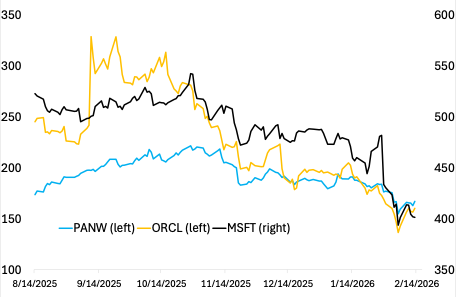
The 20% drop for the sector has been indiscriminate over the past month. That’s one reason why the group remains a recovery opportunity in our view as key components, like Microsoft and Palo Alto Networks are down 26% and 25% from their peak prices of late October (see Figure 1). The software industry isn’t subject to the extreme inventory and capital spending busts of the hardware sector. There have been scant downward revisions in software company earnings. With EPS growth of more than 14% expected this year, the industry group now sports a more reasonable valuation 28X 2026 EPS and 24X 2027 estimates.
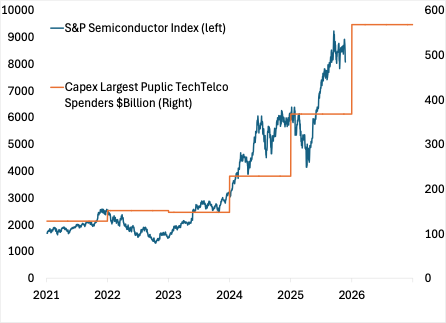
On the macro front, AI, software and hardware are poised to bolster the US economy again in 2026. In 4Q earnings reports, capital spending guidance from the four largest public hyperscalers shows anticipated spending gains of 54% this year. Compared to just three months ago, this is an upward revision of $94 billion (Figure 2). As we noted last week, this gives us increased confidence in the near-term economic outlook.
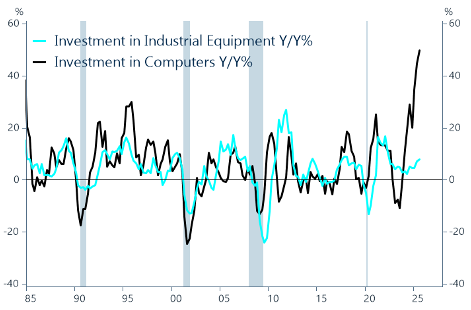
Of course, there is no doubt that spending for AI infrastructure will eventually slow even if AI applications and utilization does not. This will drive greater dispersion between winning and losing groups within the equity market. It will also slow the US economy’s growth rate by as much as a full percentage point, likely in the 2027-2028 period (see Figure 3).
There’s Jobs A-Plenty. Ignore 2025’s Downward Revision!
Delayed employment data for January and annual revisions were especially difficult for markets to digest this past week. Economists expected weak January employment, but instead the reported 130,000 overall gain and 172,000 jump in private payrolls was a huge surprise. The 5,000 gain in manufacturing payrolls was the first gain since November 2024.
The reported employment gain for January does not end the downward trend in labor demand. In fact, the trend weakened. Last year’s meager job gains of 49,000 per month on average were revised downward to 15,000.
Typically, December/January data are dramatically impacted by seasonal hiring and layoffs. But that swing is diminishing. (Unadjusted, January employment in 2025 was -2.9 million, January 2026 was -2.6 million). We would argue that any reported gain between zero and +200,000 is meaningless. Seasonal adjustment accounted for 95% of the final figures last month. In short, this was not the “broadening expansion” we’ve been waiting for.
Consumers Are Loving This
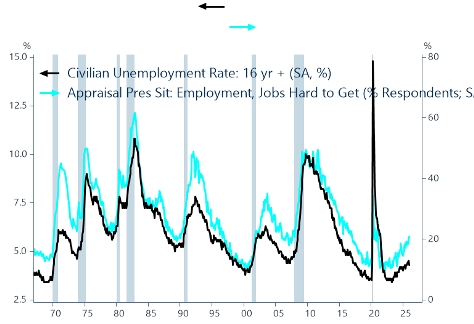
The Conference Board’s monthly consumer survey suggests that US consumers are experiencing a weakening labor market. Their data maps tie very closely to the actual unemployment rate through history (see Figure 4). This is consistent with rising consumer delinquencies, another trend that coincides with a weaker labor market. Perhaps the Fed will take note.
All’s Quiet in the Oil Patch
There are news reports the US is negotiating directly with Iran over its nuclear ambitions and other regional security matters. At the same time, the US is sending a second aircraft carrier to Persian Gulf. That’s gunboat diplomacy in action. We will soon know the outcome based on the actions (or lack thereof) of the US military.
Fortunately, the world is not short of crude oil. Despite the ongoing conflict between Ukraine and Russia, world crude oil benchmarks sit more than 50% below their speculative 2008 record high of $145 per barrel.
Of course, it is possible for crude oil exports from the Gulf region to be temporality disrupted in the event of a hot conflict there. Crude oil production/consumption cycles are very short in duration. It takes just over a month for global inventories to be consumed and replenished. Therefore, the price of crude oil can spike very sharply for a short period. Oil price volatility can be 15X the difference in production lost over the short run.
For this one reason alone, we believe investors need to be prepared for greater volatility.
Everything May Be Just Fine
As we’ve written from our Outlook 2025 to now, the US economy and world economy are poised for a broader expansion in 2026, barring new shocks. The economy suffered weakness across construction, manufacturing and trade in 2025. This weakness should reverse in 2026 if regulatory and trade policies steady. Such polices are largely at the discretion of the Trump administration, though the Supreme Court and Congress may play a more active role reining them in.
The Fed Will Definitely Not Lower Rates Ever Again
While the “micro story” of the moment is speculation about the “end of software”, the macro story is sowing confusion in markets. By Congressional mandate, the Fed pursues “maximum employment and price stability.” Tariffs disrupted price stability in 2025. But the labor market, in our view, is slowing significantly and that may bring Fed easing back into the picture.
Following the employment data, markets are now convinced the Fed will remain on hold at least until the new nominee, Kevin Warsh, is seated for the June 17th meeting. Markets believe Powell is sending a message of the Fed’s independence by refraining from further cuts.
We believe that weakening labor market data will be sufficient to bring easing back into the picture prior to the in March 18th and April 29th meetings. There may be no stronger act of independence and “responsibility” from Powell than setting monetary policy for the public. That’s why we believe the 20% odds of a rate cut before Powell’s term ends May 15 is too low.
Yes, We Have Actually Done This (Real Headline Warning)
While we are tech optimists (see Outlook 2026), the incredible concentration of US market cap in tech hardware (semiconductors) and, until recently, software makes us look for other drivers of portfolio returns and diversification from risk.
We are fairly confident of double-digit EPS gains for US equities this year. Double-digit share price returns are less certain. Therefore, we are seeking to receive more return in the form of income. This drove CIO Group to shift some assets to energy infrastructure partnerships and mortgage REITS a week ago. While these are also volatile assets, we have confidence in dividends and pass-through income near the 11% yield level for the new positions.
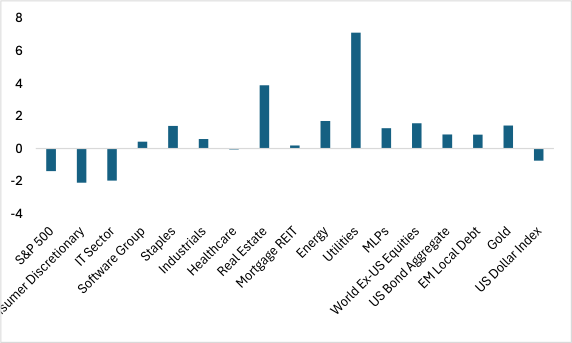
Amid volatile markets, defensive utilities, energy and real estate assets stood out in the past week. Our international assets in both equities and bonds also continue to outperform. This is notable now that Fed easing expectations have become relatively constrained (see figure 5). Should the Fed lower rates, our international investment overweight should gain further strength.
As we wrote last week, CIO Group is less bullish than the consensus of sell-side Wall Street strategists on S&P 500 targets for this year. We see a volatile year with a 10% return despite double-digit profit growth. We see strong AI spending growth continuing. Yet this adds disruptive, competitive pressures for many firms.
As such, we believe that adding further to non-US holdings in fixed income and to segments of the US equity market with yields averaging about 11% adds both diversification and solid return potential for portfolios.