Shocks vs Bear Markets. A Primer
Shocks vs. Bear Markets: The Impact of AI on Portfolios
If the film series “Terminator” is your base case view for AI’s future impact on humanity, you may want to own put options pre-“Judgement Day.” Thereafter, financial assets will be of little help.
Our own read of history is that every technological breakthrough has resulted in a larger economy. While technology inevitably brings disruptions to industries, companies and workers’ lives, the resulting productivity gains have given rise to higher standards of living and higher profits over time. (Please see our Outlook for more)
For the moment, we assume that this historical precedent will continue, with the caveat that the scope for change Artificial Intelligence is delivering is truly unprecedented, so “this time could be different” in the level of disruption ahead of us, between now and that more profitable future.
Views of AI’s Future: Both Give and Take
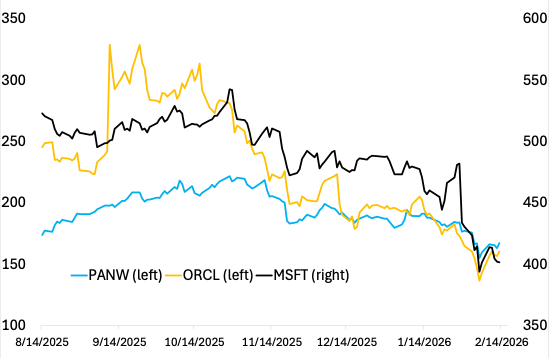
Over the past few weeks, we have dwelled on the sudden, severe selloff in software shares that occurred after Anthropic’s release of Claude Opus 4.6, which is capable of augmenting and replacing knowledge work. Broad-based, highly correlated sell-offs are typical of “shock periods” where investors liquidate shares due to general fear. (Figure 1).
Markets believe AI agents will displace both software and people. Among the firms most impacted by worker headcount, shares of office REIT Vornado Realty Trut have fallen 13.0% this year. In contrast, broader US REITS – including data centers - have risen 8.4% YTD.
Yet, the across the board sell-off in software is indiscriminate. Cyber-security provider Palo Alto Networks has fallen 33% from its peak. Firms that provide CRM and HR management (i.e. Salesforce and Workday) have fallen 30%-35% year-to-date. Shares of Microsoft have dropped 27% from last year’s peak. Microsoft is far more than a software company, with a massive presence in cloud computing, home to AI. Microsoft also has its own AI product releases and annuity-like income from both households and business accounts.
More “Agents,” Fewer People
Looking broadly, it is clear that markets do not assume “Judgement Day” is here. With the boom continuing in hyper-scaler capex (estimated +54% in 2026 for the large public companies), memory chip makers have seen shares rise about 45% this year (ex. Samsung, Micron). US semiconductor shares have rallied 17% in the year-to-date, even after booming in 2025. Investors, collectively, are not taking the view that a broad-based decline in profits of most industries is close at hand.
Looking at share price action across narrow industry groups (Figure 2), investors are repricing business categories where demand will fall or where core activities may become obsolete (think office space and IT consulting). In contrast, investors see AI infrastructure components and the energy to power AI as likely beneficiaries.
Is this sustainable? Tech hardware has shown itself far more subject to cyclical busts and less adaptive to rapid change than software. But as noted above, the “shock” of AI may be game changing for many.
Our CIO Group Investment Portfolios invest widely across regions and asset classes, far more than tech. Yet the fact that AI is still apparently boosting the fortunes of some industries tells us about the “market regime.” Investors, collectively, are not taking the view that a broad-based decline in profits of most industries is close at hand. This is despite much doomsaying of late.

Bear Markets in the Time of AI
As the US economy has evolved over recent decades, business cycles have become less about routine, relatively benign phenomenon such as inventory building and shedding. The shift from manufacturing to services has seen production and employment rise and fall periodically, without severe financial consequences.
The larger “booms” and consequent busts are different. We think a major transition point is ahead of us. Booms stand out distinctly as their ends are far from benign.
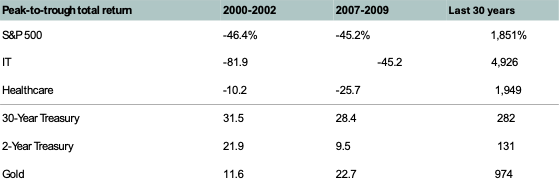
The US recession of 2001 was historically mild, yet the US equity market fell about 50% at its low point. Tech shares were down 82% at their bottom, reflecting the wild optimism prior to the early-2000 peak (Figure 3). The recession of 2008/2009 was historically severe, but it also was preceded by an irrational explosion of optimism in the housing sector (Figure 4). One can remember unfinished housing units as far as the eye could see across the deserts of Nevada. They went unsold for most of a decade.
Where the AI Boom May Live and What May Precipitate the Bust
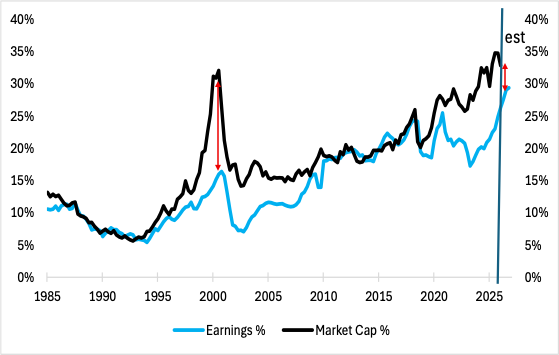
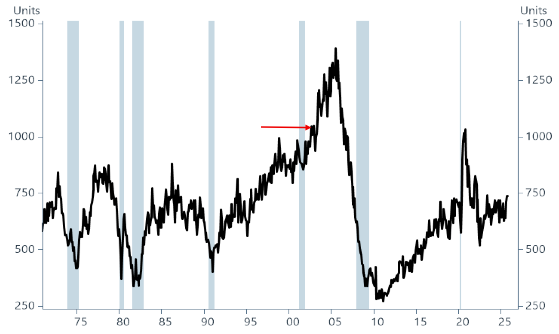
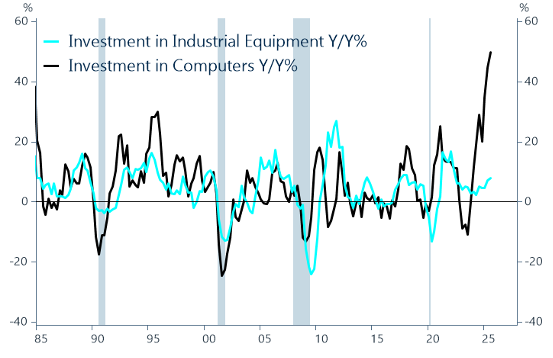
The AI boom has boosted spending on information processing equipment and data centers to a $729 billion pace at the end of 2025. Its broader impact will be comparable to other periods of extraordinary investment in US capital such as the internet buildout. It’s impact is happening on a much faster timeline.
The arrival of AI Agents marks the start of a second major wave of AI impact. There are 4.4 million software engineers employed in the US and 47 million globally. Executive assistant agents greet you by name when you call airlines, credit card companies and banks. They have already reduced headcount. (There are 5.4 million executive assistants and secretaries in the US in 2025).
Even as we are experiencing a third year of datacenter investment spending growth of roughly 50% in 2026, we are doubtful that rapid AI spending gains will be needed beyond 2027 (Figure 5).
AI leadership will see big winners and losers. The failure of some firms to compete with those able to adapt rapidly to shifts in demand for their services suggests a meaningful drop in AI capital spending at some point. Beyond this, resources constraints such as power and water alone will be an issue. For a time, fewer new semiconductors and memory chips will be needed.
That’s why we believe that this boom will end like all other booms. From whatever high they ultimately reach, AI-infrastructure related share prices will fall. Software firms whose business models don’t adapt will also see diminished growth rates, poor retention levels and ultimately lose profitability. Fear and despondence will likely drag down broader markets for a time.
The Difference Between a Shock and a Bust
A temporary shock to world energy supplies is very possible if negotiations between the US and Iran fail to result in a breakthrough. During military exercises Tuesday, Iran closed the Straits of Hormuz - which carries 20% of world crude oil exports - for a few hours. With a large movement of forces to the region, the US said it won’t rule out a strike on Iran in coming weeks.
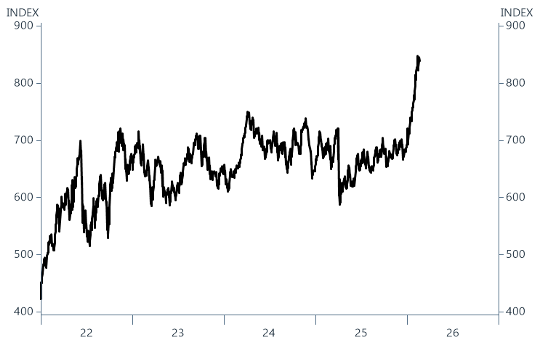
Energy shares are spiking up while many other risk assets are falling (see figure 6). We would expect any severe price impact to be short. It is certainly binary in our view. Oil and energy assets will fall back sharply if conflict is avoided in the near term If there's a strike, the impact will intensify. Short sharp spikes in crude oil are possible. This Yet, only lasting declines in world energy supplies would harm the economy in an enduring way.
The bust scenario for Ai is related to the unsustainability of investment in its infrastructure combined with its related impact on employment. We look to such a period ahead in a “boom/bust” framework because it does not represent an unpredictable shock that quickly passes.
Wise Portfolio Strategies Now for a Possible AI-Related Bust
In 2026, we expect US corporate profits to post a double digit gain. At CIO Group, we will not unduly shed assets that benefit from that growth. At the same time, the rotation from software to hardware in tech is likely too pronounced to be sustained. This is why we need to be highly specific in our asset allocation selections and anticipate change.
Our focus is to move allocations away from assets that are presently benefiting from unsustainable growth rates. Simultaneously, we are actively seeking allocations that benefit from other macroeconomic trends, including the likely further decline in the US dollar. President Trump has signaled he will seek ways to sustain tariffs following the Supreme Court’s ruling invalidating his “Liberation day” levies. This continues US-centric trade policy uncertainty.
-
Non-US equity markets have provided diversification and profits in 2026, returning 9.4% in USD terms thus far. For medium-risk portfolios, 21% of our total portfolio exposure is non-US equities.
-
We have taken steps to expose portfolios to industries far from the creative destruction of AI, including health care.
-
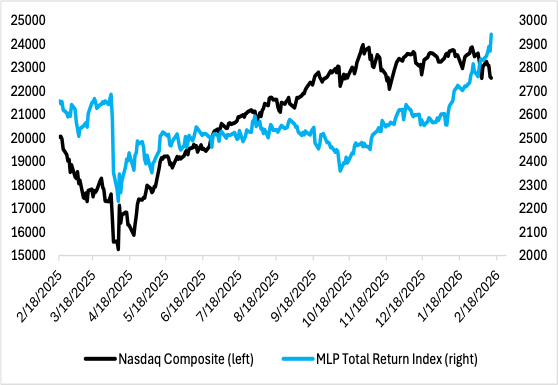
We have added exposure to Master Limited Partnerships and Mortgage REITS given secure income streams less correlated to AI’s impact in equity markets (see figure 7).
Finally, we do not ignore high quality bonds. When an AI bust does come, government bonds are now priced far better than equities for the event (Figure 8).
The long-term beneficial impact of AI will show in time in increased profits and a larger economy. But the very nature of the extraordinary investment in AI infrastructure portends a period of disruption and retrenchment in certain important sectors of the US economy.
We think that there are areas of the global economy and income generating assets unrelated to the broader economy that can benefit the total return of an investor’s portfolio. In any Bust scenario, equities will perform poorly and high growth tech equities will be especially vulnerable. Bonds will perform well and equities whose profits are far less reliant on tech will do comparably better.
In conclusion, we believe its highly appropriate for investors to manage their overall portfolio risks with changes to their asset allocation.