February Employment: Weakness Revealed, Data Distorted (like Jan)
Yesterday's US employment data will add considerably to market fears about economic fragility even as they exaggerate swings in the economy. Issues related to Iran, energy shocks and confidence may interact with how markets view the jobs data which are not impacted by these issues.
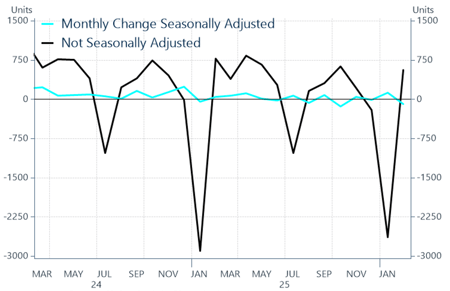
Employment in February fell 92,000 and the unemployment rate rose to 4.4% from 4.3%. The data appear to be a correction for an upwardly distorted January, which showed 130,000 job gains. As we discussed in our Point last month, 95% of the headline estimate of non-farm payrolls in January is actually seasonal adjustment. As employment gains and losses around the turn of the year have become increasingly less impacted by seasonal hiring and firing, the usual drop in January becomes less pronounced over time. As figure 1 shows, this was the case this year as January job declines were 2.64 million, below the 2.91 million drop a year ago. Similarly, the usual February gain this year was short of last year (+563K vs +775K). This "seasonal adjustment dominance" makes employment trends volatile for the short period near the start of the year.
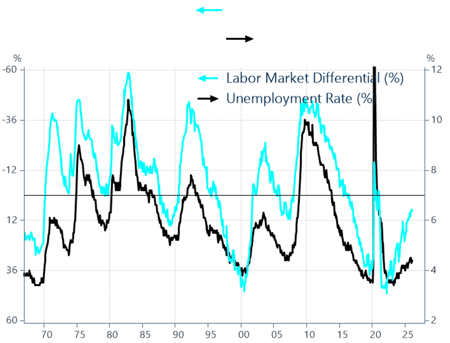
Most importantly, trend labor demand has weakened. Downward revisions to last year showed just 25,000 private sector jobs were added on average per month. The 30,000 per month added in the first two months of 2026 differs little from this. Last year's government shutdown and other actions to curtail government employment makes the overall figure worse. While many have argued that the slowing labor force (from immigration and aging) makes a "crawl" pace of labor demand "normal," the unemployment rate tells us otherwise. While turn of the year swings in survey data impact labor force participation too, figure 2 shows an upward trend in consumer views of unemployment. We expect the government household survey data to mirror this trend in coming months as it did in February.
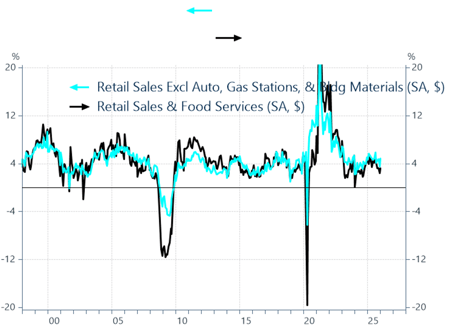
Some other data in the employment report showed more steady trends in 1Q (rising hours worked). The ISM reports for February also showed expansion across both manufacturing and services while yesterday's retail sales data for January showed core sales growing at a moderate pace (see figure 3). Output data for 1Q and corporate profits should continue to show growth that is not reflected in the labor market.
The Federal Reserve will have added headaches to ponder as headline inflation jumps on a spike in gasoline in March. While we outlined why this is very likely to be temporary in yesterday's Point, Fed policymakers are struggling to assess their reaction to temporary price spikes after their inflationary mistakes in 2020-2021. Our sense is markets under-rate the chance that Fed rate cuts will begin again. We see the market pricing of a mere 19% chance of a rate cut in late April (presumably Powell's last as Fed Chair) as too low.