Processing a Geopolitical Shock: Don’t “Chase” Market Reaction
Geopolitics and Markets: The Post-War Portfolio
The buildup was clear. The decision is now final. The decision by the President to have US forces join Israel in attacking Iran with regime-ending intent has changed the Middle East forever.
Iran was judged the single-largest state sponsor of terrorism by the US State Department. We believe Iran showed its stripes by attacking nearly every neighboring country to its West and South, choosing both civilian and military targets. While we will not speculate on exactly how and when the conflict will end or what leadership will replace the ruling theocracy, the removal of this regime would allow some hope for peace and greater economic development throughout the region.
Markets Were Preparing for Strike
Two weeks ago, we wrote in The Point that there had been a well-telegraphed US military building up in the Gulf region for weeks. This generated strong expectations for a strike, even if it appeared that Iran might have been willing to reach a new agreement to avoid it.
Given Iran’s proximity to the Straits of Hormuz – which carries roughly 20% of global crude oil exports – the 2026 military buildup alone pushed up the global crude oil price by 18% before the US struck. Since then, oil has risen a further 12%. Given the severity of the supply chain disruption, the incremental rise has been less than expected thus far.
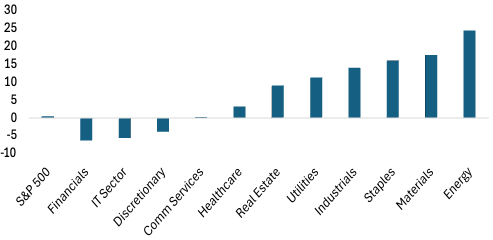
The duration of the shutdown in Persian Gulf shipping lanes and the production declines in gulf countries who have run out of local storage to hold oil will determine peak oil prices and the duration of shortages. With the build-up and now with the war underway, the energy sector has posted the largest gain among all industry sectors in 2026, generally at the expense of other sectors (see Figure 1).
No Reaction May Be the Best Reaction
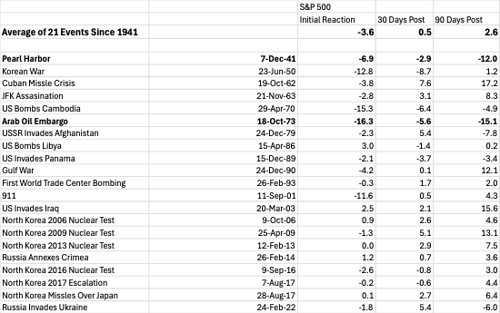
CIO Group measured 21 prior geopolitical events and shocks (see figure 2). In only two cases, the 1974 OPEC embargo and World War II, did major events and shocks change the direction of the world economy.
The vast majority of conflicts have severe regional impact. But, on average, global asset prices have shrugged off shocks in a month’s time. For this reason, we believe investors could easily mistake sharp reactions to the oil shock for lasting trends.
History suggests that crude oil prices will go up and then normalize with the end of the conflict and the reopening of the Straits. This may begin to happen over weeks or months. But in the end, we believe that investors who try to align their portfolios for further sustained gains in crude oil or in the energy sector would very likely be making a mistake.
Looking at prior oil shocks explains our view.
This is Not the 1974 OPEC Embargo
The late 1973 conflict between Egypt, Syria and Israel led to an embargo by Arab oil exporters that curtailed global exports. This occurred at a time when US oil production had fallen by almost 20% from its 1970 peak and the country, like many others, had become heavily reliant on imports from the Middle East. The US economy’s reliance on oil was also higher in those days. This enabled OPEC to curtail supplies in an effort to pressure Israel’s allies. Major energy shortages ensued and this led to an inflationary recession.
The petroleum situation in 2026 differs dramatically from the Arab-Israeli war period of late 1973. Today, US crude oil production is at record highs while OPEC’s policies are far more accommodative. First, OPEC repudiated its use of oil as a political weapon. And in a sign of accommodation, OPEC raised its year-over-year production by 6.5% over the past year while promising further output increases to mitigate the inevitable supply shock from Iran.
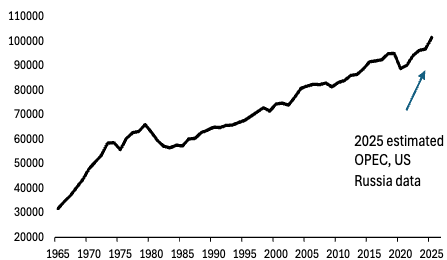
In fact, US and OPEC output was so high prior to the conflict that global crude oil production rose to a record high, even with output losses from Russia (see Figure 3). And the war came at a time when key measures of global oil demand, such as China’s transportation fuel use, are weakening (see Figure 4).
In our view, assuming no disruption to Persian Gulf crude oil shipping, the global crude oil price would be closer to $60 than $80.
The “Crisis Price” vs the Lasting Price
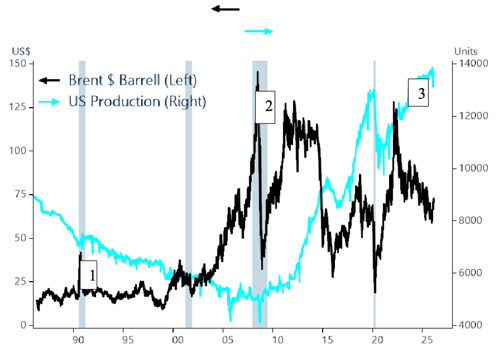
When supply shocks occur, commodity prices have a history of overshooting, reaching a “crisis peak” quickly, then receding. When the US built up its forces to remove Iraq from Kuwait following its invasion in 1990, the crude oil price pushed sharply higher. The worst of the actual supply disruption occurred as retreating Iraqi forces set Kuwaiti oil fields ablaze. Yet the oil price had already peaked months before on speculative oil purchases (see figure 5.)
Russia delivered a faster oil shock when it invaded Ukraine on February 24, 2022. The still-raging conflict required a redirection of global petroleum and gas flows from west to east, “balkanizing” commodities markets. It represented one of the largest commodity supply chain shocks in history. Oil and gas did surge in price as Western governments disconnected from Russian supplies. Yet, it took no longer than two weeks before crude oil had reached its peak before falling back 35% in the following year.
The Great Recession of 2008/2009 ended a massive rally in crude oil which reached history’s highest price near $145 per barrel. In 2008, there were rampant fears that the world would run out of oil before shale engineers proved that output could rise dramatically.
Hold that Portfolio Steady…
Geopolitical shocks rarely upend the direction and strength of the world economy. The lessons of the gulf wars and Russian invasion provide investors with context for this new chapter of conflict in the Middle East.
While the Straits of Hormuz are vital for global petroleum trade, they will not stay closed. While closed, strenuous efforts will be undertaken to reroute and hasten supply deliveries. In short, we expect that world economic growth will persist and not suffer a severe, lasting impact from the conflict.
Time to Revisit Cybersecurity Shares
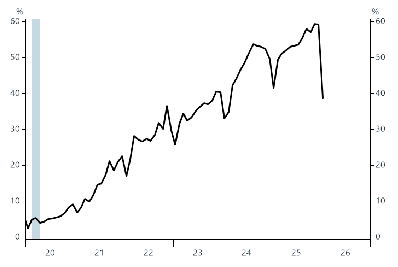
While investors are focused on the unfolding conflict, some market dislocations may get little attention. Software and IT services shares are among the weakest performers this year while tech hardware - such as memory chip makers — are the strongest.
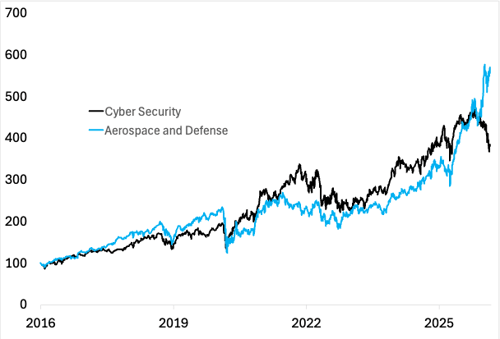
The outperformance of IT hardware and semiconductors versus Software and Services is at its most extreme since the bubble peak of 2000. Among techs subsectors, cybersecurity software – critical to defense - have lagged behind Aerospace and Defense manufacturers by a record 80 percentage points over the past year.
As we’ve discussed in recent weeks, the indiscriminate selling in software, including cybersecurity, looks like a market dislocation that is better bought than sold. Yet, there is little room for investor attention to such an opportunity while riveted to the new events unfolding in the Middle East. At CIO Group, we are maintaining our focus on global growth, diversified streams of income and opportunistic additions during periods of excessive fear.