No Easy Way Out
Uncertainty Drives Volatility. There are Reasons to See Through It
The lack of a comprehensive strategy for the Iran War became clear this past week. The assumption that sustained bombing of military facilities and the assassination of major Iranian clerical and military leadership would be sufficient to stem a significant military response from Iran proved false.
For 2,500 years, Persians have waited for their chance to revenge the Battle of Thermopylae, when 300 Spartans held off an army of as many as 300,000 Persians in a narrow mountain passageway. For the moment, the Straits of Hormuz are the US's Thermopylae.
Though the US and Israel meaningfully degraded Iran's ballistic missile stock over the first two weeks, subsequent events suggest Iran retains significant retaliatory strength. The Israeli attack on Iran's South Pars natural gas field on March 18 drew immediate Iranian counterattacks. Iran struck Qatar's Ras Laffan natural gas facilities with drones causing $26 billion in damage, taking 3% of the world's LNG supply offline. Iran then warned the US and Israel of further unrestrained attacks on neighboring energy sites if they struck more of Iran's energy assets.
These events and the absence of additional military resources from Western and Middle Eastern allies have led to a high-risk situation regarding energy infrastructure. It signals further uncertainty as to what comes next.
It is our view that investors should be focused solely on the reopening of the Straits of Hormuz as the critical signal for the immediate direction of global markets. Tehran's decision to pause its counterattacks signals restraint, but also resolve. During the Iran-Iraq war from 1980-88, military attacks continued but had little impact on energy transit and production. If tacit agreements are reached to avoid further destruction of regional energy production and the Straits reopen, this will be a positive signal for risk assets and begin the normalization of energy prices.
We caution investors, however, that many potential outcomes remain possible. Three weeks is too short a time to judge a conflict of this scale. Liberating Kuwait from Iraqi occupation took six weeks of bombing and a well-planned ground invasion. If the US decided to use ground forces to take Kharg Island, for example, one could imagine a more sustained and potentially destabilizing regional war. If the US is able to create safe passage for ships, the opposite. Experts have many opinions. Only time will tell.
Risk Off As Correlations Go To "1"
For investors, risk aversion is building in global markets in a way that may continue over the short run. Traders in every global asset class are trying to gauge how high crude oil might rise and for how long. Reversing this trend requires a convincing peak in the price of oil.
Correlations to the oil price are intensifying for every asset class. In the past, a gentle rise in the oil price was a sign of growth. Now the price spike signals economic constraint. Since the US bombing of Iran began, the correlation of the S&P 500 to oil has spiked to -56% on a daily basis. The same figure was +12% over the past five years. Gold, silver and currencies are increasingly correlated to oil. The US government bond market has lost 1.8% in return since the strikes began, US equities -5.4%.
Previous oil shocks have seen a pattern where prices quickly overshoot to a "crisis peak". In 2022, this was $128 for Brent a month into the conflict with Ukraine before the price began to decline (please see our last two Points for details - EP 21 & 22. Thereafter, commodity producers and consumers adapted and energy markets stabilized over time.
Don't Chase Energy Shares
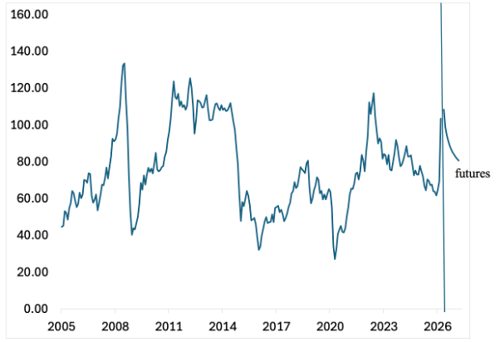
Since 1990, large cap US energy producer shares have produced risk-adjusted returns 31% below the S&P 500. Investors should see the "crisis peak" for oil as an exaggeration, not a reason to "go long". Crude oil futures for delivery one year from now trade at about $80 per barrel (Brent) vs about $110 for spot oil today (see Figure 1).
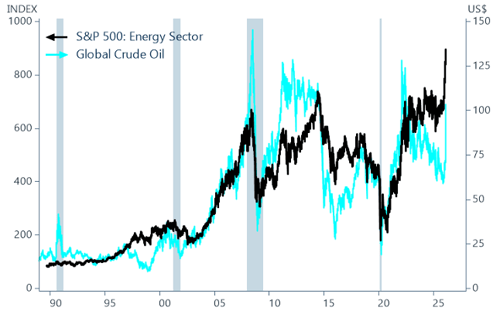
At CIO Group, we don't advise investors realign portfolios at this time. Security developments can change quickly. The crude oil price is at a level the world has experienced many times before (Figure 2). Yet, energy producer shares have jumped 32% year-to-date, mirroring the rise in the oil price. Investors should also expect these shares to drop, if and when oil slides.
CIO Group portfolios are neutral energy producers and overweight energy distributors with high income pass-through yields. While worthy of their current full allocation, the long history of commodity investments and shocks does not suggest that oil and oil producer shares are the best growth vehicles for long-term portfolios.