Shock and Awe: This Is Not Going Well
Introduction
The burden of the Iran War on the US and world economy is significant and growing, but CIO Group expects financial markets to recover when energy costs fall back. That said, we expect a somewhat larger decline in real economic growth than the spike in energy costs alone implies.
Even as markets expect energy prices to decline in the future, interest rates have risen and are expected to stay higher for longer. While this is in line with past oil shocks, including those of 1990 and 2022, consumer spending will be negatively impacted. The combined impact of higher energy prices and rates creates a large headwind for the US and world growth.
Higher energy costs redistribute income from consumers to producers. They change which industries are more and less profitable. In certain circumstances, an energy shock can catalyze recession. In this week’s Point, we explain the dynamics of markets in the face of an unexpected war.
The Supply Shock
The Iran War and its impact on energy prices is dominating global market attention. The negative correlation between equities, credit and currencies to the price of energy has strengthened sharply. Hopes for the cessation of hostilities has generated great relief rallies.
Even when the bombing ends and shipping resumes, the Iran War will have lasting impacts on the global economy, regional politics and the energy complex. If global energy flows freely again, the lasting damage to Middle Eastern economies would not curtail growth elsewhere. Despite repeated, tragic regional hostilities, global growth and conflict have coexisted as a norm.
Yet, the Iran War will reshape the geopolitical future of the Middle East. The participants are not new, but their alignments are. Israel and the US are seeking Iranian regime change. But the prosecution of the war has not gone as planned.
The weakened Iranian leadership and military have adapted by using their limited, but accurate weaponry to attack neighboring energy assets, maintain the closure of the Hormuz Strait and utilize the lack of US preparedness to extend the conflict, frustrating the President and his desire for a rapid victory.
The immediate result has been a major supply shock to the global economy. Higher energy costs and a reduction in supplies can cause an economic contraction and, if sustained, a recession.
19 of the past 21 geopolitical shocks have not resulted in a lasting bear market, but this is no “average” shock. The economic and market consequences of the Iran War are multiplied by these factors:
- The curtailment of oil shipments in the Straits represents the largest global oil supply reduction in history. Trade in other critical supplies has been similarly impacted.
- The price change in energy, gas and products made from and with petroleum translate into a major reduction in GDP, both US and Global.
- Trade through the Straits of Hormuz is the largest transmission factor for global impact. The presumption that it will open quickly has been dispelled. Iran uses this leverage as a weapon.
- Abundant global petroleum supplies sourced away from Persian Gulf waters makes the present supply shock different from the OPEC embargo of 1974. If not for the war and blockade, global petroleum costs would be falling, reducing inflation and helping energy consumers everywhere.
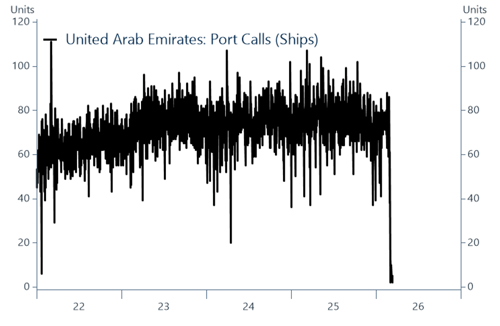
- Iranian drone and missile strikes on its neighbor’s energy infrastructure has created limited, but important damage to LNG and oil supplies. The temporary loss of shipping has a much greater impact at present. See Figure 1.
A +$170 Billion “Bill” for Energy in the US in 2026
While the minute-to-minute “spot” price of oil has ranged from $98–115/bbl, the crude oil price for delivery a year from now has risen to just $80 per barrel, a mere $10 higher than prior to the US and Israeli strikes. Futures markets balance the risk of a long-term supply curtailment against rising supply globally and diminished demand. This includes substitution impact from electrification and renewables. It also includes the re-direction of supply through land-based pipelines in Saudi Arabia, Iraq and Turkey.
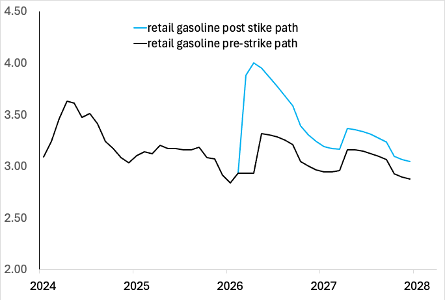
The US retail price of gasoline has surged 32% in March, with wholesale diesel fuel up an incredible 66% (see Figure 2). When you take the “forward futures curve” and estimate the aggregate increase in the cost of US oil for the year, you get a very large number — $170 billion. While these costs are projected to decline, the present estimate for 2027 is an additional $60 billion. These estimates represent the change from the price levels just before the strikes.
Consumers and businesses will pay more for energy and have less for other purchases. Furthermore, the cost of goods goes up by a small multiple of that increase as firms try to maintain the same level of profit. Demand falls to the extent that there is no additional real income and substitution for oil is nearly impossible in the short term. (Electric car sales may rise, while new and used gasoline-powered car sales may fall proportionately.)
Many Market Impacts, None Beneficial
Higher Interest Rates
President Trump’s communications are influencing global energy prices daily. So too, are facts on the ground, as shipping and inventories data are reported.
Meanwhile, global interest rates have risen about 40 basis points across government and private markets, on average, across tenors. This is in line with past supply shocks that boosted prices including 2022 (Ukraine invasion) and 1990 (the Iraq war). While this impact is no worse than past experience, it is an independent, negative consequence of the shock and compounds the negative global economic outlook.
The negative influence on equity wealth is similar to the impact of higher interest rates. Global equity markets have seen a $7 trillion decline in value since the start of the Iran War.
Higher Inflation Leaves the Fed on Hold
The supply shock will increase the US CPI in March by a full percentage point, generating a roughly 3.5% year/year gain. If not for the conflict, US consumer prices would have risen by just 2.5%. While we don’t believe the Fed will raise interest rates to try to suppress the price effects of the supply shock, the Fed is not able in any way to offset the shock to real US incomes. However, once the energy shock fades, we believe the negative growth impact on the US labor market makes larger rate cuts somewhat more likely.
US GDP Down
Energy costs are the most dynamic element under stress in the global economy. If we isolate the recent energy shock impacts to our estimates for US growth and inflation, it reduces our real US growth forecast to a 1.75% pace in 2026 from 2.5%. It boosts our estimate for the full year CPI to a 3.0% gain from 2.5%. In 2027, growth should improve and inflation fall. The overall level of US output will fall short of what would have been achieved without the shock. Notably, energy costs would need to fall in line with futures, or the impact would be worse.
Global GDP Down Even More
The US is far more isolated from the oil price shock than energy importers in Asia and Europe. We would expect global inflation measures to rise about 4.5% in 2026 led by emerging markets. Prior to the shock, inflation would have been about 3.7%. With higher savings rates among oil producers than consumers, global growth is likely to be 2.25% this year versus 3.5% pre-shock.
Dollar Up
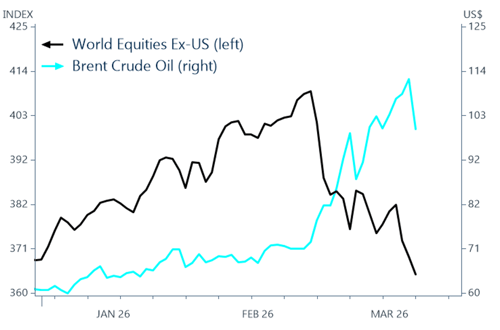
US dominance in fossil fuels extraction has buoyed the dollar, with the greenback rising roughly 2% since the Iran strike began. Non-US equities, reflecting a larger negative income impact, have fallen more than US shares.
Even after the rally in the USD, non-US equity markets have 4% stronger year-to-date performance (see Figure 3). We believe non-US equities have slightly more to gain from a détente and more at risk in the event the war intensifies. Global bond markets have moved in lock step with the US.
2026 Corporate Profits Rise by Double Digits, But Energy Takes a Bigger Share
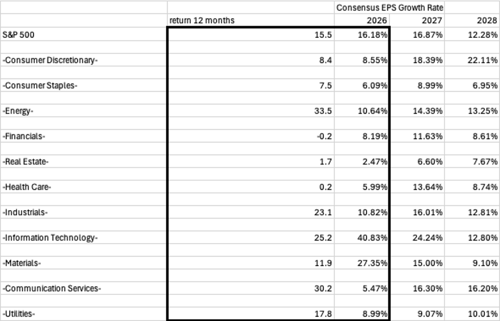
The net impact on growth, precautionary savings and business costs should reduce S&P 500 EPS by about 4 percentage points using our simulations from the shock this month. This is despite a gain for Energy EPS that is likely triple current estimates for gains this year.
The cost of energy changes every day, and by near record amounts at present. Profit estimates for the past month’s shock have only begun to adapt. Markets are much faster. For example, energy shares have now risen 34% over the past year. EPS for the sector is estimated to have dropped 0.7% in the year through 1Q but estimates for 2026 should be marked up sharply vs the consensus gain of 10.6%. Only sustaining or expanding the energy price spike to higher levels than expected would drive energy shares substantially higher.
Other sectors are impacted in more complex ways. The consumer related sectors have moved in line with expected EPS gains and losses. They would benefit from oil price declines but are even more vulnerable to oil price spikes.
In our view, Industrials appear somewhat vulnerable after a 23% gain over the past year, eclipsing profit expectations. The sector is vast however. We see more vulnerability in transportation-related firms.
Healthcare has underperformed EPS estimates and has not fully benefited from concerns about the economy as a non-cyclical area (see Figure 4).
Perspective: A Major Shock, Not a Boom—Bust
While this is a major shock, it is not as severe and lasting as a “Boom — Bust.” Similarly, the Pandemic was a major shock, but had few long-term consequences. In contrast, the mid-2000’s US housing credit crisis and China’s real estate overbuilding spree, still being resolved, are examples of busts that caused deep recessions. See our Point of January 24, (“Shocks vs. Booms”).
We believe investors need to stay positioned for long-term economic growth. The worst shocks of our lifetime have been less impactful than the wild booms and busts that have taken the economy off course. (Consider the Global Financial Crisis, the late 1990s tech bubble or the persistent monetary policy mistakes of the 1970s.)
What Is the Safe Asset? Here Is a (Short Duration) Tip
“Trading a war” is a fool’s game for investors. Our estimates suggest markets have reacted with solid efficiency to the energy dislocations and uncertainty. The severity and persistence of the shock is still an open question and will determine market direction across all asset classes until the end of the war and the reopening of the Straits is clear.
Futures prices represent a range of risks that traders see ahead, but can’t accurately predict future events and impacts. For example, the possibility exists that war damage and transportation insecurity could result in a heightened oil price for years to come. A change in access to the Straits of Hormuz and the increased cost of insurance for its transit are such factors. Uncertainty caused heightened near-term market volatility. One month implied equity volatility reached 30 this past Friday and oil vol was 97, the second highest level in history.
Yet, some assets need to be set aside to hedge risks and dampen portfolio volatility. Holders of oil producer shares have benefited in the past month from the unique aspects of the current shock. But as the pandemic period showed, not every inflation episode is energy-related. And holders of gold should remember that one can overpay for anything.
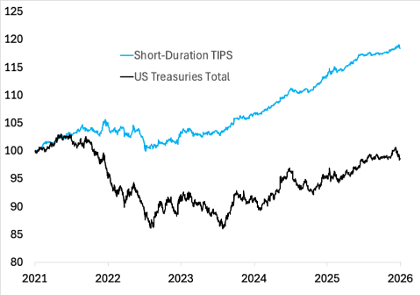
One asset we see well suited for the role of safe asset is real return bonds. Treasury Inflation Protected Securities have seen returns soar from “unexpected inflation” in recent years (Figure 5). They won’t build wealth rapidly, but they will receive inflation compensation in the period just ahead. If real economic growth surges, they will lose value. If growth falters or inflation jumps, they will gain.
With the broader US Treasury market losing ground to inflation fears in the past months, TIPS outperformed. Shorter-durations performed best as interest rates rose. At CIO Group, we use short-duration TIPS for 22% of US Treasury holdings (a smaller share of total holdings) in medium risk portfolios. This is much higher than US Treasury benchmarks which are about 3% short-duration TIPS.