
Strait to Earnings Season More than Words…?
Introduction
After threatening “a whole civilization will die tonight,” President Trump and Iran’s Minister of Foreign affairs announced a two-week ceasefire on April 8 and the opening of the Straits of Hormuz while the two sides negotiate a “lasting end” to hostilities. Spot crude oil promptly plunged 13%, global equities rallied 3%, and the US dollar index fell nearly 1%.
By Thursday morning, so many traders and investors - eager for the war to be over and the great cloud lifted from the global economy - looked at timely data for the shipping through the Straits of Hormuz. But they saw ships moving due to safety concerns (Figure 1). Iran reportedly demanded that all vessels obtain permission to transit. It is possible that the Straits will remain effectively closed by Iran to give it leverage in negotiations over the coming two weeks and perhaps beyond.
The US seems very eager to move on to other issues (please see recent point). The negative reaction from voters to a 40% jump in fuel prices and jet fuel shortages seven months ahead of mid-term elections weighs against a US-driven long extension of the conflict. Yet, there remains a small possibility that the US may invade Kharg island, the transport point for 90% of Iran’s oil exports, in the event negotiations go poorly.
Trump is facing mounting political pressure. A University of Michigan poll showed sentiment fell to a record low, an historic reading fueled by the war with Iran and its impact on inflation. Americans expect prices to rise at an annual rate of 4.8% over the next year.
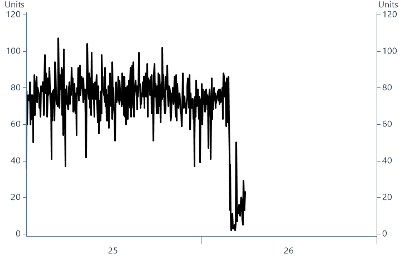
Security Unclear, Market Drivers Crystal Clear
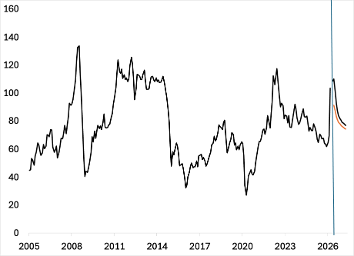
An actual, significant resumption of trade through the Persian Gulf is the critical short-term variable that will determine the scope of damage or relief for the world economy. Of course, the market reaction of Wednesday, April 8 is an important “tell.” There is no shortage of oil and gas available for extraction. There are severe limitations to its transportation. Truce talks over the next two weeks were enough to speed up the plunge in crude oil futures already anticipated in markets (Figure 2). Yet the improvement in supply is contingent on coming events on the ground.
Leaning Into Investment Risk
Oil for delivery a year from now only trades $5 per barrel higher than before the US strike. This is perhaps an overconfident prediction by oil traders. But if correct, the duration of the energy/commodity shock has not been long enough to set the world economy into a self-sustaining cycle of weakening.
In our view, the War was a “shock” – an interruption to current trends rather than a lasting imbalance. Once past, the shock will not change the generally positive direction of the global economy and corporate profits. Equities rallied when the perceived trade impediment was removed. Such should remain the case even if hostilities resume and markets relapse for a time.
The peak-to-trough decline in US equities within the first quarter was a just 9% with the S&P now less than 3% below a record high. Nonetheless, with our expectation of a 10-15% EPS gain this year, the modest drop leaves US equities slightly better priced for future returns.
Global vs Local
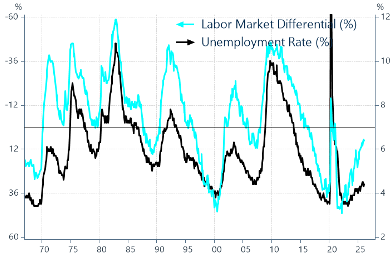
The greater impact of the oil shock across the world is a stronger driver for non-US returns once the issue truly passes. If hostilities subside, the Fed will more easily focus on a US labor market that is seeing demand weaken on a trend basis (Figure 3).
Prior to Wednesday’s “ceasefire,” the US bond market priced in a highly improbable Fed rate hike as a possibility this year. After the news, it gave a modest nod to the chance of resumed rate cuts by year end. When the outlook for US monetary policy clarifies, we expect it to result in modest further easing by the Fed and resumed declines in the US dollar.
Declines in the dollar and a recovery in energy supplies will help cyclical industry shares that dominate in Europe and Asia and also to a lesser degree in the US. Our weightings in these regions focus on high quality long-term growth assets. These were somewhat less sensitive to the oil shock. Therefore, they “bounced back” less on Wednesday relative to more sensitive assets (such as airline shares) with their correlation to transportation fuel costs. If we see a greater probability that ceasefire yields a stronger resumption of energy trade, we are likely to add somewhat more to cyclical equities across the world.
Strait to Earnings Season
US corporates will release earnings results and guidance for the future in coming days while still under the cloud of war. If the truce takes hold, a great many firms will tout how results could improve in the future because of it. If the US and Iran relapse into conflict, they will blame the war for worse results than were possible.
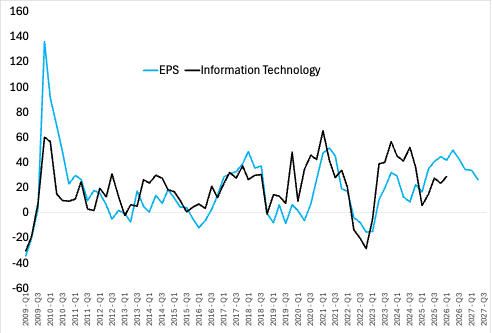
Investors need to sort out where earnings are rising on a sustainable basis and what share prices already “discount” for the future. Tech has stalled this year with shares off about 4% in the year-to-date while EPS is expected to rise 41%, driven by the boom in semiconductors and memory chips (Figure 4). The “gap” is most clear for software, off 25% with EPS expected up 13% this year.
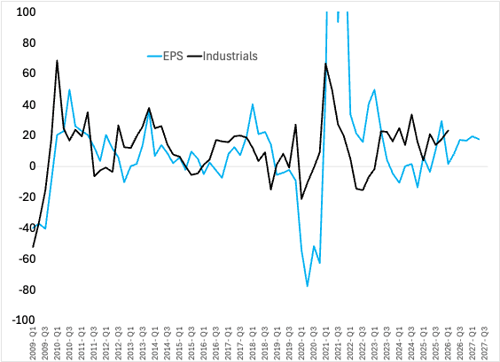
US industrials have outperformed this year, up 10% in the year to date. Strength is understandable for defense and aerospace shares and for electrical equipment manufacturers in great demand for AI infrastructure. Yet, agricultural and construction machinery have performed equally well despite slower EPS gains and softness in global orders. While we expect recovery, shares have performed as though the recovery is well underway. As discussed above, international competitors to many of these cyclical/industrial firms may be a stronger new investment allocation. If conditions unfold favorably for world energy supplies, we anticipate some switches of overpriced US shares for more attractive international options.
Back to Worrying About the Impacts of Artificial Intelligence
Spending on AI continue in an unrelenting fashion. Meta Platforms committed an additional $21 billion for rents of AI chips from cloud provider CoreWeave to 2032, bringing its total spending at CoreWeave to $35 billion. Amazon’s internal chip business hit a $20 billion run rate according to its CEO Andy Jassy a figure twice what was disclosed just two months ago.
Meanwhile, Jerome Powell and Scott Bessent gathered Wall Street CEOs to consider potential security risks from Anthropic’s latest AI model, Mythos. Anthropic has released the new model for testing by Apple, Amazon, JPMorgan and others as part of “Project Glasswing”, a project that is attempting to prepare users for attacks from bad actors using the same AI model.
The Anthropic announcement accelerated the sell-off in software and cybersecurity stocks. Ironically, as threatening as Mythos is, markets reacted by sending existing cybersecurity shares down sharply as if their business models and software infrastructure were becoming worthless. Cloudflare dropped 14%, Akamai fell 16% and other leaders like CrowdStrike and Palo Alto Networks came under huge selling pressure. IGV, the Tech-Software Sector ETF, fell to new lows and its year-to-date performance worsened to -25%.
While there is no doubt that SaaS business models will be forced to change by the arrival of even more powerful AI, the idea that advanced agentic AI will replace human security professionals and destroy subscription-based cybersecurity business models seems very premature. In fact, AI developments suggest heightened demand for cybersecurity spending in particular.