
Presidential Declarations Won’t Fill Jet Fuel or Helium Tanks
Deadlines. Ceasefires. Extensions. Talks with one side missing.
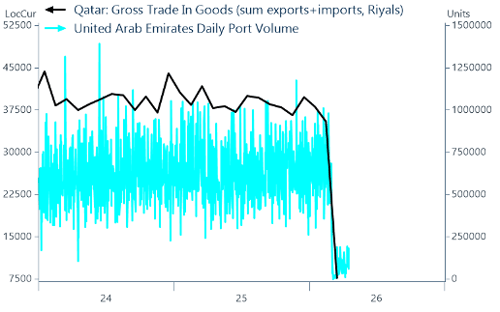
As yet another US deadline comes and goes, the two-sided blockade on the Straits of Hormuz continues. Global trade – both critical exports and imports – have been severely curtailed to and from Persian Gulf economies for eight weeks (Figure 1).
While Saudi Arabia has rerouted about 25% of the crude oil previously exported through the Straits of Hormuz, world energy supplies remain constrained due to an unplanned, record disruption. Liquified natural gas, fertilizers, plastic feed stocks and helium - key exports of Qatar - are falling into extreme deficit. Helium is critical to the semiconductor industry, showing the breadth of the war’s impact.
What’s the Strategy?
CIOG’s conversations with experts, US General Curtis Scaparrotti and Brookings’ Thomas Wright , suggest pure military operations to open the Straits of Hormuz without Iran’s agreement would be dangerous, lengthy and costly for US forces. The incentives for Iran’s Revolutionary Guard to negotiate the reopening may be absent. Ending the conflict may catalyze the regime change the Iranian military hopes to avoid.
Strait Talk
As we’ve pointed out routinely, the world energy issue is one of local storage and transportation from the Persian Gulf, not a shortage of energy commodities that can be easily extracted. There is much talk of long recovery periods and costly repairs to regional infrastructure. This is true at the margin. Yet in our view, restoring trade through the Straits is essential for resolving the global energy shock.
At the same time, “hope” – driven in part by President Trump’s persistent comments that a resolution is close at hand – has left energy traders anticipating an imminent breakthrough that never comes. In fact, the US has just added a third aircraft carrier in theater.
Regardless of rhetoric, the longer the trade disruption persists, the further the world’s manufacturers and refiners will run down scarce commodity inventories, eventually facing binding limits on their ability to deliver essential products. Over time, the economic shock will intensify.
Hope is Not a Strategy
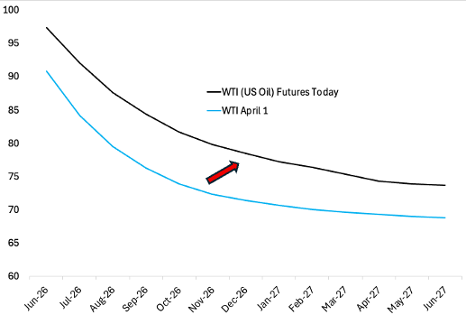
The futures curve for oil is flattening (Figure 2). This means that the world is adjusting to the greater likelihood that there will be higher oil prices for longer. Near-term prices have not been able to exceed the “crisis price” of $118 reached last month. But the price for delivery a year out is rising. Higher for longer energy costs are being “priced in” despite large day-to-day swings in spot oil driven by fear that attacks will resume or hopes for a diplomatic solution.
Our enhanced investment in US oil and gas distributors and exporters in late January has helped our returns this year. A rapid drop in the prices of oil and LNG could hurt it. Such declines would dent returns for the broader energy sector which has rallied 27% in the year-to-date, leading all sector returns. Yet the risk of a longer conflict argues for adding to more reliable energy sources closer to home at the expense of energy-dependent assets.
Not Hot Air - Helium Shortages Place Semis at Risk
Semiconductor manufacturing relies on helium, a by-product of natural gas extraction. And semiconductors are the essential element in data center and AI growth. Once the Straits closed, Qatar’s exports - which provided one third of global supply – ground to a halt. South Korea relies on Qatar for 65% of its helium requirements, meaning that Samsung and SK Hynix, the world's largest memory chip makers, are left to scramble. Liquid helium has a 45-day shelf life and existing inventories are barely sufficient to sustain current, booming production levels.
Software Stands Out, as do Carbon Alternatives
One industry that is relatively insulated from energy is software. We believe markets have taken too pessimistic a view of the industry’s earnings prospects. This coming week, many of the largest US software and hardware firms will report earnings and for many there are likely upside surprises relative to deflated expectations.
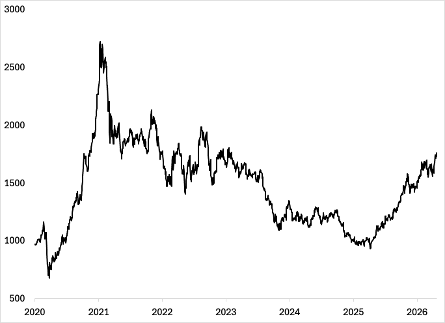
We will also be closely monitoring reports from clean energy technology leaders. These companies, despite President Trump’s misgivings, have seen returns strengthen as the world’s fossil fuel supplies become less reliable (Figure 3).
Negotiations Matter and More Countries Want Them Underway
With hopes of a “quick win” in Iran fading and the global economy imperiled, there is a new calculus at play. Many countries who were reluctant to support the war are now suffering much more than the US. China has many reasons to see the Straits reopened and the US and Iran reach a constructive resolution. Russia owns the largest alternative to Qatar’s helium exports but is benefiting from higher for longer oil prices, so it has something to trade.
US allies in the Middle East - even those who rooted for regime change in Iran - are now suffering deeply. And US domestic politics, skewing against the President and his goal to retain control of the legislative branches, are undoubtedly ramping up pressure for a solution. But can the US afford to negotiate a settlement that may end up benefitting the Iranian regime, whether it says so or not? Stay tuned.