This Market’s Rose-Colored Glasses
Investors are not “looking beyond” an unsustainable AI infrastructure boom. But they are willing to brush aside a real and ongoing energy supply disruption, one that may linger in various forms for years. When investor psychology is asymmetrically positive, you are in a boom. The tailwind this time is profits, tons of them. Here’s a look at what’s put those rose-colored glasses on.
Where Markets Are & Why
The current profit boom has many sources. US energy producers should see EPS gains this year in excess of 50%, even as consumers agonize over fuel costs. But, the build out of physical AI infrastructure is the primary driver. Semiconductor makers in the US — just 19 firms in the S&P 500 including equipment providers — are on track to generate about 30% of S&P 500 profit gains this year. Others gaining from the AI boom, including hyperscalers and cloud computing hosts, are primary customers of semiconductor and IT hardware makers.
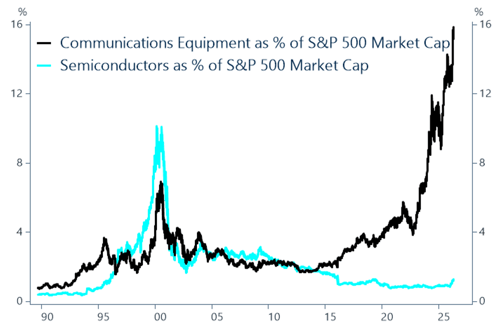
The IT sector’s 2026 EPS estimate has been revised up 15% in the past three months to a 45% growth rate. Semiconductors are expected to grow EPS 91% as data center spending rises 70%. As evidence of how markets have absorbed this, the semiconductor group has reached a record high 15% of S&P 500’s total market cap, dwarfing the percentage of market cap of communications equipment and semis at the tech bubble peak of 2000. Semiconductor shares are up 31% in the year-to-date and a remarkable 112% from the 2025 tariff-scare.
With just two-thirds of S&P 500 firms reporting, the EPS level for the calendar first quarter has drifted up by a full 10% to a 26% gain. This makes a 20% EPS gain for the S&P 500 this year quite likely.
A Precarious Presumption
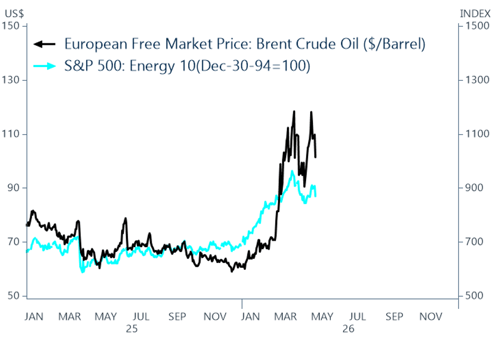
Interestingly, investors have largely concluded that global energy shortages driven by the blockade of the Straits of Hormuz won’t be a lasting phenomenon. We believe that the pervasive rally in global equities on the hopes of a diplomatic breakthrough needs to be confirmed with an actual change in trade flows in the Straits. Energy producer shares are of course subject to weakening energy demand if prices rise too much. Their shares have not risen to the full extent a long extension of the current high prices might imply — a signal worth noting about what markets actually believe.
What Makes Sense and What Makes Less Sense
Having established where markets stand, it is worth reviewing how this picture compares with the views we entered the year holding.
Here’s What is Consistent With CIO Group Prior Views…
Equity returns and the AI boom. As our Outlook for 2026 stated, we came into the year expecting low double-digit equity returns amid an AI boom and upheaval in the post-war norms of global governance. On these matters, our point of view looks to be on track.
Semiconductor overweight. Throughout 2025 and 2026 we have been overweight semiconductors in our portfolios and maintain that position. That stance has been rewarded: semis are up 31% year-to-date and 112% from the tariff-scare period a year ago.
Innovation and IT as the long-term driver. We are bullish on innovation and IT as the key long-term driver of equity returns. The current profit data strongly supports that view.
The energy shock as non-permanent. It remains our view, as it was from the beginning, that the conflict with Iran will not shut down a large share of Persian Gulf oil and gas exports forever forward. Investors’ broad conclusion that the disruption will not be lasting is consistent with our own.
The labor market. A labor market as flaccid as we anticipated has not undermined the profit expansion — if anything, it has supported margins.
And What We Did Not Expect
The energy shock was not in our framework. We were optimistic that the US and world economy could grow in a more widespread way as business caution from the US tariff shock of 2025 waned, boosting corporate profits more broadly across industries and regions. We did not anticipate that an energy shock of historic proportions would intrude.
EPS gains exceeded even our most optimistic scenario. We considered a gain in S&P 500 EPS as high as 15% for 2025 to be a generous ceiling. With just two-thirds of firms reporting, Q1 has already produced a 26% gain. This is a welcome departure, but it raises the bar for what markets now implicitly require.
Sources of Market Optimism - Supported by facts
The AI infrastructure earnings surge is real. Data center spending rising 70%, the IT sector’s EPS revised up 15% in three months to a 45% growth rate, and semiconductors expected to grow EPS 91% are not projections — they reflect actual capital commitments and earnings revisions already underway. Just 19 semiconductor and equipment firms in the S&P 500 are on track to generate about 30% of all S&P 500 profit gains this year.
Valuation is not stretched on a forward earnings basis. If EPS grows 91%, the S&P semiconductor group will see its forward P/E fall to about 18.6x versus 35.7x today. We would not be surprised if these shares rallied another 30% by year end as the AI infrastructure spending pace hits a peak. The earnings math, at least for this year, is supportive.
Energy sector earnings are grounded in the data. US energy producers should see EPS gains in excess of 50% this year. That projection flows directly from the elevated price environment and is not speculative.
Optimism Running Ahead of Realities
The energy relief rally needs confirmation. The pervasive rally in global equities on the hopes of a diplomatic breakthrough needs to be confirmed with an actual change in trade flows in the Straits of Hormuz. Hope is not the same as resolution. Energy producer shares have not risen to the full extent a long extension of current high prices might imply — the market itself appears to sense the uncertainty, even as broad equities have rallied as if a resolution were near.
Semiconductor market cap concentration has reached historic extremes. The semiconductor group has reached a record high 15% of S&P 500 market cap, dwarfing the market cap share of either communications equipment or semis at the tech bubble peak of 2000. This is the market “not looking through” an unsustainable AI infrastructure boom as a one-time surge — rather, it is pricing in perpetuation. Semi shares have also fallen 40% or more four times in the past 25 years, and business investment in computers and semiconductor profits fell as recently as early 2023.
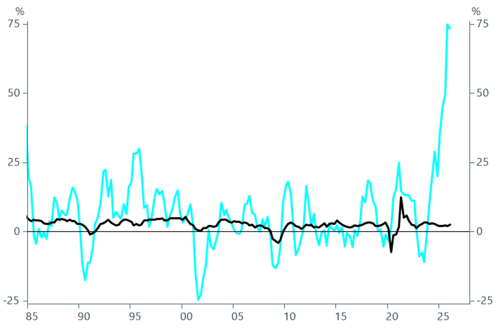
The extrapolation of AI spending growth is mathematically bounded. If we were to extrapolate 2025’s exit rate of +75%, business investment in computers alone would be larger than the whole US economy by 2035 — an impossibility. AI’s physical capital will be akin to a “rapidly depreciating utility” in the future, requiring massive spending to maintain, offering higher profit levels for an industry more critical to our lives than ever. Nevertheless, the absolute level of spending will eventually fall, pulling semiconductor shares down for a time, even as innovation powers long-term returns.
Conclusion: Valuations in Boom Times Are Complicated
We believe financial markets are generally “looking through” the energy shock driven by the blockade of the Straits of Hormuz. They are generally not “looking beyond” an unsustainable AI infrastructure boom as a one-time surge. The asymmetry is striking: market participants are willing to discount a real and ongoing supply disruption while simultaneously pricing in perpetual AI expansion. This dual stance is exactly what we would expect from a bull market regime.
Why the dual views on the sustainability of the AI boom and the transitory nature of the oil shock? We believe it is endemic of a bull market regime. It is a matter of investor psychology to exaggerate positives and diminish negatives in such periods. In bear markets, investors reverse this, failing to acknowledge positives and value the future adequately.
This does not mean the bull market view is wrong in either case. Our own view aligns on the energy side: the conflict with Iran will not shut down a large share of Persian Gulf oil and gas exports forever. And the AI earnings boom is real enough that — on a forward earnings basis — even the semiconductor group is not obviously overvalued if 2026 estimates are realized. We would not be surprised if semiconductor shares rallied another 30% by year end.
What it does mean is that the two views carry very different risks. On the energy side, the risk is that hope does not become reality fast enough — and the rally in global equities requires confirmation that has not yet arrived. On the AI side, the risk is not that the technology is unimportant, but that the trajectory of capital spending is being extrapolated well beyond what is mathematically sustainable, and that the market capitalization assigned to the sector already reflects a perpetuation that cannot hold.
We maintain our overweight in semiconductors and remain bullish on innovation and IT as the key long-term driver of equity returns. But we do so with clear awareness that business investment in computers fell as recently as early 2023, that semi shares have fallen 40% or more four times in the past 25 years, and that AI’s physical capital will eventually function as a rapidly depreciating utility — requiring enormous maintenance spending while the absolute growth in new investment necessarily slows.
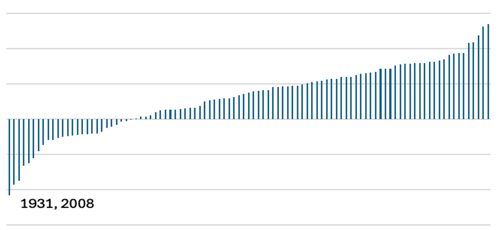
While the past century of data has shown us that bull market periods outnumber bear markets 3-1, as risk managers we must ultimately prepare for both. A 20% EPS gain for the S&P 500 this year is quite likely in a fairly wide range of scenarios. That is a powerful foundation. But foundations are not the same as guarantees, and the current dual optimism — on AI extrapolation and energy resolution alike — asks investors to trust two things that are not yet confirmed simultaneously.
1 We use a liberal 5% estimate for nominal GDP growth in this exercise. Personal consumption of computers is excluded and is about one-third the level of business investment spending.