
What China and Iran Mean For the Global Economy Now
It is tempting to view this week’s Beijing summit as benign. After all, there was little conflict and few significant announcements. But upon inspection, China sent a clear message to the world, showcasing its strength, stability and long-term economic strategy.
China Doesn’t Care About Iran
China is not suffering an energy crisis due to the closure of the Straits of Hormuz. That’s a result of President Xi’s focus on building infrastructure and industry to achieve both energy self-reliance and dominance.
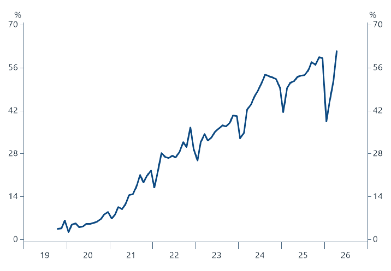
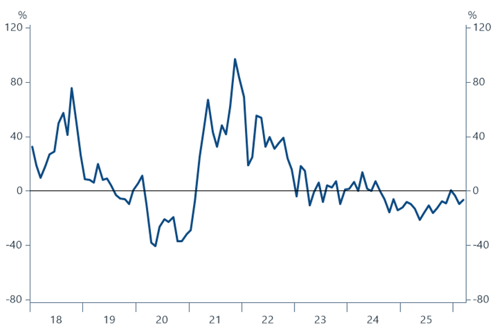
China is seeking global superiority and dominance in Electric Vehicle technology. With its own vehicle fleet significantly electrified, China’s energy imports are on a downward trajectory (see Figures 1-2). Between higher US oil and gas exports and lower internal petroleum demand, China has limited the impact of higher oil prices on its economy and arguably cushioned the global severity of the oil price spike from the Iran War.
China now has 65% of the global EV market and produces 80% of batteries for all EVs globally. China also produces nearly 80% of the world’s solar cells for export and domestic consumption. These strategic decisions benefit the Chinese economy and currency. In fact, China’s currency is a standout performer since the strikes on Iran began, gaining 0.7% while most global currencies fell against the US dollar.
China: A “Good Neighbor” With A Clear Industrial Policy
More than half of South Korea’s memory chips are exported to mainland China. Much of this is for re-export globally. China is taking a more conservative approach to investing in commodity chip capacity, just as it is ramping up its ability to design and produce the most advanced chips given US restrictions on their export.
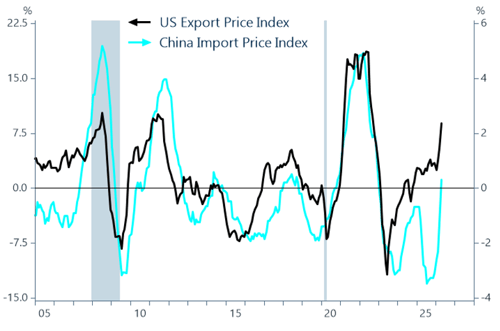
Ironically, amid the Iran conflict and the sudden resumption of global inflation concerns, China’s propensity to produce rapidly and export cheaply is now seen as a diminished threat, likely to help stem world price pressures (Figure 3).
And What About US?
US energy policy is the opposite of China’s. The Trump administration has unshackled US fossil fuels production, opening opportunities for domestic (and international) crude oil and gas extraction while blocking or slowing permits for wind and solar projects. It scaled back the Biden-era Inflation Reduction Act (IRA) subsidies for clean energy investment. And the US administration raised tariffs on Chinese imported solar components and batteries that could have lowered overall US energy expenditures.
The leaders of China and some Middle Eastern oil exporters are looking at the massive expansion of US crude oil and gas output in recent years as unsustainable. At today’s record high extraction rate, the Energy Information Administration estimates suggest that US shale oil and gas reserves will be largely depleted within a decade. While this estimate may be too pessimistic, they see the US becoming more vulnerable over time and at some future date dependent again on others for energy. In striking contrast, China and the Middle East are diversifying their economies away from oil with deliberate speed.
The Iran War is Exporting Inflation
Heading into the Iran conflict, higher US production and Chinese shifts toward electrification left crude oil at a lower inflation-adjusted price than most anyone had projected. Now, the curtailment of shipping, the shutting in of oil supplies from the UAE, Kuwait, Qatar and Oman has created shortages and higher prices globally.
On the day after the summit ended, Iran was commandeering vessels attempting to traverse the Straits of Hormuz. Brent crude oil rose 8% over the course of the week. Global bonds sold off, with the 10-year US Treasury yield rising above 4.5% Friday.
Many investors have begun to fear that there is no easy “off-ramp” that will allow exports from the Persian Gulf to flow freely again. US inflation readings this week posted higher-than-expected gains in the month of April with no relief in sight.
The Fed Can’t Cure this Type of Inflation
This week, the US reported a 3.8% year/year rise in the Consumer Price Index, the highest reading since May 2023. More troubling for markets, higher energy costs of the past two months appear to be spilling into “core items” such as transportation. The core CPI is now 2.8% above a year ago.
Some see a need for monetary policy to knock US demand down to “fit through the Straits of Hormuz.” Yet, a sudden drop in supply is a difficult task to address with monetary policy. Shocks are unpredictable and often short-term in nature. Monetary policy can only work credibly over a long period.
In stark contrast to a year ago, the US bond market now prices one 25 basis point rate hike in a full year’s time. That’s a big difference from the modest rate cuts expected as recently as February. But it is also not a “confident” signal for Fed tightening. The US dollar index has climbed 1.7% since the strike on Iran, a reasonably sanguine view by global investors in the safety of dollar purchasing power.
Inflation protected Securities Price US CPI inflation at an average of 2.7% for the next five years. For the next 10 years, 2.5%. However, folding in the differences in the CPI and the Fed’s preferred inflation measure, these readings are 2.4% and 2.2%. This is hardly a catastrophic collapse in Federal Reserve inflation credibility.
Central Banks Can’t Cure this Type of Inflation
Central banks are tasked with stabilizing prices by limiting excess demand in the economy over time. With no resolution to the dual blockades in the Straits of Hormuz, many see this as a turning point for inflation which has slowed at a very gradual and unsatisfactory pace since 2022.
The US policy rate is currently 3.5%-3.75%. This is unusually high compared to the Eurozone’s 2.0%, even as the EU faces somewhat higher headline price pressures from imported energy. The ECB’s singular mandate on prices argues for near-term rate hikes of about 75 basis points in the coming year. But what would ECB or Fed rate hikes accomplish? Probably very little in terms of inflation.
In short, the Fed and Central Banks globally face a supply shock that won’t boost prices every year ahead. Turning the Straits “on or off” is not a lasting rise in the supply of money, but rather the availability of global energy.
Implications for Global Markets
The persistent supply shock in the Persian Gulf is harming the bond market, which was patiently counting on further, gradual progress in reducing inflation. While the Fed and ECB seem unlikely to tip economies deliberately into contraction in an attempt to manage short-run inflation, the pressure on the bond market is being felt in equities.
As important as rates are for US equities, investors remain nervous over the boom in AI-related hardware. This coming Wednesday, Nvidia’s earnings report and commentary on the state of the AI buildout may be critical for determining how much of the bond market’s recent pain will be shared by equities and credit.
Our Portfolio Actions
The significance of the Iran War goes far beyond inflation headlines. The actions of the US are in stark contrast to China’s. China seems likely to emerge from a deflationary period stronger and more stable. The US will see higher than expected inflation and the world an even greater energy-driven inflationary spike.
This is why CIO Group has emphasized diversification with allocations to specific industries benefiting from titanic shifts in technological change, from industrial development of necessary energy and data infrastructure and from the need to rebuild defense and aerospace capabilities that require new equipment to fight on a new battlefield.
We are also believers in international diversification, even as we took our allocation down for some European and Japanese equities last month in light of the energy shock. The US may always be dominant in technology, but IT doesn’t have a linear path higher. US energy policy, among other America first initiatives, may at some point be a vulnerability rather than a strength.
While we don’t believe inflation will accelerate and run out of control for many years ahead, we do expect higher CPI readings in coming months.
Last month, we shortened portfolio bond duration and further raised our allocation to short-term Treasury Inflation Protected Securities. In addition, we invested more in US energy infrastructure and energy producers on the view that the Iran conflict could drag on longer than markets anticipated.
We believe short-duration TIPS always have value as an ultra-safe real return asset in portfolios. Even so, we won’t always hold inflation-leveraged assets as overweight positions.
As we discussed last week, the accelerated buildout of AI infrastructure – yielding EPS gains of more than 90% for semiconductors in 2026 – points to a 20% EPS gain for the broader S&P 500 this year. We are on alert for heightened volatility, and in particular, some further reckoning for the energy shock. Yet, with such strong EPS gains - more than 5% above our start-of-year estimate - a similar rise in the S&P 500 total return is likely by year end, even with some valuation contraction.
With all this said, it is hard for us to conceive of a 2027 that is driven again by even higher growth rates for AI infrastructure (including both data center spending and electrification) in the years beyond. As we noted last week, we must be ready to manage US tech hardware allocations directly in asset allocation portfolios.