A Clear Look Ahead: Bonds, Bears, Nvidia Shares
No Trust in Truss: A Lesson
Today, many investors fear a “Liz Truss moment” for the US bond market. If you don’t remember Liz, this is why.
On September 6, 2022, the UK Tory Party named Liz Truss Prime Minister. Within days of her ascension, she announced plans for tax cuts to give Great Britain a brighter growth outlook. Global bond investors voted with their feet. Over the course of three weeks, long-term UK Gilt yields rose from 2.95% to 4.5%. The Pound briefly hit a record low against the US dollar.
Within 50 days, Truss was no longer Prime Minister, and the Tory Party reversed its fiscal plan.
At this moment, there are bond bears comparing the US to UK, or even Turkey, where President Recep Erdogan has fired multiple Central Bank Governors. Turkey has seen its currency lose more than 80% of its value over the past five years. Could this be in store for the US?
We don’t see it this way. The US has a short-term problem with energy-driven inflation. It has a long-term problem with age-triggered entitlements. But it certainly does not have a Truss-Erdogan issue.
How to Generate a Bond Crisis? Stop Growing.
Stagnant economies are another form of “bond hell.” Japan’s government debt-to-GDP ratio has risen about 80 percentage points more than the US in the past 40 years. This is despite Japan’s government bond yields averaging 2.7 percentage points below the US. The clear message: growth is a necessary factor for debt sustainability.
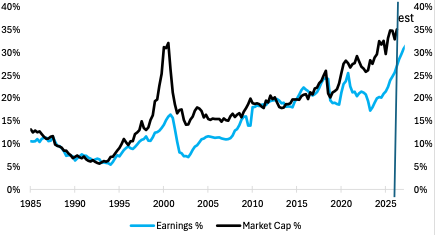
The US dollar and credit markets benefit from the growing profits of US corporations, presently driven by an expected 93% gain for semiconductors this year. The 22% EPS growth rate of S&P 500 EPS stands in contrast to a world where EPS is likely to grow at little more than half that pace in 2026.
Oil, Inflation and Rates
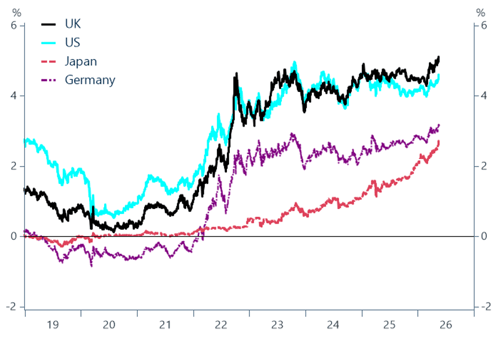
Even though the US is funding the war in Iran, all global bond markets are feeling the impact of the inflation hit simultaneously (Figure 1).
If the war is settled with a reopening of Persian Gulf energy trade, we expect global inflation concerns will unwind. Bond investors largely agree. Markets reflect just 15 basis points in increased inflation compensation for the coming 10 years since the US strike on Iran, with most of that expected to occur in the coming year.
With the latest surge in US inflation to near 4%, real US Treasury interest rates are again barely positive on average across the curve. Central bank policy rates across the world are unusually low compared to the US at the moment. As such, foreign policy rates are expected to climb more than the US’s in the coming year.
Energy Exports Cushion the Blow for the US
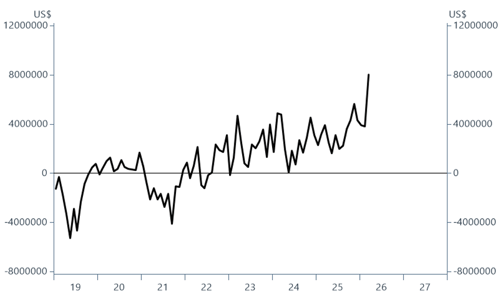
The US’s energy trade surplus is running at a $100 billion annual surplus in the latest month with further near-term gains likely. This will be a significant offset to the war’s costs in terms of national income (Figure 2).
The US energy position is a medium-term strength. Over the longer run, the sustainability of US fossil fuel extraction rates into the decade ahead is a risk. (Please see last week’s Point.)
To Understand Debt Sustainability, Watch Your Currency
The US energy boom beginning around 2012 has long improved US terms of trade, erasing a need for oil imports and their financing. The war this year has improved the energy sector’s contribution further. Yet overall, voracious US borrowing continues, with a Federal budget deficit of $1.8 trillion expected this year, or 5.8% of GDP.
All else constant, government deficits are inflationary. Budget deficits largely finance demand without producing supply. This “leaks out” into demand for financing from the rest of the world and represents a downward source of pressure on US assets.
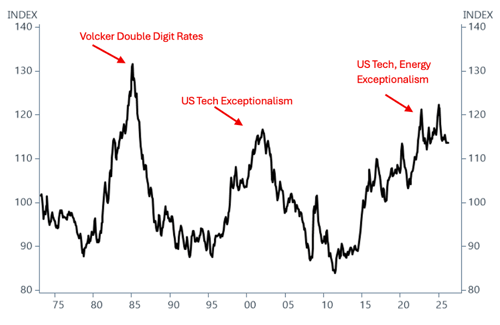
One might expect this to damage the dollar. Instead of voting with their feet however, global investors have shifted toward the US, pushing up the dollar 1.8% against a basket of the most widely-traded currencies. In fact, the broad trade weighted dollar is just below its second highest level on record in inflation-adjusted terms. (Figure 3).
It’s important to remember, currencies are relative values. Budget deficits and growth opportunities of all economies are weighed against each other.
We believe either declines in equities or US policy interest rates could be catalysts for the US currency to resume declines from present levels. We doubt the US dollar will decline because “Fed policy rates aren’t high enough.”
Booming Tech … Booming Currency?
Nvidia’s 95% gain in first quarter EPS – coupled with strong revenue guidance for the year ahead - is exceptional. Wall Street’s estimate for a 35% EPS gain for Nvidia in the year ahead is almost certainly too low. But unless you believe “rainbows don’t have an end,” a 95% EPS growth rate can’t be sustained far into the future.
Investors have sent the world’s largest company by market cap up 68% over the past 12 months and 131% over the past two years. This implies a reduction in valuation. A doubling in EPS in the quarters ahead would imply a 19X multiple for the $5.3 trillion company, which investors rightly see as a “national treasure” of innovation.
Yet some years from now, we would expect investors to recognize 2026/2027 EPS as a “boom earnings” period for computing power. This does not leave the company truly “cheap.”
CIO Group Wisdom: Own Bonds Built for Near-Term Inflation
As a hedge against near-term inflation, our bond portfolio has a below average duration (4.7 years versus the global benchmark of 6.2 years). We hold nearly 30% of US Treasury securities in the form of short-term Inflation Protected Securities, about 10X the benchmark weighting.
We also have over-weights in energy-related equities given the near-term strength of oil and gas. We also have small stakes in gold and bitcoin with a view to eventual declines in the US dollar. We expect that energy costs will fall before very long, taking down the value of some of our portfolio hedges, benefiting the rest of our portfolio.
As We Plan For An Inevitable Tech Correction
Right now, the tech sector is growing profits faster than the economy at large. The roughly 15% gain in AI-related capital spending embedded in analyst estimates for calendar 2027 is more of a guess than a confident projection. While growth may slow, it could easily be stronger in 2027 before an outright decline takes place (Figure 4.)
Note that the last decline in business computer investment spending was quite recent -- early 2023. Investors have short memories.
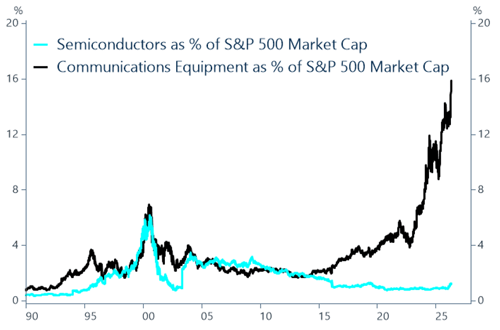
The semiconductor group has experienced four bear markets of 40% or more in the past twenty-five years. That’s before rising to its present place atop all other industries.
We believe investment managers will have to carefully manage around an inevitable tech correction that will likely come while tech shares are at historic high share of global market cap. (Figure 5 and our Point of two weeks ago).
While tech has not reached bubble standards of 1999-2000, we are beginning to see the same polarized views that catalyzed the bubble bursting. As we like to say, we remain innovation optimists -- “growth investors in equities, value investors in bonds” – and market realists.
We don’t dismiss market history as an “insult” to AI’s place in the future.