When Silver is as Valuable as Gold: Trimming Hardware Overweights in US, Asia
When Silver is as Valuable as Gold: Trimming Hardware Overweights in US, Asia
In 1925, President Calvin Coolidge famously said “the chief business of the American people is business.” Today, we would add “the chief business of the US is technology.”
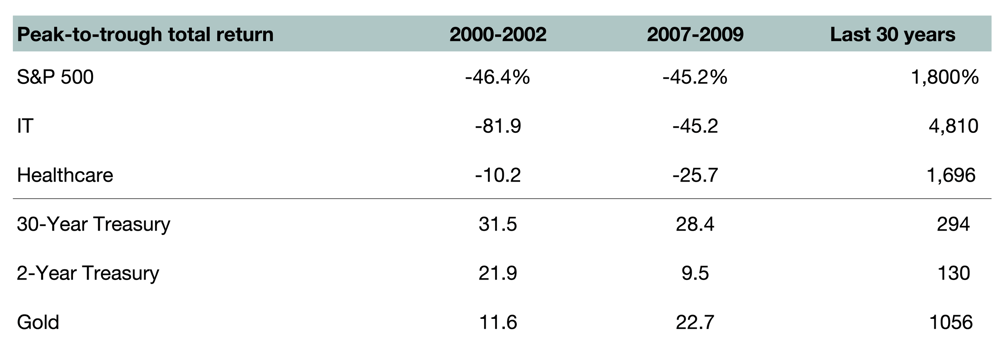
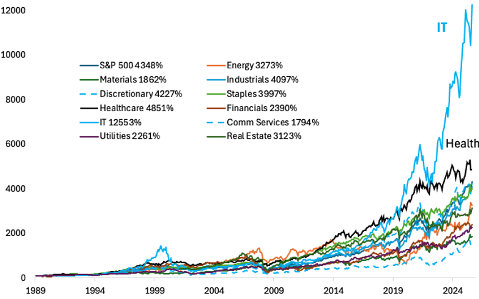
The S&P Information Technology Sector has returned about 2.6X more than the next strongest sector since 1990 (Figure 1). Healthcare is the only other sector to beat the overall S&P.
The S&P 500 is being powered by its 38% IT-sector weighting which excludes tech companies in Communication Services and Discretionary. With the rapid growth in AI infrastructure spending, we believe the Industrials and Utilities sectors have also become part of the IT boom. While there are some strongly tech-driven markets in Asia such as South Korea and Taiwan, the overall weighting of tech in the US is two to three times that of non-US markets.
Beware When Valuations Anticipate Endless Earnings Boom
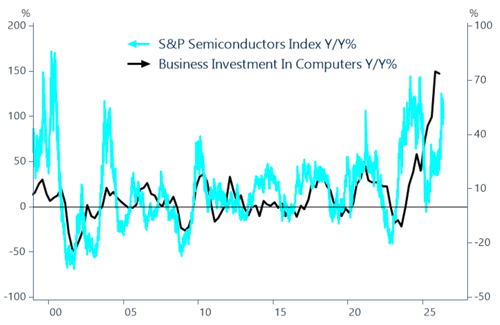
The IT sector trades at a trailing valuation that is 43% higher than the S&P 500. EPS for information technology is expected to be up 50.1% this year compared to “just” 13.9% for other sectors. This would explain and close that gap. The 50% EPS gain for 2026 could also be an understatement. Business investment in computing power for AI data centers is in its third consecutive boom year, with public hyperscaler spending projected at a 70% pace (Figure 2). As a result, semiconductor profits are expected to more than double.
A Bit of DRAM History – Higher Highs and Lower Lows
In an age of “meme stocks” and “meme coins,” you cannot blame investors for chasing real corporate profits. If stocks are going up fast and for fundamental reasons, all the better. However, the latest phase of this tech rally is particularly risky.
The strongest component of the tech rally now is memory chips. DRAM pricing is up 5-fold on chip shortages. Memory chip makers will be “sold out” of their product and boosting production as rapidly as possible to meet demand in the coming year or two. There is no doubt their profits will surge as data center builders and others are willing to pay more for “chips now” to complete their projects quickly. But the business of AI providers is to sell their data services, not expand their stock of hardware.
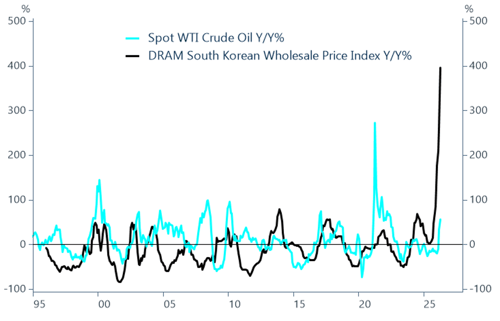
Looking back on the history of DRAM pricing, there has never been a time when profits margins expanded and remain high without setback. As figure 3 shows, DRAM is a commodity and its scarcity is temporary. Prices have risen and fallen every other year. This will prove true eventually even as there will be massive future maintenance spending on the now larger capital stock of data centers.
DRAM: Earning All of Nvidia’s AI Returns in Just One Year
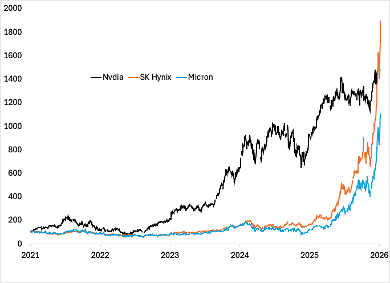
The shortage of memory and other hardware components has meant that DRAM leaders such as Micron of the US and SK Hynix of South Korea have achieved stock market returns in the past year roughly equal to those of Nvidia’s over the last three years. This takes us back to when OpenAI convinced the world that AI would be a breakthrough that changes life as we know it.
Nvidia’s innovations in chip design have enabled AI more than any other company. It has the greatest revenue exposure to AI, even if it is no longer unique in providing this IP. There are many new advanced chips and chip designs coming to market that will, over time, create price competition for high end chips.
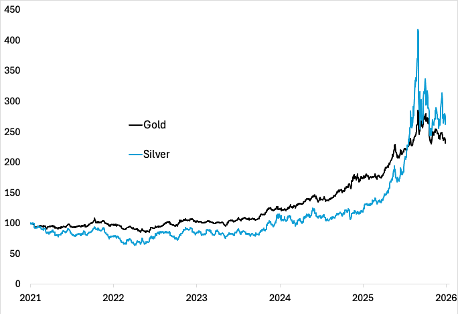
But for markets to provide returns for commodity memory in the same fashion as Nvidia seems unsustainable to us. While computer equipment components are far more consequential in the age of AI, we look at the DRAM maker “catch up” trade as akin to “silver catching up with gold.” Silver is the more ubiquitous, more volatile commodity. Yet, investors sometimes push it to dramatically higher returns than gold before an inevitable decline sets in (See figure 4).
We Are Trimming Hardware Overweights in US, Asia
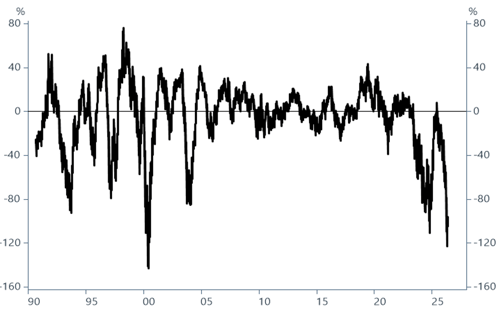
As we’ve noted previously, the outperformance of all tech hardware has exceeded software by the greatest amount since 2000, when the advent of the internet drove an unsustainable boom in telecom equipment spending. This month, semiconductors exceeded systems software returns by the greatest margin since 2000 (Figure 5).
Software makers face an onslaught of competition from AI services who want to win customers solving the same problems. Yet, the valued service they all provide is code, the solutions we pay for. Hardware is simply the vehicle that enables it.
Hardware innovation will always be a value to us embodied in firms such as Apple and Nvidia. But with the latest powerful surge in storage and components, we’ve decided to trim tech hardware weightings in both the US and Asia. We’ve reinvested the majority of the proceeds in dividend growth strategies in both the US and abroad for the time being.
Our CIO Group portfolios remain slightly overweight US tech hardware and more definitively overweight software, particularly cybersecurity. The profit gains of hardware makers are a fundamental driver of today’s outperformance. We see no evidence that AI infrastructure spending is falling or necessarily will fall in the coming year. Yet the fact is, hardware spending at the current pace is far too rapid to sustain for many more years (please see our Point of May 10). And with such tremendous tech exposure in the US equity market, we will need to be ready for the day when fundamentals don’t support immediate gains, even if we are long-term bulls.
History Bears Remembering
Calvin Coolidge was president during the roaring 20s, leaving office in early 1929 before the October crash and onset of the Great Depression. The Depression was a painful but passing phase in the great march of progress. Even so, there were many signs indicating that a crash was possible, then likely.
The larger macroeconomic mistakes of the Roaring 20s and Great Depression need not be repeated. But here is today’s minor parallel. We see markets as building major concentrated risk in hardware and in particular tech hardware commodities. It may not come soon, but an inevitable revaluation of these sectors is ahead. As always, we want to be cognizant of the risks and be prepared for appropriate portfolio actions (Figure 6).