Testing Your Pain Tolerance: The Clash Between AI, the Fed, Free Markets
The financial crisis that began in 2008 saw enormous government intervention to forestall a potential depression. The pandemic in 2020 saw Congress turn on its printing press and the Fed create “free money” to avert yet another economic calamity. These actions and actors shared a central belief, that the Federal Reserve and government could intervene in the economy effectively in crises, without overriding negative consequences.
The new Fed Chair is challenging that assumption. The precarious balance between “free markets” and excessive “interventionist” macroeconomic policy, between banks, investors, and those who regulate them, may be shaken. For the moment, investors are feeling an extraordinary lack of certainty about how “less intervention and less information” will impact markets.
Interventionism and Overconfidence
In 2008, a handful of business leaders of major banks wrecked their institutions and sent the economy into a slump with millions of long-term job losses following a debt-fueled housing boom. Investors and the general public learned that lenders didn’t “police themselves” in the years running up to the sub-prime mortgage crisis. The late Alan Greenspan called his reliance on bankers to make collective decisions consistent with their own self-interest a “mistake.” The “invisible hand” failed to guide them.
Following the Lehman Brothers-led cascade of bank defaults, there was coordinated and prolonged monetary and fiscal intervention to prop up the entire US financial system to an extent unseen since the Great Depression. Even with that level of support, the US economy did not reach full-employment for seven years. US unemployment averaged 8.4% in the five years after the Great Recession ended.
On the inflation front, consumer prices rose at a benign 1.8% rate, this is despite a zero interest rate policy until early 2016 and a five-fold expansion of the Fed’s balance sheet from the pre-crisis level.
Those who feared “hyper-inflation” from 2008-2009 policies were wrong. Yet, once it was clear the deflation and cascade of ruinous defaults experienced in the 1930s was skirted, policymakers became overconfident. Some thought their actions to intervene in the economy without inflation could be boundless.
The Pandemic and the Great Recession Playbook
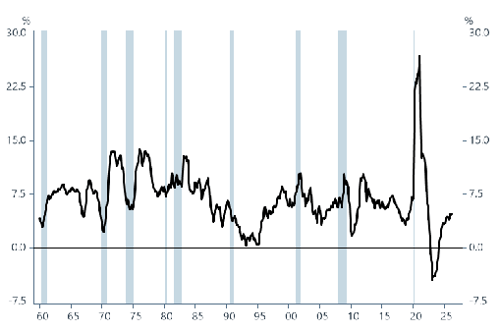
The Pandemic saw the Fed and Congress monetize history’s largest fiscal expansion with direct demand stimulus during and after the 2020 pandemic (see figure 1). Some even argued that the public needed a permanent “Universal Basic Income” – a government paycheck without producing anything. Though the crisis was large and the response huge, many assumed that inflation would remain tame.
But as it turned out, “free money” spent on goods and services during the 2020-2022 period was indeed highly inflationary. Jerome Powell raised policy rates from 0.25% to 5.5% over 17 months in an attempt to cool inflation that reached a peak of 9.1% in June 2022.
Warsh is Confident that Overconfidence in the Fed is Dangerous
These periods of “extreme overconfidence” in government intervention have brought us a new Fed Chair who looks cynically at “centrally planned” monetary policy. His latest comments following his first Federal Open Market Committee meeting closely matched his historic views. Here is what Warsh said at the Hoover Institution in 2018 after a decade of below target inflation:
"My overriding concern about continued QE, then and now, involves the misallocations of capital in the economy and the misallocation of responsibility in our government.” – June 7, 2018, Hoover Institution
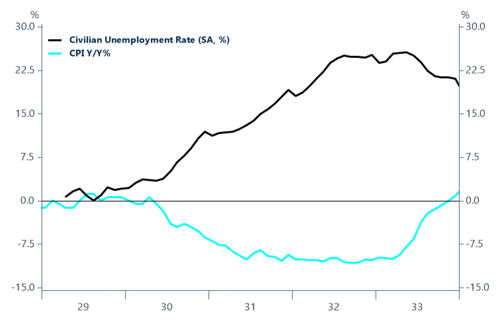
Warsh’s comments were delivered at a think tank founded by the US President who presided over a laissez-faire approach to the Great Depression. Looking back at the result, Hoover said his government believed that the collapse of banks, the resulting cascade of business defaults, and skyrocketing unemployment would purge the “rottenness” out of the system (see figure 2).
It is ironic that Warsh’s reliance on market discipline is antithetical to President Trump’s own willingness to use any and all parts of government to intervene in markets and even company-level decision-making.
Warsh, Markets and Mixed Signals
In markets, this moment feels like a faint echo of 2022, a period that saw the flattening of the yield curve, a drop in equities and a rising US dollar.
Since Warsh’s intro talk, the current balance of market views has shifted. Bond market participants believe the Fed is even more likely to increase rates than lower them. The US bond market prices a 60% chance of two 25 basis point rate increases within a year’s time and a 100% chance of one rate hike. This is despite the massive unwinding of the Iran oil shock which pushed up inflation since March.
Watch the USD
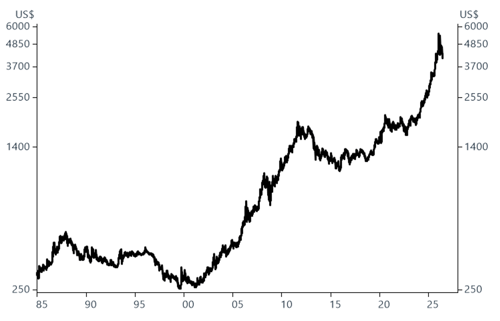
After Fed easing steps and self-imposed US tariffs on all trading partners in 2024 and 2025, investors had positioned for a weakening US dollar. The extreme rise in gold and silver prices was one indicator (see figure 3).
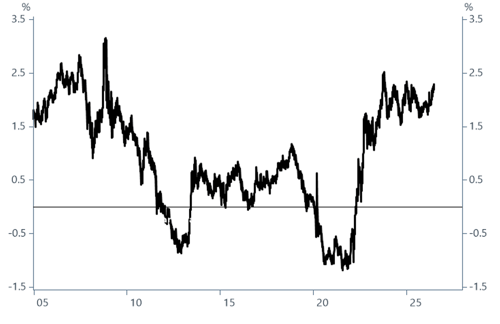
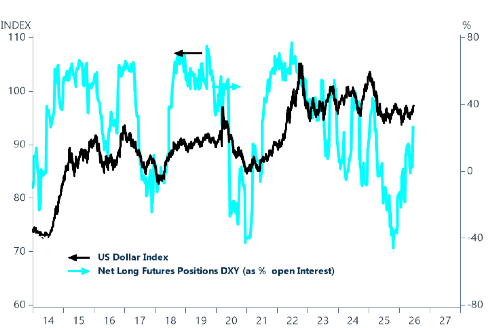
Now, investors are repositioning for a stronger US dollar (see figure 4). At first, this occurred with the rise in the US energy exports after the strike on Iran. Now, it is occurring as investors judge Warsh to be a more hawkish Fed Chair than Powell.
In our own portfolios, we are not currently adding to non-US-dollar assets, reflecting our near-term view on dollar strength. Over the long term, we continue to believe many international assets can contribute to returns.
That said, there is material risk that investors will judge a new Fed Chair incorrectly. With energy prices normalizing, global manufacturing gently rising and positive earnings momentum, there is no compelling reason for rates to fall – or rise. We would expect headline inflation to fall to 2.5% in 2027 with the Fed’s preferred inflation measure closer to 2%.
For Economy and Markets, Artificial Intelligence is Not a Risk-Free Experiment
Before Adam Smith died in 1790, he wisely observed that human labor was the primary source of all wealth. Value creation was tied to human efforts. In Smith’s world view, machines were subordinate, substituting for muscle and repetition of motion. Smith also believed that “self-interest” governed behavior and that the propensity of humans to truck, barter, and exchange was innate.
An economy of artificial agents pursuing assigned objectives has no obvious place in Smith’s world view. The idea that machines can “think or reason” seems farfetched now, but there is no doubt that the significant replacement of labor by machines that are able to “consider” options or “make decisions” is upon us. Basic “thinking tasks” including the synthesis of data or the full replacement of certain human tasks (i.e. driving or trading) may upend Smith’s “invisible hand” view of collective good.
We believe that the impact of AI on the US economy will require more public policy safeguards than less. For example, AI’s targets include the financial institutions that serve as the bedrock of the world economy. While we are AI optimists, the technology seems likely to test free market orthodoxy. The technology is sufficiently potent to destroy elements of the economic system its creators rely on.
True AI Innovators vs “Byte Players”
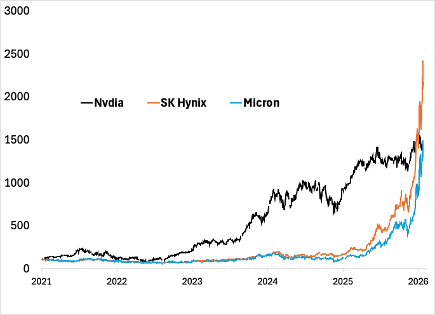
As we look at markets now, an added complexity for investors is that the most attractive growth assets in the US are in the throes of correction. “Momentum” investors don’t seem to care that EPS estimates for semiconductors continue to increase for both 2026 and 2027. The mere “lack of gains” is their reason to sell. After historically massive rallies with commodity memory chip makers reaching multi-trillion dollar combined values, shares are exhibiting greater volatility (See figure 5).
We believe true AI innovators will generate stronger future returns than some of the firms needed to build the infrastructure to deliver initial services. It will be no easy task to calibrate the right exposures. For us, the higher short-term interest rate backdrop, rising dollar and now falling inflation leaves our “defensive assets” (bonds) a critical portfolio contributor (see figure 6).