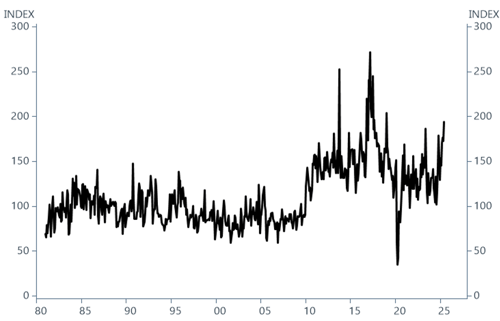
2026 is surprising us to the upside. Both earnings and world equity markets appear poised to rise more than CIO Group expected when the year began.
While some unusual economic risks are rising beneath the surface, the preponderance of evidence suggests the bull market will continue in 2027. Though we remain vigilant, US and global conditions over the next 12 months are most likely to reflect increasingly polarized market views rather than broadly falling values.
In our Outlook for 2026, we warned of both rising geopolitical risk and “shocking volatility” in markets. We also recommended staying “long AI capital” as future returns were worthy of taking incremental portfolio risk.
Our readers may wonder why we are both optimistic for the remainder of 2026 and early 2027, and yet warn of impending risks. The answer is simple, but what to do about it and when, is not.
While there were sharp interruptions within years including 2020 and 2022, we’ve enjoyed over a decade of well-above average returns for US equities. We are also experiencing a true, once in a lifetime boom powered by the rapid rise of artificial intelligence that is still unfolding in a way that boosts corporate profits.
Booms end in busts, periods of marked equity declines. But knowing when to become defensive in portfolios is an art, not a science. Given the powerful returns of the past decade and high profit margins, when a lasting equity correction comes, it will be a major drop.
Our Mid-Year review focuses on the risks to our near-term positive outlook. These are:
- The sustainability of hyperscaler demand for compute power (chips and memory).
- High interest rates relative to inflation and higher bond market volatility.
- A new Fed Chair who does not prefer to intervene in markets nor signal his intentions.
- A stronger US Dollar
- The US Election amid extreme political polarization and negative consumer sentiment.
What is most interesting about this set of risks is how they could compound one another. If the technology sector gets hit hard and the Fed does not react as it has the past 30+ years, there can be multiplying negative impacts. Further, such an event could cause a contraction in credit markets, which could impair growth in the economy for a time.
Our role in managing assets is to be mindful, vigilant, data-driven and also prudent. We are not market timers and remain fully invested where we think risks are rewarded. What we invest in can serve as a stabilizer or bumper when rough seas come. Our Active Asset Allocation methods take all of this into account, as does our “hyper efficient” portfolio design.
For more of our thinking, read on.
The Next 12 Months and Then What?
Following an inflation-driven interest rate spike in 2022 and a “tariff panic” in 2025, the S&P 500 is poised to complete a fourth year of gains in 2026. Our Outlook 2026 noted that the median annual S&P 500 return for almost 50 years was 15.2%. During “bull market regimes,” returns like last year’s (+17.9%) are not unusual and the first half of 2026 has maintained that pace. Yet, returns that strong are unsustainable. Over the past century, one in four years has posted an average decline of 13.5%, knocking the compounded annual return for the S&P 500 down to 10.0%.
In our view, after a decade of above-average returns, 10% is still too strong to be the correct forward-looking return forecast for the next decade. With this said, longer boom periods before busts have become common. Since 1980, equity market declines have become slightly larger on average. But the frequency of negative return years over that period has dropped sharply; 8 vs 18 from 1929-1979.
Major Equity Market Declines are Not Random Events
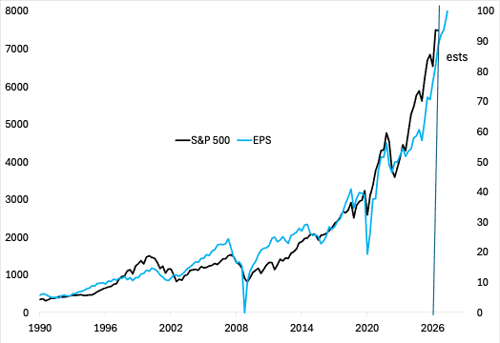
Major equity market declines are not random events. Equities rise and fall slightly before corporate profits do (Figure 1). Powered by unusually strong results for tech hardware (semiconductors), the 2026 S&P 500 EPS growth rate has been a torrid 30% over the past year, stronger than 92% of all periods since World War II.
While earnings estimates show corporate profit growth slowing sharply in the coming year, they remain far stronger than the long-term compounded 6% average. Even if earnings estimates appear too high for next year, if 2027 sees just half the past year’s EPS growth rate, US and global equity returns are likely to remain consistent with bull market periods. This assumes investors do not see credible early warnings that 2028 will experience a bust.
Nonetheless, we believe that when the history of the 2020s is written, it will contain a remarkable AI boom and bust in closely-linked asset prices during a period of unprecedented technological change. Since “that hasn’t happened yet”, the period ahead requires a respectful understanding of how prior booms and busts played out and the prudent use of key portfolio tools to mitigate the downside.
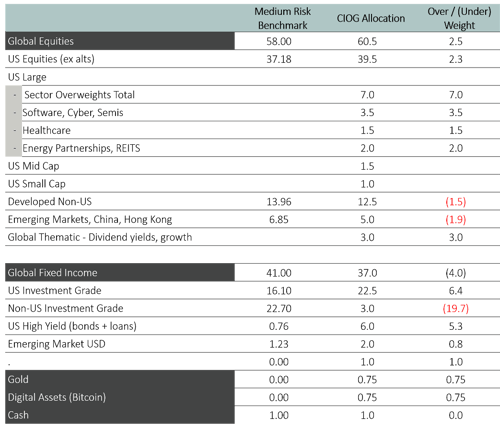
Our case for an overweight position in equities would be even clearer if short-and long-term interest rates were lower, if the Fed were promising “easy money” for a “lengthy period ahead” as it did for half of the past two decades. (See our asset allocation table at article end). Yet, today’s investors are blessed with sustainable yields on their safer assets, rates that are not requiring them to take excessive risk (see figure 2).
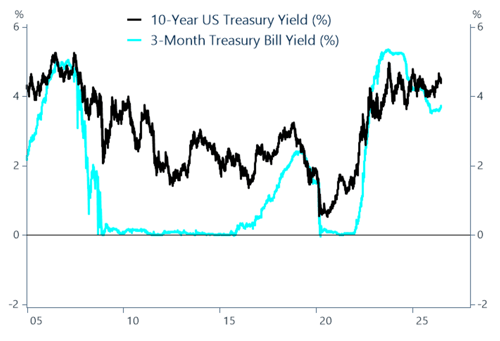
“Normal” interest rates - ones that should exceed forward-looking inflation - are back. Unlike 2022, this allows asset allocation to do its job. In a non-inflationary recession of the future, bonds will rally in price when equities fall.
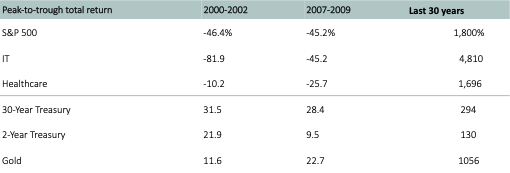
In the past two years, CIO Group has seen excessive market pullbacks as opportunities to add risk or hold steady in the face of shocks (i.e. tariff fears, war in Iran). We also have the asset-allocation tools within portfolios to manage through larger and lasting bear market retrenchments (see Figure 3). History tells us these periods are unavoidable. Fortunately, they are soundly outnumbered by the years of bull market progress.
Important Events to Watch in the Second Half of 2026
This year, some global commodity memory chip producers have seen returns of as much as 700% YTD. Several have caught up to Nvidia’s entire return since OpenAI shocked the world with its capabilities just 3 years ago.
We believe that this historic boom in business investment in data centers is raising concentration risk in US and emerging Asia shares to an unprecedented level (Figure 4).
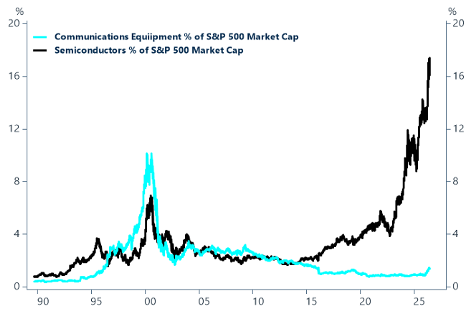
Yet, the boom in related shares is very fundamental. For example, memory chip maker Micron’s profits have risen more than 10-fold over the past year. The wrinkle is the 65% three-year pace of spending on business computers is unsustainably rapid, more than 10X the growth of the whole economy. We see a peak in profits and demand being reached sometime within two years, even if maintenance spending on AI infrastructure remains elevated.
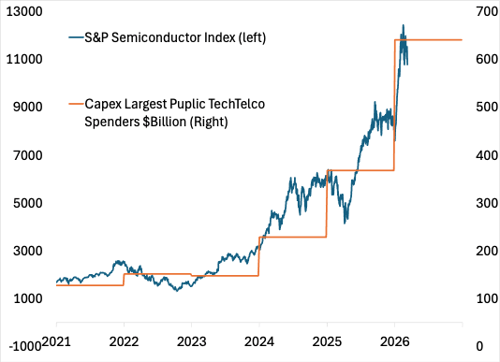
Over the past year, each quarter has seen tech and telecom hyperscalers – the public firms providing current and future AI services – raise their capital spending projections. As CAPEX spending has gone up, so have semiconductor profits and shares (Figure 5). Each quarter, we will track these spending plans to assess whether shares have overshot or especially, if spending appears to be normalizing.
2 - US Real Interest Rates and Rate Uncertainty
New Fed Chair Kevin Warsh is not a believer in Fed activism. He expressed skepticism over the extent of US credit easing after the 2008/2009 Great Recession -- even after 10-years of below target inflation. He likely laments the Fed’s even stronger demand support during and after the 2020 pandemic which fueled the most severe inflation surge since the 1970s.
Recently, Warsh made optimistic comments recognizing the dwindling Middle East energy shock. At the same time, his historic views, induction comments and clear desire for the Fed to stop guiding markets has created greater interest rate uncertainty.
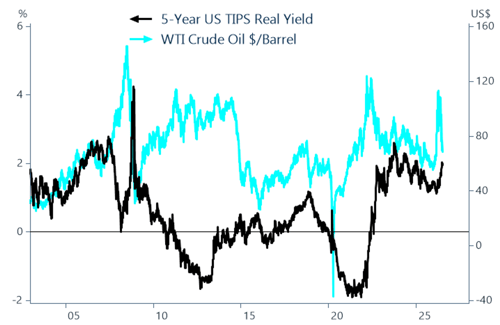
As a result, even after a 35% drop in the US crude oil price since early April, markets have priced in at least one US rate hike and modestly higher real interest rates on the view that the new Fed Chair is an inflation hawk (Figure 6).
While cementing low inflation is critical to a more sustainable economic progress, Warsh’s possible reticence to Federal Reserve intervention could exacerbate volatility if an adverse shock develops. This may even make any reversal of progress on the Iranian supply shock a larger market event.
The US dollar fell sharply in 2025 as the Trump administration announced what appeared to be the largest tax increase since World War II in the form of tariffs. The tariffs are paid for by US importers and are significantly passed on to US consumers. Unlike 2018’s highly targeted tariffs on China and specific goods, the so-called “reciprocal” tariffs targeted the entire world. It was viewed by markets as a unilateral, self-directed supply shock.
The announced tariff headlines were overstated. About 70% less was collected than initially estimated by economists. The Supreme Court ultimately ruled that the tariff actions did not have a legal basis. For the first time ever, tariff collections are now negative on repayments.
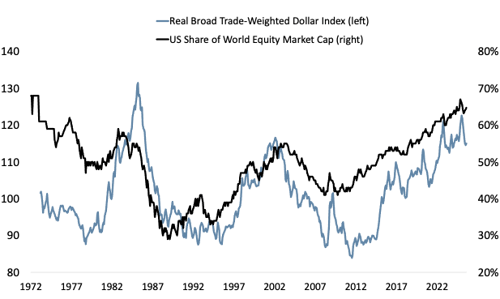
The US dollar remains 14% above its long-term average value when taking into account domestic and foreign inflation. In other words, the US dollar is priced as an “exceptional real value” (Figure 7). Though there are many reasons why the US dollar has attained this status, higher expectations embedded in valuations are a greater hurdle for future returns.
The US dollar has strengthened recently on both its energy trade surplus and the hawkish words of its new Fed Chair. At the same time, the record 15 years of US equity outperformance prior to 2025 and the higher US dollar valuation represent dual risks. The market cap of traded US equities is about 2X the remainder of the whole world. Any signs that US real economic growth will disappoint (See Observation 1) would likely exacerbate US dollar declines. Hawkish surprises from new Fed leadership could cause a lurch higher in the dollar and weaken global asset prices.
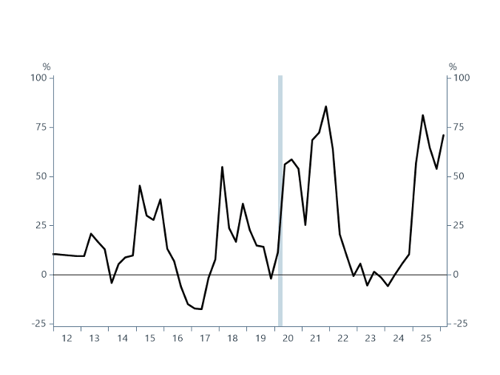
Overall US corporate debt (non-financial) grew a modest 4.6% in the year through 1Q 2026. This figure includes public and private credit. The debt of firms building AI data center infrastructure, on the other hand, appears to be growing at an extremely rapid clip (Figure 8). And that’s the debt of public spenders.
The private credit industry has a substantial concentration in loans to the software industry. The good news is that software has the strongest long-term risk adjusted return in the equities market. It is also an industry subject to significant technological obsolescence. With the rapid rise and extraordinary capabilities of AI, Anthropic, OpenAI and many other AI model providers are seeking to displace traditional software.
Private credit returns are limited to interest payments and the return of capital, so a shifting balance of risk has harmed expected returns to private credit funds and institutional providers. Actual credit performance will have to be carefully watched. In the arena of evergreen funds issued by major publicly traded PE companies, redemption requests have far exceeded the 5% quarterly gates most funds have established.
5 - US Mid-Term Election – Can Extremism Worsen?
Since World War II, 7 of the last 10 presidents who entered a midterm election with a unified government lost control of at least one chamber. Many voters see the “checks and balances” of divided government as a stabilizer.
With that said, hyper-polarized, combative governance has emerged over the past 15 years and comes with its own risks. The President’s July 3 invocation of “communism” as a threat is indicative of the level of vitriol.
The President recently purged the leadership of the bipartisan U.S. Election Assistance Commission (EAC). He dismissed the remaining two Democratic commissioners and allowed a Republican to resign, leaving the agency that certifies voting systems and maintains national registration forms effectively inoperable. While not our base case view, investors could potentially be shocked if the Federal Government challenges results that would stop an orderly transition of leadership in the House or the Senate. Conversely, a rout for Republicans may raise market fears of future policy changes unfriendly to investors.
The US economy has been blessed with strong demand and supply apart from temporary shocks in recent years alongside full employment and moderating inflation. Yet, consumer sentiment has reached lows unseen even at the depths of 2008 and 2020. Today’s fractured information environment, state-sponsored AI-powered disinformation, and severe US partisan discord are psychological elements of a major electoral malaise (see figure 9).