Is There Enough Fuel in the Tank to Keep Markets Rising?
With higher interest rates, higher oil prices due to a new escalation of the Iran War and tech earnings season upon us, investors are worried and bond investors are asking for more compensation. That makes for jittery markets.
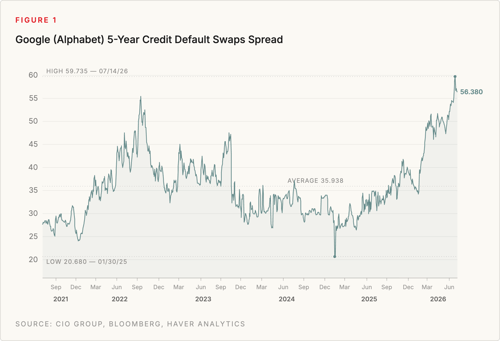
Credit markets are now charging a premium for big tech spenders including Alphabet, which has among the highest credit ratings among US corporate borrowers (Figure 1). This is even as most US corporate credits (either investment grade or below) trade with tight spreads. This suggests that credit will be one of several constraints that will slow the explosive growth of data centers at some point soon.
EPS reports are half of what investors watch for Alphabet. Google reported rapid earnings and revenue gains last week. But it also estimated even higher spending plans for AI, showing an increase from $185 billion to $200 billion, pushing its free cash flow negative.
Everyone wonders, will this extraordinary AI infrastructure spending pay off and when?
Apart from Nvidia’s earnings release, which comes on August 26, reports from MSFT, AMZN and AAPL will be among the highlights of “peak earnings season.” Traders will look for guidance on whether firms such as MSFT and AMZN will also borrow and spend more on hardware (data center) in coming quarters.
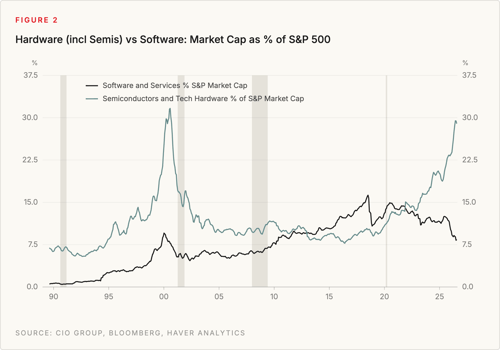
Over the past three years, investors have only experienced rising spending, faster. Even with a recent setback in memory chipmaker shares, the supply chain for the technology service ecosystem has an unusually strong value compared to software and services (Figure 2).
Beyond Tech, Earnings are Still Up
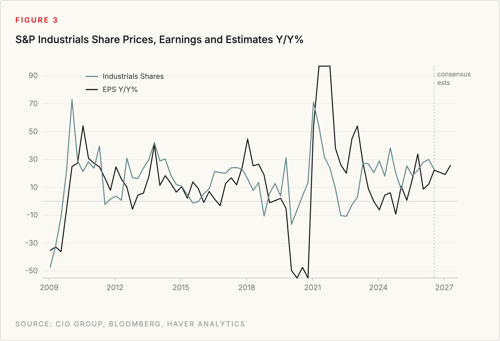
The data we track suggests S&P 500 EPS is rising 15-20% away from semiconductors. This is an historically rapid pace. It does include a 125% gain for the energy sector last quarter.
Excluding-semis and energy, we expect EPS to rise between +13 and 18% year over year, propelling broader equity market gains (Figure 3).
The War Weighs on the Market
Investors have reason to worry again about the global energy supply chain. We believe the US is a standout in its durability. Yet a global adjustment to Persian Gulf energy supply disruptions is still underway.
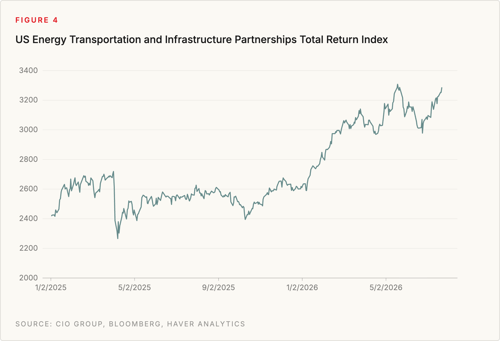
We believe markets should assume the US must enforce security in the Straits of Hormuz for the long-term. This implies near-term disruptions and longer-term steps to bypass the waterway. If so, energy infrastructure and supplies will hold greater value than prior to the conflict (Figure 4).
Consumer spending, in spite of higher energy prices, continues apace. Tracking data for US real consumer spending in 2Q suggest a 3.5% growth. This is strong, and an acceleration from 1Q despite the energy shock.
On the other hand, from the Fed’s point of view, recent progress on inflation is likely to begin reversing by August unless a renewed US/Iran truce takes hold.
Fragile Equity Market Confidence – Especially in Software
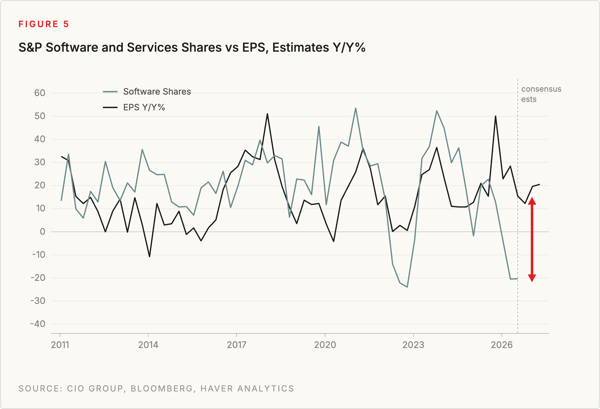
For the moment, the US equity market is trading with confidence in future earnings beyond tech. The most striking divergence between share prices and EPS is actually within the tech sector itself. Software-maker shares have fallen 22% over the past year while EPS estimates show a 15% gain for the full year (Figure 5).
Unlike semiconductors, investors expect AI to cause software profits to shrink. As software and AI are areas of rapid innovation and obsolescence, there is sure to be some disruption. Yet the “gap” between actual increases in profits and falling shares needs to be reconciled. Risk/return for software appear attractive.
Caution over AI Boom Merited
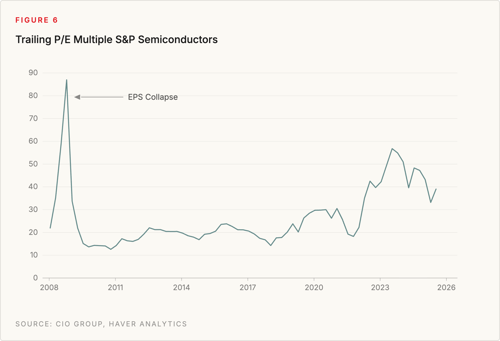
Last week, we highlighted the fact that past bear markets have begun when earnings are unsustainably strong. The 117% EPS gain for semiconductors expected this year, coupled with correcting share prices, has resulted in a falling P/E multiple for the industry group (Figure 6).
With this said, the well above average multiples on “boom time earnings” should still suggest caution on long-term returns for the group at current price levels (Figure 2). This is even as history suggests shares will also reflect strength in profits over the near term.