
Wunderkinds, Wars and Warsh
"You can observe a lot by watching.” -- Yogi Berra
Have you heard of Leo the Wunderkind? Leopold Aschenbrenner was Columbia's valedictorian at 19, joined OpenAI’s research team, and then wrote what many thought was the defining investment narrative of the AI boom. That brilliant thesis, “long AI infrastructure, short legacy software” was on quite a winning streak in 2025 and in 2026 (+400%) -- until it wasn’t (July -80%).
With a reported $45 billion “under management” in his hedge fund at end June 2026 and just a wee bit of leverage (4x), the two-sided, one-way trade unraveled violently last week. Leo’s long positions in holdings like SK Hynix, Nebius, SanDisk, Micron, and CoreWeave went down more than 35%, while his software shorts, reportedly in names such as Adobe[1], reversed their headlong declines of the prior two months. Alarm bells rang all over Wall Street’s margin desks and, shockingly, Ken Griffin of Citadel took Leo out of his misery in one fell swoop.
[1] See CNBC, July 30, 2026
Forgiving Leo
We must forgive Leo. He was just 18 when, in 2021, Archegos Capital Management famously incinerated. Bill Hwang, the former "Tiger Cub" had used total return swaps to build hyper-concentrated, levered positions in ViacomCBS, Discovery and some Chinese tech names including Baidu and Tencent Music. With some $50 billion in positions and under $15 billion in equity, Archegos lost $20 billion in a matter of days, leaving its lenders naked. Credit Suisse alone had losses in excess of $5.5 billion.
Leo’s fund, eponymously named for his famous essay “Situational Awareness” ignored Howard Marks’ basic axiom: you cannot know where the market is going, but you ought to know where it stands.
Booming Revenues and Booming Demand
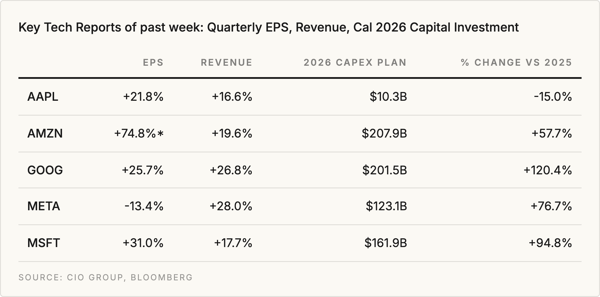
In Q2, the hyperscalers demonstrated awesome growth in revenues. Microsoft saw its fastest rise in earnings in two decades powered by its Azure cloud infrastructure business. Azure saw revenues rise by 43% with guidance for further acceleration to 45% growth next quarter.
Alphabet saw its Google Cloud revenues up 82%. Meta also beat estimates with 28% revenue growth. Amazon saw quarterly net sales exceed $200 billion for the first time and its AWS cloud business had revenue growth of +37% year over year, the unit's fastest expansion since 2021.
In short, there is no doubt that the business of renting out computing infrastructure and services from the hyperscaler’s global network of data centers is truly booming.
Capex Growth Exceeds Expectations, Again
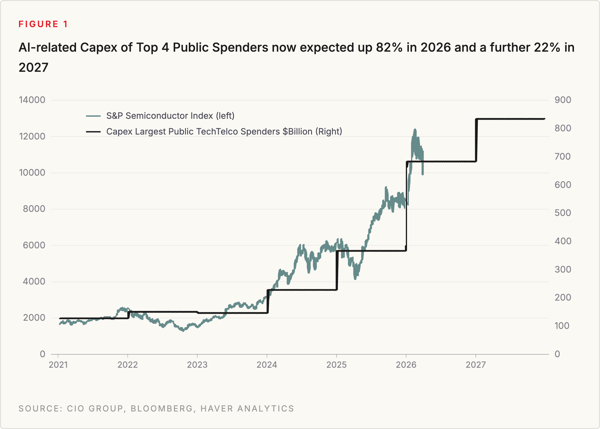
Amazon, Alphabet, Meta, and Microsoft are expected to spend a combined $695 billion on Capex in 2026, an 85% increase over 2025 spending. Most of those dollars are for “compute”, the chips, energy and infrastructure that powers AI. As these firms reported earnings this past week, they also signaled even more Capex spending in 2027. You can see the step function in Figure 1.
Consensus now has hyperscaler apex rising from $384 billion (2025) to $682 billion in 2026, then to $875 billion in 2027. Each of the last four quarters they have reported their intent to spend more than previous estimates. This means that profits for hardware makers are likely to continue to rise into 2027, too. Not exactly the end of the boom.
Yo, Leo
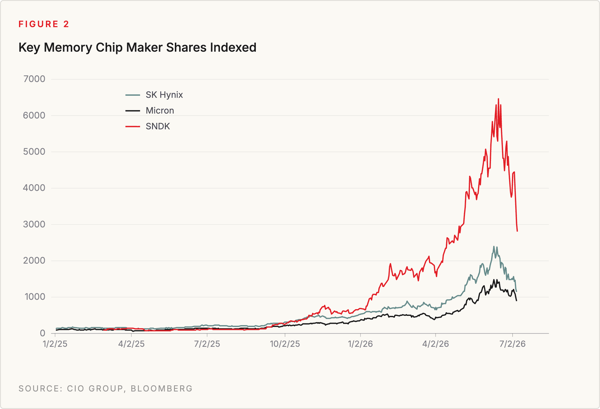
What CIO Group has said repeatedly since the end of 2025 is that the boom in hardware spending cannot go on forever. We noted that DRAM prices and shares had gone parabolic even though their product was largely a commodity. There is a difference between NVIDIA chips and basic memory, yet Micron’s equity performance had caught up with NVODIA in just one year. (Figure 2).
That’s where Leo lost his sense of where markets were. Capital spending is outgrowing the revenue it funds at every company reporting. Nobody wants to be the hyperscaler that underbuilt AI infrastructure. But that doesn’t mean that equities for hardware makers only go up and software shorted shares only go down.
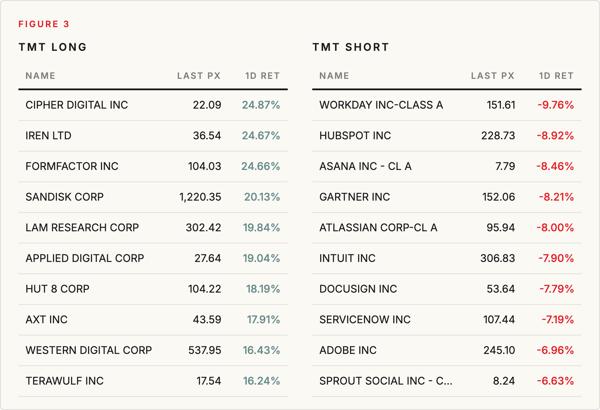
Michael Burry published these two charts to demonstrate how violent the reversal in hardware versus software was after Leo’s implosion. (Figure 3.)
And then there is the War…
Situational Awareness means looking well beyond one’s area of specialization.
The war in Iran took numerous unexpected turns this past week and promises to get only more complex over the months to come.
Fighting resumed after the U.S. military intercepted what it called a "surprise attack" as multiple Iranian missiles were fired at American forces across the Middle East on Tuesday. The conflict widened geographically as Saudi Arabia joined the U.S. in striking Iran-backed militants in Iraq, while Egypt came under fire for the first time via a drone attack on a Mediterranean port.
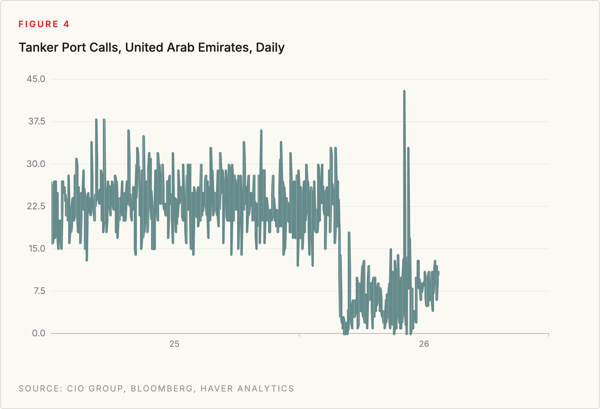
On the maritime front, fourteen countries backed a Saudi proposal for a multinational "Maritime Defense Alliance" to protect shipping and a Qatari LNG vessel transited the Strait of Hormuz for the first time in nearly three weeks. But the economic toll kept building. Transit across the region declined (Figure 4). Oil prices jumped to their highest levels in weeks as the trade route between Africa and the Gulf, which had served as a release valve for crude unable to transit Hormuz, also came under fire.
As the conflict broadened, equities came under fire, exacerbating market volatility in summer’s thin markets.
And then there is the War…
Kevin Warsh also added to Leo’s pain.
Fed Chair Warsh held rates steady at 3.5–3.75% for the fifth straight meeting while declaring "there is no soft inflation target... there's only a target, and it's 2%". … What?
Having abolished forward interest rate guidance, Warsh declined to spell out what would make him raise rates or even explain why the current rate was deemed appropriate. He also declined opportunities to connect his 2% commitment to any concrete action. This lack of information and parameters effectively outsourced inflation-fighting to bondholders. The 30-year yield surged to 5.21%, its highest since 2007, during his remarks.
If there is a credibility shock, it’s self-driven.
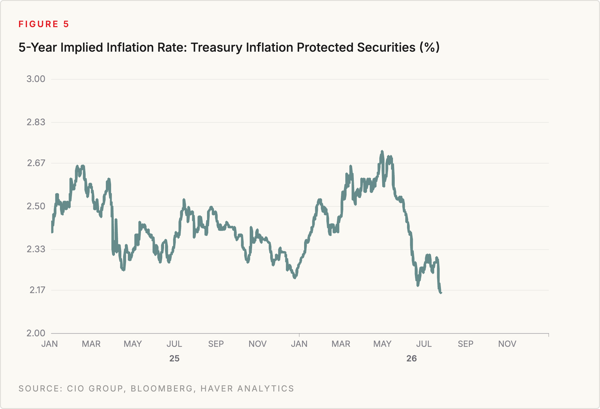
Figure 5 shows that inflation expectations are coming down. The cost of the war is reflected in energy prices, but when the war ends, it is more likely than not that energy prices will normalize and so will the external energy impacts that accompany it.
Aschenbrenner Syndrome
As we enter August, CIO Group believes that markets will remember what Ben Franklin said: "An ounce of prevention is worth a pound of cure." In other words, if you’re going to lever-up, it is best to do so on the defense not offense. That’s especially true at a time of War and Warsh.
Oh, and don’t feel bad for Leo. Rumor has it his fund will survive as a much smaller enterprise with a few billion in Anthropic pre-IPO shares to ease his pain.