Higher Profits Equals Higher Markets for Now
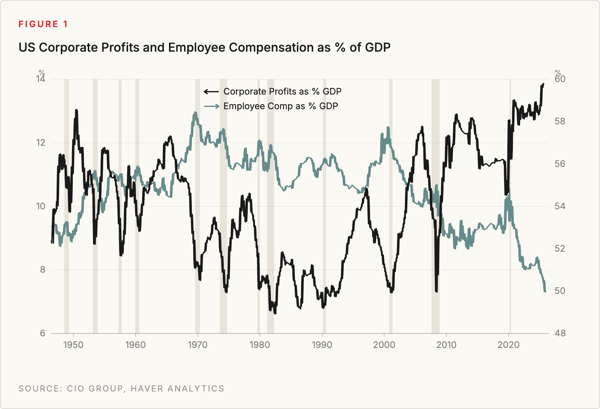
Friday’s labor report came in the dead center of corporate earnings season. As usual, there were some distortions to the July figures. What really interests us is the relative strength of corporate versus labor income (Figure 1). The corporate earnings share was up and labor’s share lower pre-pandemic. Now both are probing new historic records in opposite directions.
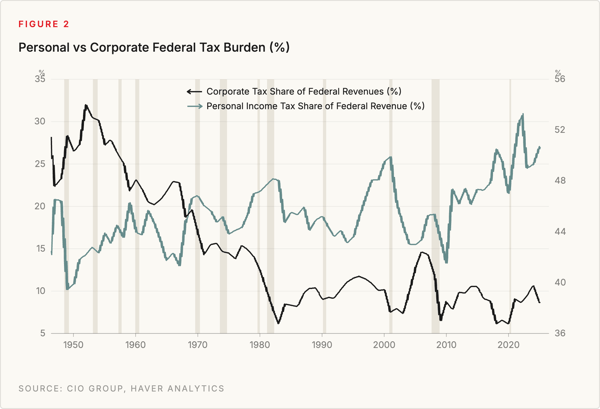
This is likely to get greater attention as election season begins, extending to the Presidential race two years out. Who bears the tax burden will make this even more contentious. The shrinking share of labor income bears a near record high share of the Federal tax burden. Corporate income is taxed ever more lightly (See Figure 2 & Note Figure 1 data are pre-tax).
For US equity investors, faster profit growth exceeding economic growth is critical for the return outlook. Declines in US markets occur when profits fall. But the severe (-50%) declines for US equities in 2000-2002 and 2008-2009 were more than reversed when the structural outlook for corporate profit recovery was strong as has been the case.
Record Profits and Record Share Prices Go Hand-in-Hand
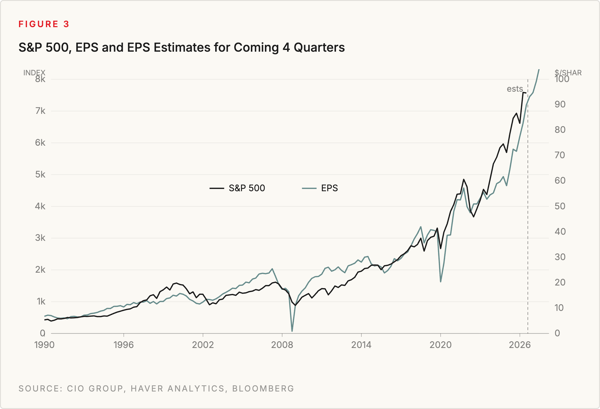
Through most of 1H 2026, CIO Group has maintained a tactical overweight in equities. Our expectation that profit reports would beat estimates, and that estimates for future quarters would rise is key. Declines in profits and share prices are routine, but share prices won’t stray far from actual profits for long (Figure 3.)
Our global diversification has helped our performance, with the total return for broad non-US equities of 26% over the past 12 months vs 23% for the S&P 500. The margin of non-US outperformance was larger in 2025, but is being maintained.
By sector, our overweight in software hurt performance through July, though this has reversed of late as our much larger holdings of cyber-security-oriented shares have rallied 36% YTD.
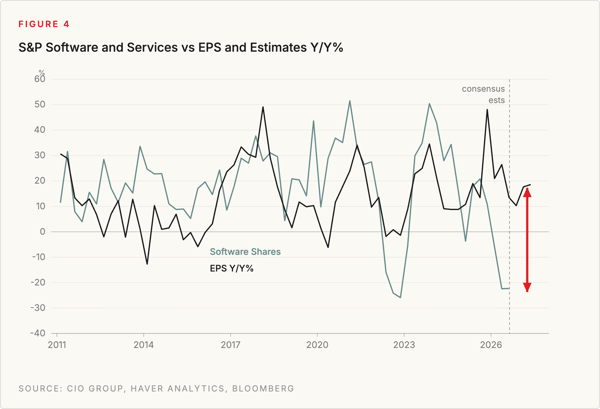
Software Benefits as Profits Exceed Bleak Expectations
It is critical to judge if profit estimates are right or wrong (figure 4) and assess whether shares are following the path of profits or diverging. The underperformance of many applications and system software makers is a signal that investors expect declines in earnings estimates. This has not materialized, leaving the tactical outlook for software attractive (see last week’s Point).
Bonds Are Down, But Not Out
Over the past 12 months, global bonds have returned just 2% versus 24% for global shares. Our underweight to bonds (-4% recently) has therefore helped performance. This is particularly the case in international bonds which have trailed US returns and our underweight is largest.
We would expect that performance gap to narrow some in the year ahead, with equities seeing the larger slowdown in returns while bonds return somewhat more.
The Warsh Factor
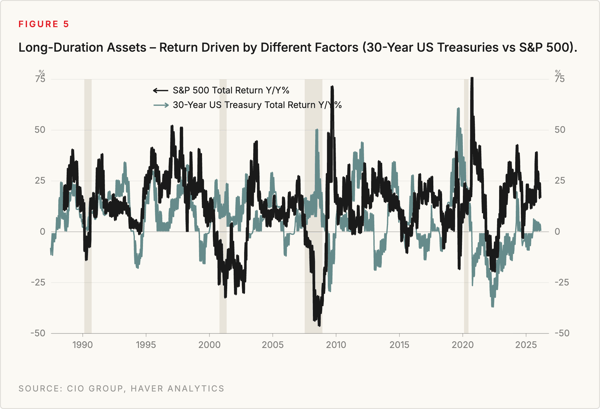
The value of true asset allocation comes when profits are contracting rather than making new records. The longest duration US Treasuries and equity returns over one-year periods have a roughly -40% correlation (Figure 5.). When US equities briefly fell 40% in 2020, the US “long bonds” return was 60%. When US equities fell about 50% in both the early and late 2000s, 30-year Treasury returns averaged a +31% return.
Of course, one does not build a fixed income portfolio solely with the riskiest long-duration securities. But investors do need to be able to shift bond duration out and quality higher as asset allocation tools.
Equities and interest rates don’t always rise. The US’s new Fed Chair may have done investors quite a favor questioning the Fed’s credibility. This has left an asset allocator’s most valuable tool with a cheaper entry point. Bonds have more diversification value thanks to Mr. Warsh.