
Bond Anxiety Rising: Are Bond Yields Too High? Is US Debt Unsustainable?
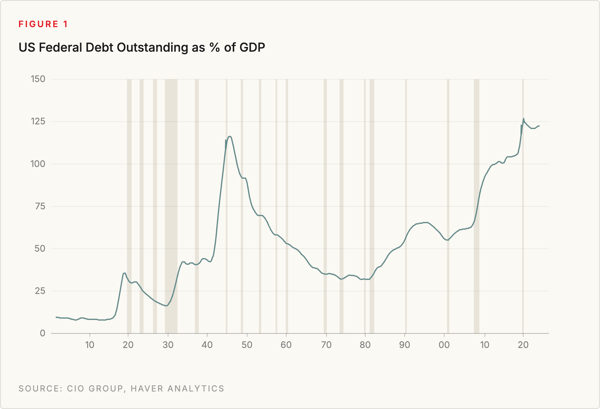
- The US fiscal outlook could be described as “on an unsustainable path” beginning around 1980, with root causes beginning much earlier. There were brief periods of improvement, but a trend of rising debt/GDP accelerated from 2008 on. This now coincides with a gradual worsening of important structural factors, such as age-triggered entitlements.
- The fact that the Fed is contemplating rate hikes from current rate levels is a key bond market issue, along with high uncertainty over how new Fed Chair Warsh intends to conduct monetary policy. His coming speech at Jackson Hole Aug 27-29 is an immediate source of bond market apprehension.
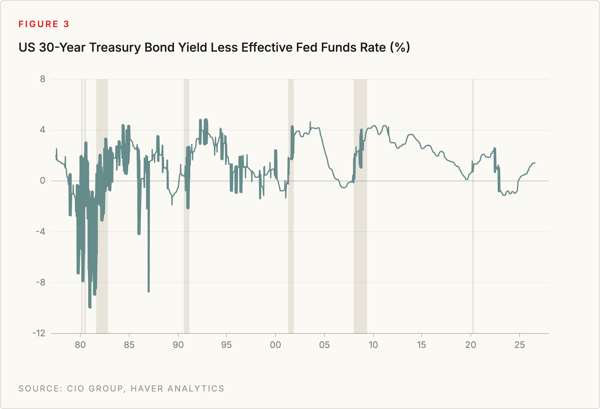
- Solid private and public-sector borrowing at the same time has pushed up yields. With this said, the rise in US government bond yields in 2026 has less to do with huge deficits or US credit worthiness than headlines suggest. Yields have risen globally. The US dollar has held firm, showing no relative loss of global investor confidence. The US 30-year bond yield at 5.25% is close to its average long-term premium to the Fed funds rate of 3.63%.
- Treasury Secretary Bessent’s intervention to buy back longer-dated Treasuries - slightly altering the duration risk of US borrowing - scarcely changes the fundamental picture. It shows a dueling vision for markets between those of the administration and Warsh, who seeks stronger signals for policymakers from market forces rather than central command.
- Bond investors may feel like they are trying to “catch a falling knife.” But for those under-allocated to long-duration Treasuries in broader portfolios, 3% real yields offer true portfolio diversification.
Borrowing Past and Present
In World War II, annual US government borrowing surged to 30% of GDP at the war’s peak. This is far beyond the fiscal emergencies most readers have lived through, particularly the pandemic. The debt/GDP ratio surged to 118% by the end of 1945, from 42% before the war. But unlike the more recent period of fiscal expansion, wartime spending was temporary. Scaled against GDP, US debt shrank sharply from 118% to 35% from 1946-1970 (see figure 1).
Following the post-war recovery, borrowing from the future became a great convenience, a way of life, rather than an exigency.
We would bet the probability of tax cuts is higher than spending cuts in the coming few years.
The rising debt/GDP ratio in recent years reveals that US leadership (and the voting public) is unwilling to dedicate today’s resources toward what it demands. From social insurance payments, to education and defense, the US wants future taxpayers to shoulder today’s spending.
There Is a Fundamental Reason for Today’s Rising Rates
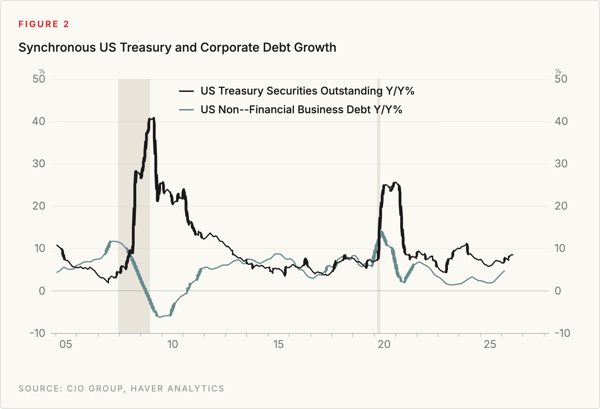
There is a fundamental reason yields are generally rising. Stronger private borrowing for business investment is playing a role, if not the central one. The overall pace of consumer (housing) and business credit growth is moderate. Rapid debt growth for AI infrastructure spending is one component.
What’s unusual is that Federal borrowing is going up at the same time (see figure 2). At a time of 4% unemployment, government spending is not rising to counter economic weakness, it’s simply high and rising while tax collections trail far behind.
Equity Performance May Drive Rates Even Higher
Strong equity return expectations along with rising corporate borrowing needs leave the bond market in a weaker place. Yields might have to rise to a level that restrains the pace of expected growth in the absence of an even larger surge in foreign inflows or drop in domestic savings to finance debt growth.
With that said, the level of US 10-year note yields is about 100 basis points above the Fed funds rate, right at the long-term average. The 30-year bond yield is only very slightly higher than average given the Fed’s policy rate is 3.5%-3.75%. The bond market still prices in a 25 basis point rate hike by year end.
In short, we believe US bond yields are unlikely to move dramatically for the balance of the year, even with trepidations over Chair Warsh.
US Debt Sustainability Is Not Driving Today’s Markets and Yields
We don’t believe investor fears about the future of US credit worthiness is particularly significant in driving rising bond yields this year.
Real yields are rising on a variety of factors including 1) high uncertainty over the path of future Fed policy. This weakens investor confidence in the asset class, even if it doesn’t worsen inflation 2) rising federal and corporate borrowing at the same time, rather asynchronously.
Chairman Warsh Is…
Investors and traders have been building up apprehension over Warsh’s first speech to the annual Jackson Hold symposium of August 27-29.
Fed Chairman Warsh is not the first to question the US central bank’s credibility as an inflation fighter. He is, however, the most important voice on the subject. Markets have been stunned with his words and lack of action.
The uncertainty over how closely the Fed will adhere to its inflation target is a major factor affecting yields. First, Warsh suggested the Fed failed to ensure price stability since the pandemic. Then the FOMC took no action at both June and July meetings.
Warsh’s inflation concerns are not evident in the bond market’s key measures of inflation expectations over any tenor. (Inflation compensation in the US Treasury market is remarkably similar at 2.25% from 5- to 30-years ahead). But Warsh’s inconsistency is evident in broader bond market performance and US exchange rates.
Warsh is a wild card for markets at month-end. We would assume markets will breath a sigh of relief once they’ve digested his message. Traders fear Warsh may have something to prove and have been sharply reducing short-positions in the US dollar since May. For the time being, the overhang of “Jackson Hole” is one of many bond market worries.
Warsh Does Nothing, Then Bessent Steps In
Warsh hopes market participants will do the thinking for themselves about rates and Fed policy. In reality, the US central bank can have a large and lasting impact on global yield levels as seen for decades now.
In complete contrast to Warsh, US Treasury Secretary Bessent has announced $4 billion in long-term Treasury repurchases with the department’s market liquidity facility. This is a pittance compared to private long-duration Treasury holdings of $2.3 trillion. The action merely signals the administration’s willingness to swerve from the market forces Warsh seems so keen on. It’s been demonstrated many times before, with the US seeking stakes in public companies.
You Don’t Have to Be a Bond Bull to Own Some Bonds
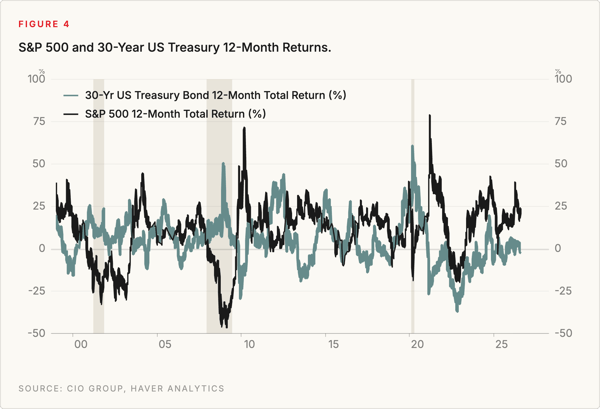
The market repricing of long-term yields is a portfolio issue for the near term. The relative returns of US equities versus 30-Year debt is now 18 percentage points in the year to date (see figure 4). Our current portfolio bond duration averages 4.7 years, below the global benchmark of 6.2.
Yet, as we discussed last week, long duration government bonds are a true diversifier of equity and corporate credit risk, deriving value from very different sources. The opportunity to add this asset, along with cheapening foreign assets, is in the making.
We advise our clients to expect political and legislative challenges over investment taxes in the decades ahead. How the US will meet its immense spending promises for the future is to be seen. If difficult decisions are not made on a bipartisan basis, it is likely one party in control will make decisions that are highly unpopular.
Important Information
This material has been prepared by CIO Capital Group, LLC (“CIO Group”) for informational purposes only and does not constitute investment advice or an offer to buy or sell any security or the solicitation of an offer to buy any security or investment advisory service. All opinions are subject to change without notice. Past performance is not indicative of future results. Investment returns may vary significantly over time. Indexes are unmanaged, are not available for direct investment, and do not reflect the deduction of fees or expenses. This material has been prepared without regard to the specific investment objectives, financial situation, or particular needs of any individual investor.
CIO Group believes that the information obtained from third party sources contained herein is reliable, but no representation or warranty is made regarding its accuracy or completeness. CIO Group accepts no responsibility or liability (including for indirect, consequential, or incidental damages) for any error, omission, or inaccuracy in such information and for results obtained from its use.
Certain information contained herein constitutes ‘forward-looking statements’ which are based on current expectations, estimates, projections, and beliefs. Forward-looking statements are subject to risks and uncertainties that could cause actual results to differ materially. Any forecasts, projections, estimates, or market expectations are based on current assumption and should not be considered guarantees of future events or investment results.
References to portfolio positioning, asset allocation, sectors, or investment strategies reflect CIO Group's views as of the date of publication and should not be interpreted as recommendations to purchase or sell any particular security or investment strategy.
CIO Group is an investment adviser registered with the SEC. Copyright ©2025 CIO Group. All rights reserved.