
With the news that the US economy added 162,000 jobs in August, the Fed lost another reason to stay on pause. The decline in jobs reported for July was also erased with these upward revisions. And in Warsh’s thinking, the news that inflation slowed over the past two months doesn’t erase a long stretch of inflation above the Fed’s target.
Following Friday’s robust jobs data, Fed funds futures price in a 62% chance of a 25 basis point rate hike on September 16. This would mark the possible start of a new Fed hiking cycle, reversing the modest cuts of 2024-2025. Ironically, the sources of inflation, including Trump-led tariffs, associated trade disruptions and the Iran War will not matter much to Warsh and company.
The fact that Chairman Warsh doesn’t believe the Fed should strongly signal its intentions makes it unlikely markets will price in a high level of certainty about the outcome of the FOMC meeting. Action will “make us believers.”
Fed Hikes Now Will Be Modest…
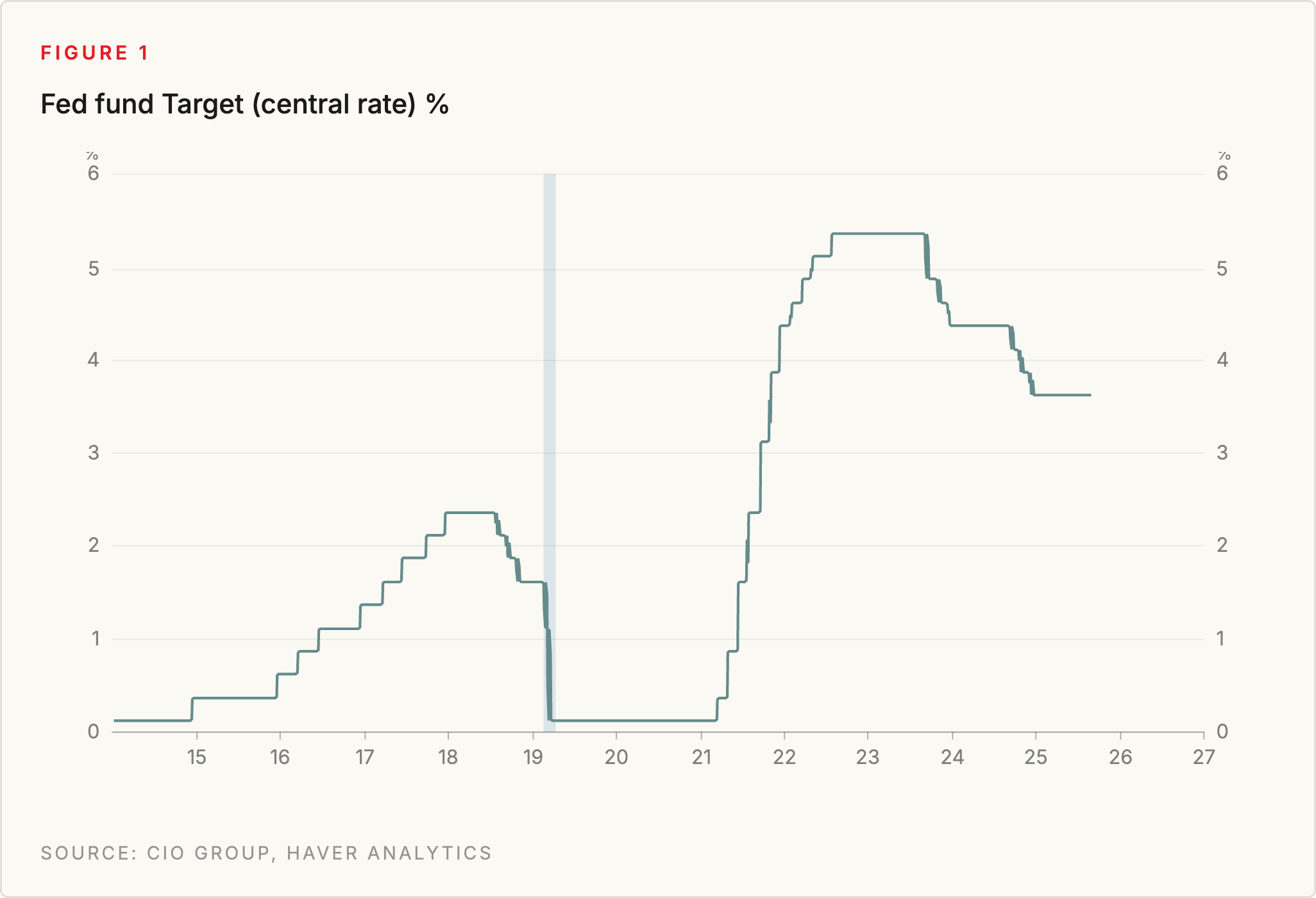
Markets currently price 50 basis points of hikes to a 4.25% upper rate peak during the year ahead. This seems a modest expectation given the state of inflation and the broader outlook for the economy. (Figure 1.)
A larger “correction” to the Fed’s 2020-2022 policy mistake was already made by former Chair Powell, who hiked US policy rates from near 0% to 5.5% at peak. The Fed’s subsequent decision to ease to 3.5%-3.75% helped preserve the current economic expansion.
The slowdown in post-pandemic inflation was too gradual for Warsh as he outlined at Jackson Hole a week ago (please see last week’s Point).
Higher Rates Do Not Suggest an Immediate Economic Derailment
If Warsh’s Fed hikes rates the President will not be amused. President Trump attempted to fire Powell for failing to cut interest rates further than he did. He installed Fed Governor Miran apparently to drive rate cuts and looked for a time to add additional rate-cut sympathetic officials before nominating Warsh. Future disharmony is a strong possibility.
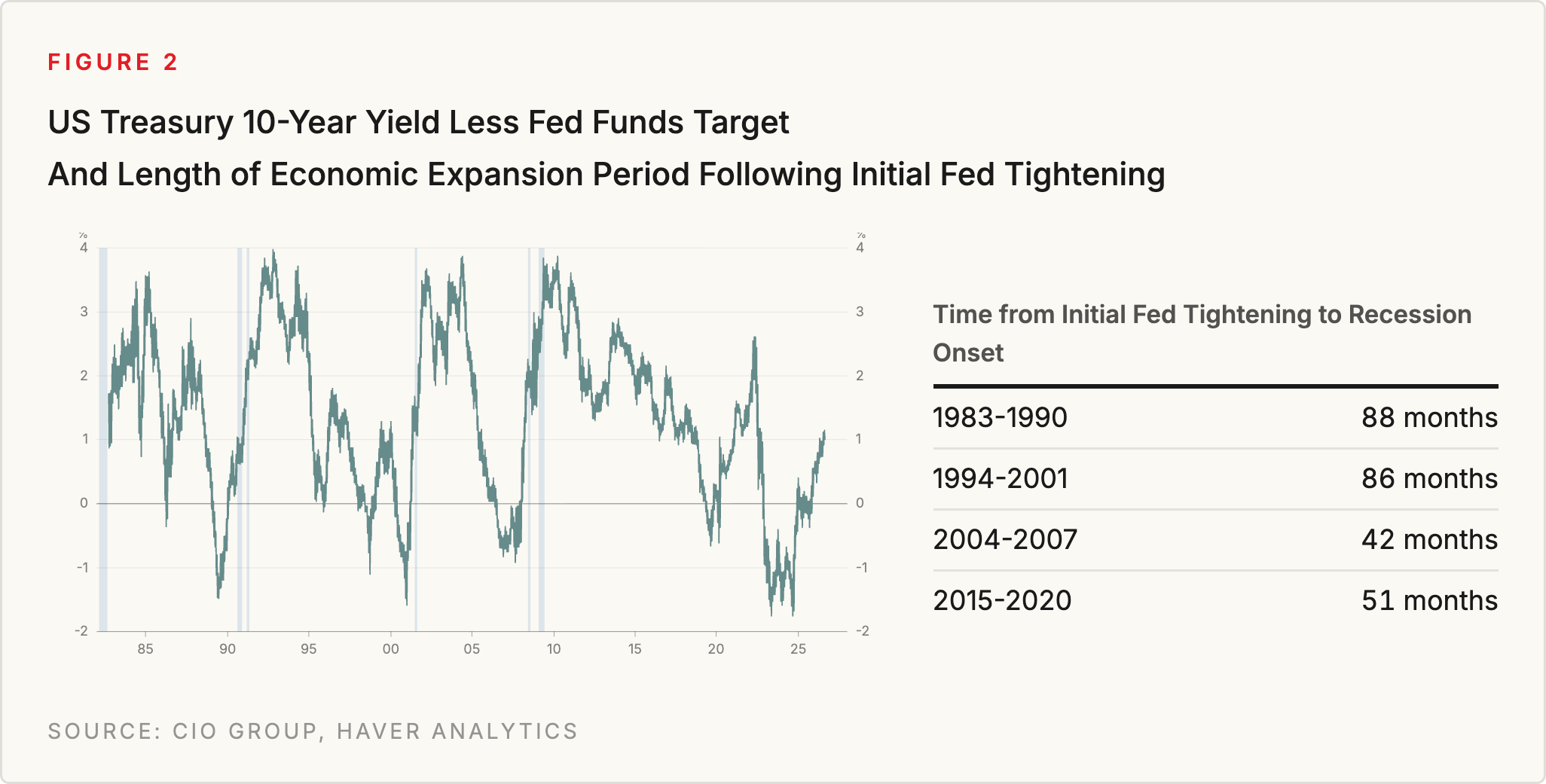
In our view, history suggests the Fed is unlikely to derail the economy with modest rate hikes from current levels. Rather, it’s the future economy that will eventually send the Fed on a different trajectory.
Not since the Fed deliberately induced recessions in 1980-1982 has a firming of US monetary policy driven a contraction in the economy rapidly. Unlike 1982, the Fed’s policy rate is not 14%, well in excess of the nominal rate of expansion in the economy. And the Fed is not presently restrictive. It has not made cash a more attractive return opportunity than the returns the economy generates.
The Fed is the Economy’s Demand Regulator
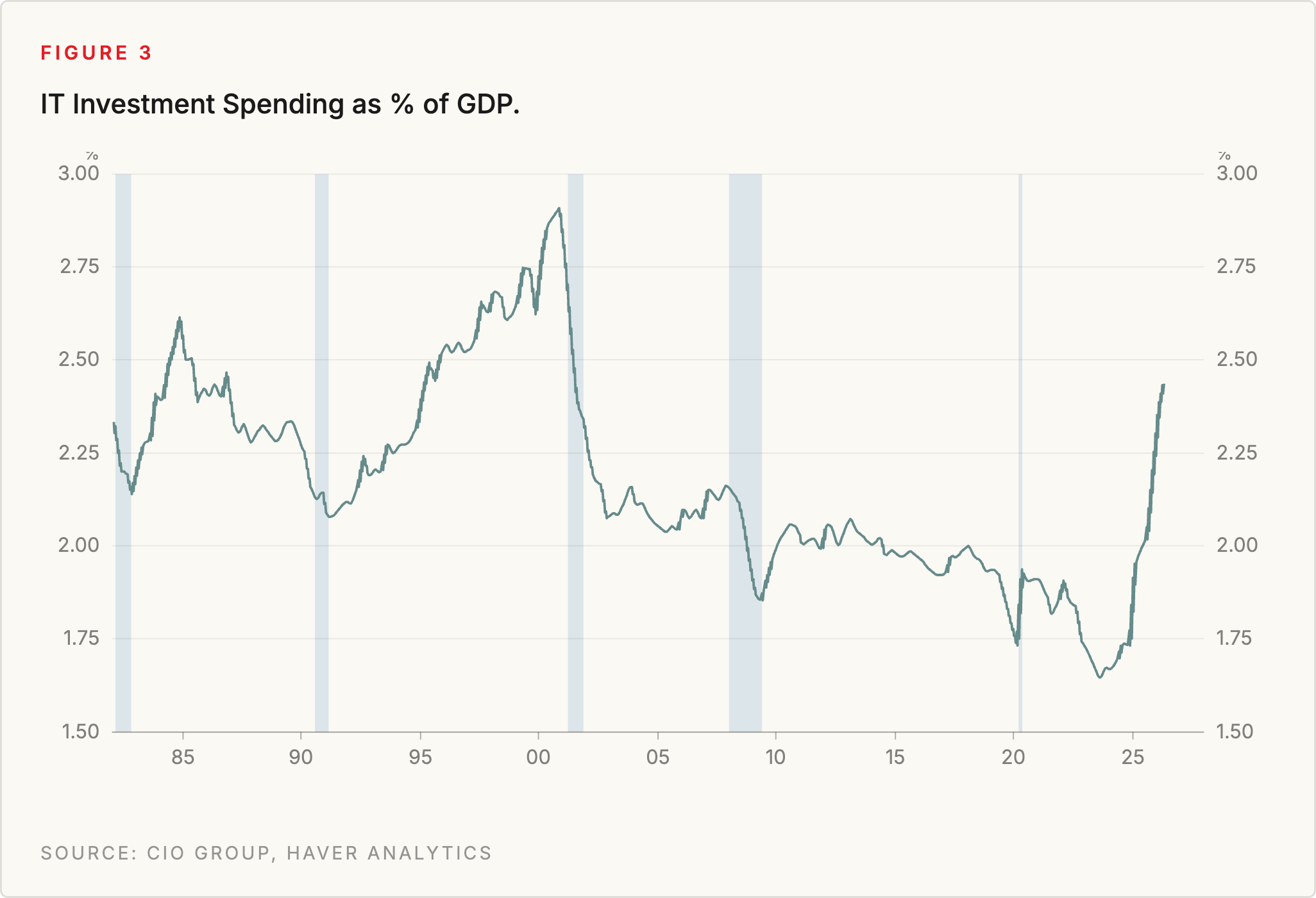
Unfortunately, the Fed’s policy rate “catch up” is not the greatest risk to the economy. The key issue is the future course of investment spending, just as it was in the 1990s expansion that ended in 2001 (Figure 3). Investment in IT equipment is directly responsible for driving 40% of US economic growth in the past year. IT’s 65% growth rate for the past 2 ½ years may continue for the coming year but cannot be sustained far longer. With the completion of data centers, spending will certainly fall, perhaps meaningfully in 2028.
At that time, the Fed funds rate may be too high for expansion to endure without rate cuts. So many financial and real economic variables are aligned with this spending. Only a marked broadening of the sources of expansion would prevent a severe economic slowdown at that time.
The Fed cut its policy rate from 6.5% to 1.0% from 2001-2003. Tech-focused investors of the day lost the majority of their portfolios in the tech wreck. We don’t believe events must follow the exact same course. However, investors do need to understand that the Fed did not cause the excessive optimism in tech investments of the time and it didn’t bring about their end. The Fed also did not stop the bubble and bust from occurring with its subsequent rate cuts.
CIO Group’s Portfolio Actions
Today, investors should understand the economy’s strengths and vulnerabilities and take advantage of policy developments. On Monday, August 31, CIO Group raised its allocation to short-duration US fixed income 1% across portfolios, moving US equities lower by an equal amount.
With the US dollar boosted by Fed-related developments, we have stayed modestly underweight non-US equities and now neutrally positioned globally. During a period of future US rate cuts – which are unlikely in the coming year – we would look to adjust up our share of non-USD assets in portfolios.
Important Information
This material has been prepared by CIO Capital Group, LLC (“CIO Group”) for informational purposes only and does not constitute investment advice or an offer to buy or sell any security or the solicitation of an offer to buy any security or investment advisory service. All opinions are subject to change without notice. Past performance is not indicative of future results. Investment returns may vary significantly over time. Indexes are unmanaged, are not available for direct investment, and do not reflect the deduction of fees or expenses. This material has been prepared without regard to the specific investment objectives, financial situation, or particular needs of any individual investor.
CIO Group believes that the information obtained from third party sources contained herein is reliable, but no representation or warranty is made regarding its accuracy or completeness. CIO Group accepts no responsibility or liability (including for indirect, consequential, or incidental damages) for any error, omission, or inaccuracy in such information and for results obtained from its use.
Certain information contained herein constitutes ‘forward-looking statements’ which are based on current expectations, estimates, projections, and beliefs. Forward-looking statements are subject to risks and uncertainties that could cause actual results to differ materially. Any forecasts, projections, estimates, or market expectations are based on current assumption and should not be considered guarantees of future events or investment results.
References to portfolio positioning, asset allocation, sectors, or investment strategies reflect CIO Group's views as of the date of publication and should not be interpreted as recommendations to purchase or sell any particular security or investment strategy.
CIO Group is an investment adviser registered with the SEC. Copyright ©2025 CIO Group. All rights reserved.