
There is a Wall Street axiom worth noting this week. “How do you know when markets have peaked? The day after.”
We expect soon-to-be released third quarter earnings results to be strong and exceed most analyst expectations. And we expect that the noise of mid-term elections and the unstable and arguably dangerous state of Mideast politics will add volatility and drama.
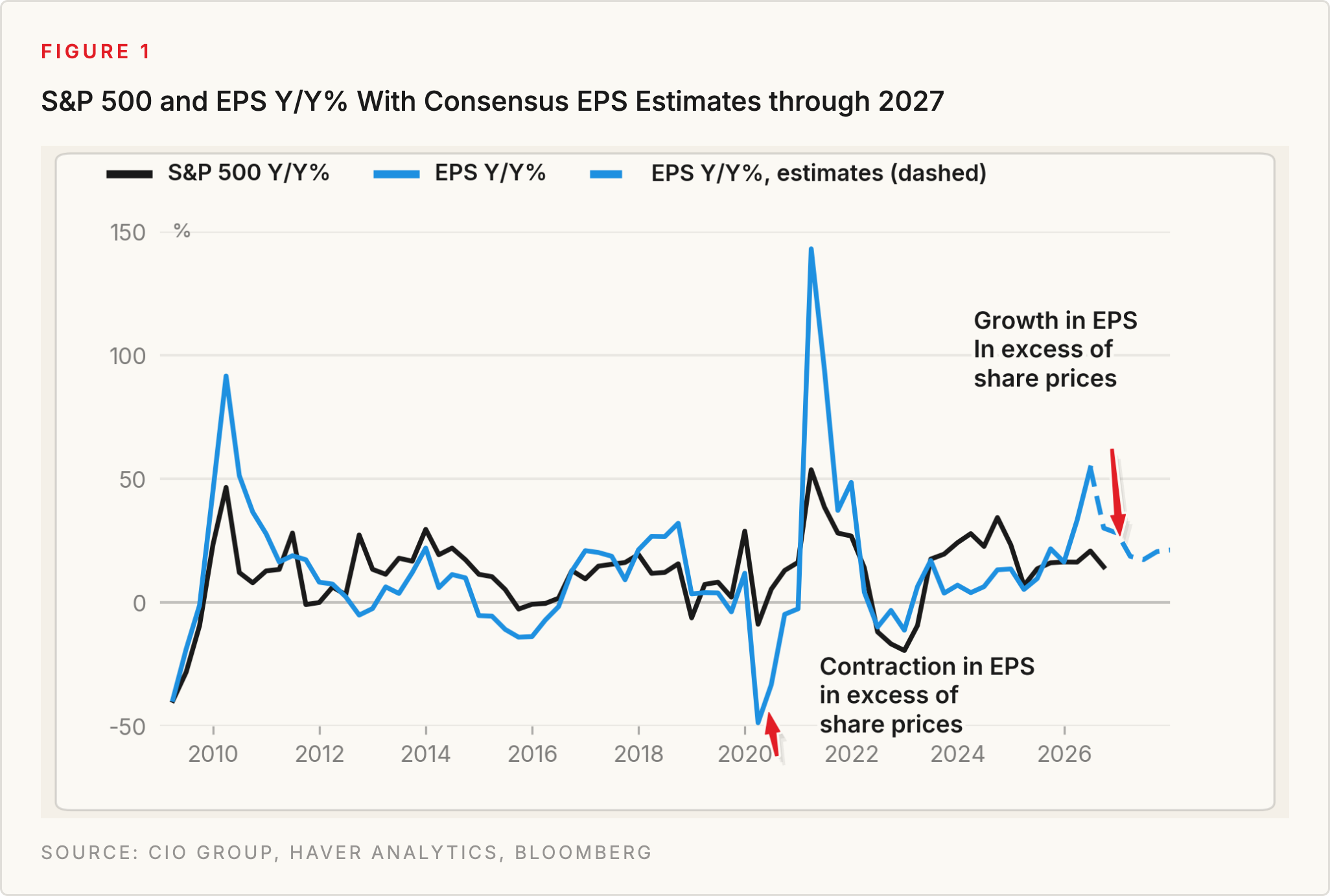
Meanwhile, there is no doubt but that equity markets have lost momentum. Though US shares, led by tech, briefly made a new record high last week, the 16% rise in the S&P 500 market cap weighted index over the past 12 months (10% for equal weight), trails behind the 30% gain in EPS over the past year. The rise in interest rates, and to some degree, other risks, has caused US equity valuations to contract.
This pattern of higher rates, a strong economy and shrinking valuations speaks to our view that “While we are still in a bull market regime, it is certainly aging.”
The Fed may entice us to the sidelines with increasingly attractive yields on short-term US Treasuries. (Note to banks: I haven’t heard about your new, higher deposit rate). But nothing beats rising corporate profits as a driver of higher share prices.
Pause in Short-Term Yield Pressure
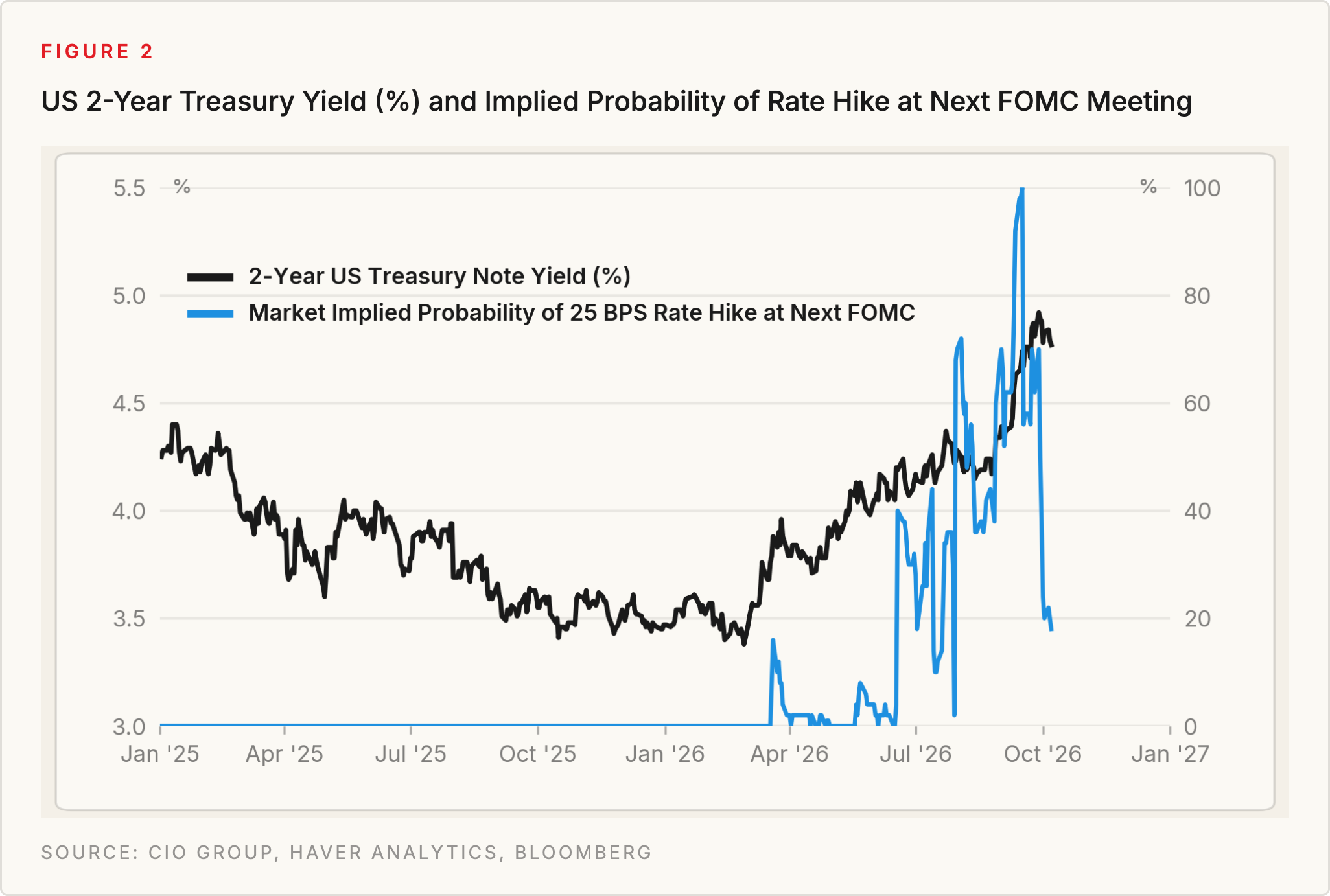
While long-term rates continue to climb globally, the two-year US Treasury yield has fallen about 12 basis points from its most recent high. With employment growth for the third quarter of just 54K per month and core inflation rising 2.0% annualized, markets now price just a 20% chance of a rate hike at the Fed’s October 28 FOMC meeting.
Crude oil, the largest headline price driver across the world today has vacillated around $100 globally. This is being driven by continued threats of renewed conflict across several critical fronts. Nonetheless, oil hasn’t breached the $118 peak it reached at the end of February. This is consistent with our “crisis price overshoot” thesis - the supply of oil is ample, it’s the ability to ship it safely that is impaired.
Hawks are hawkish. Doves are dovish. Higher highs are harder.
The “big picture” is still generally bullish for the coming year. This is even as Fed Chair Warsh is likely to lead further tightening in US monetary policy regardless of any calm on the inflation front in our view. The new Fed chair says he doesn’t look to recent data to guide policy. Despite the market’s recent judgment, Warsh’s comments uniformly suggest he believes monetary policy is too “easy” for inflation to return to the Fed’s target in a lasting way. Some further rate hikes are likely sooner or later.
Reasons to Stay Bullish, but Maintain a Neutral Asset Allocation
In the second half of the 1990s, before anyone considered issues like the insolvency of social security as more than a thought experiment, 10-year US Treasuries rose as much as 250 basis points. Despite fears of the “Y2K” bug, the 10-year yield began 2000 above 6.5%.
Yet, equities rallied as time and again, rising corporate profits outweighed rising yields during earnings expansions. Conversely, however, contracting profits have been a powerful signal to both policymakers and the bond market, pushing down yields.
How well AI services providers are investing for the future; how well they understand their future competition, including technological changes to come, remains a critical open question. Each of the past few quarters has continued a pattern of increasing plans for 2027 capital expenditures on AI infrastructure by the leading spenders. This cannot go on forever, or even for the next 2 years.
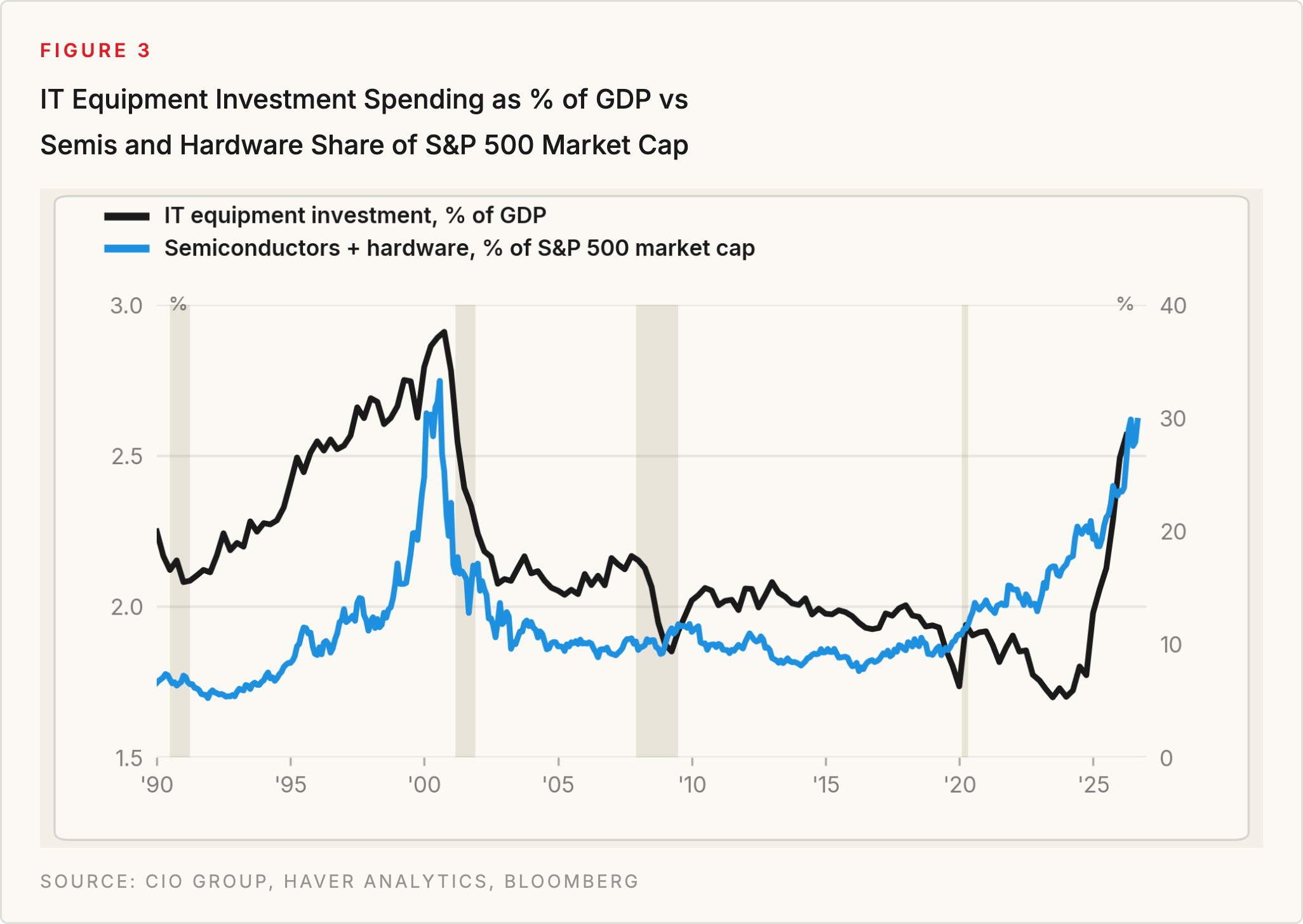
Reflecting the boom, price increases for scarce components such as memory chips have rarely been as strong in more than 40 years, raising the cost for data center projects to be completed. It is also raising the cost for basic consumer products like handsets. Yet the history of the late 1990s internet buildout - our closest analog - suggests further gains in earnings are quite possible (see figure 3).
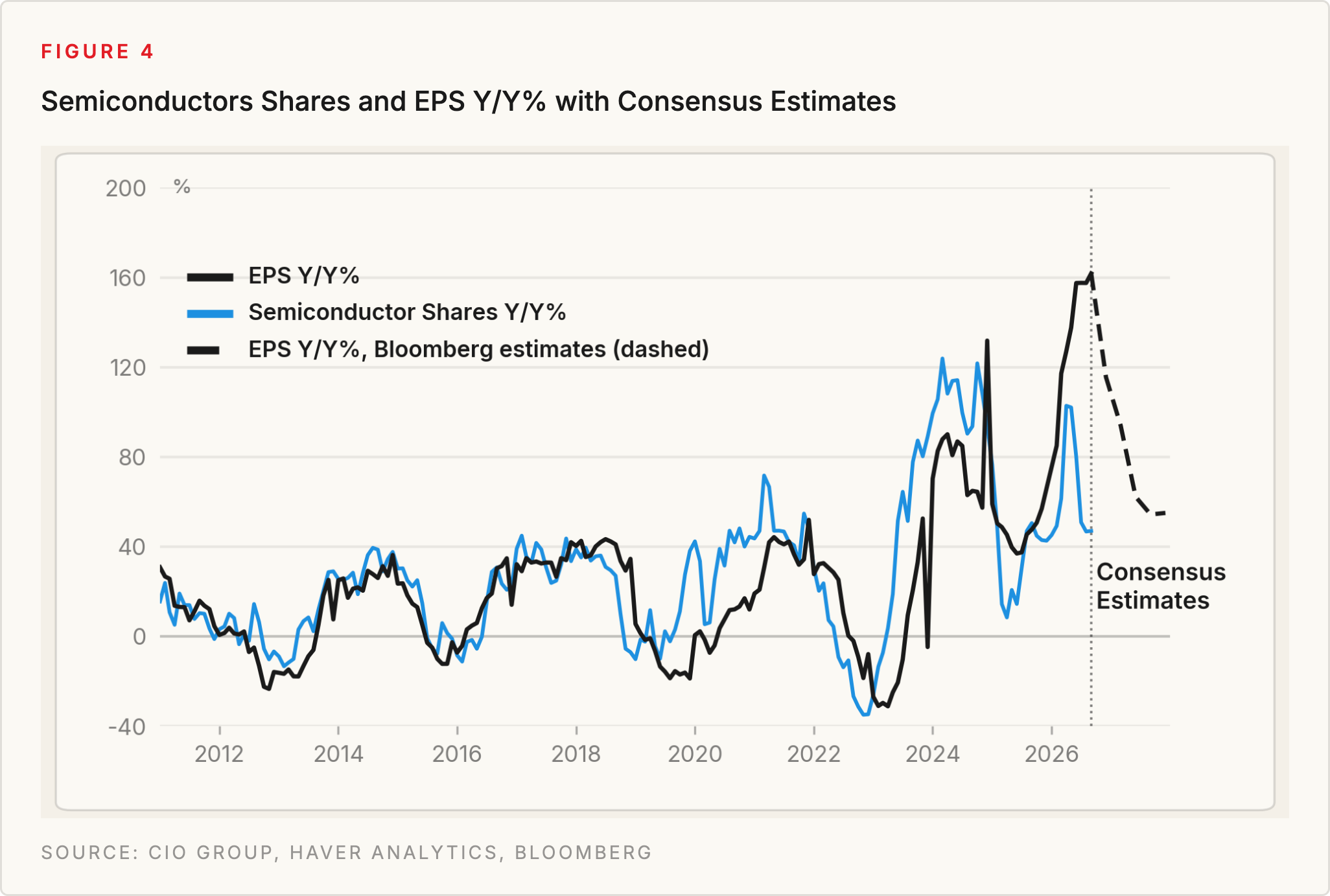
Most convincing are the projections of the spenders themselves and guidance from Nvidia, which expects revenue in 2027 to rise 70%. If so, upwardly revised expectations for semiconductor EPS at +63% for 2027, may be exceeded. Even meeting their current growth rates would likely drive shares to new records, as shares have jumped less than their earnings and revised estimates have climbed (see figure 4).
A Coda and then, the End
Most historical business cycles were routine. Contractions in production and employment came from overestimating demand, “overbuilding inventories” and cutting sharply to correct. These were quite self-correcting, during much of the 19th century and the decades after World War II. In expansions, growth in production and employment had to accelerate faster than consumer spending to catch up with demand following recessions.
Yet, as goods production became less profound to the health of the economy, less frequent drivers of boom and bust now stand out more. These included financial bubbles of great magnitude and real investment booms.
The most recent of these include the Internet boom of the 1990s and the housing boom of the 2000s. When it became clear that investment (tech or housing) had risen to great excess and many of those financing the boom would not be repaid, busts followed (see figures 5-6).
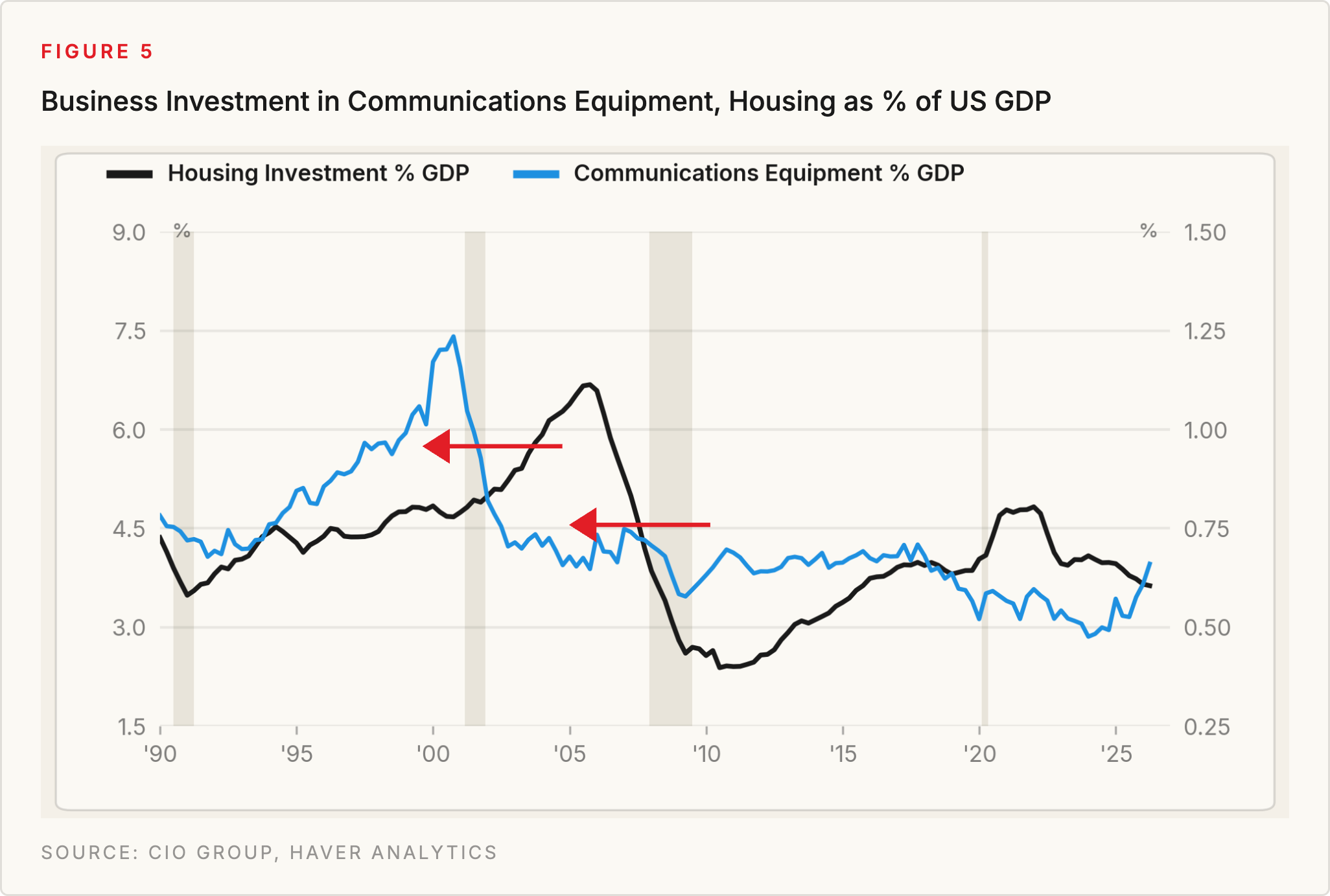
Today’s hyperscalers are far more profitable and solvent than late-1990s internet firms and there are many different scenarios for how today’s investment boom might unfold.
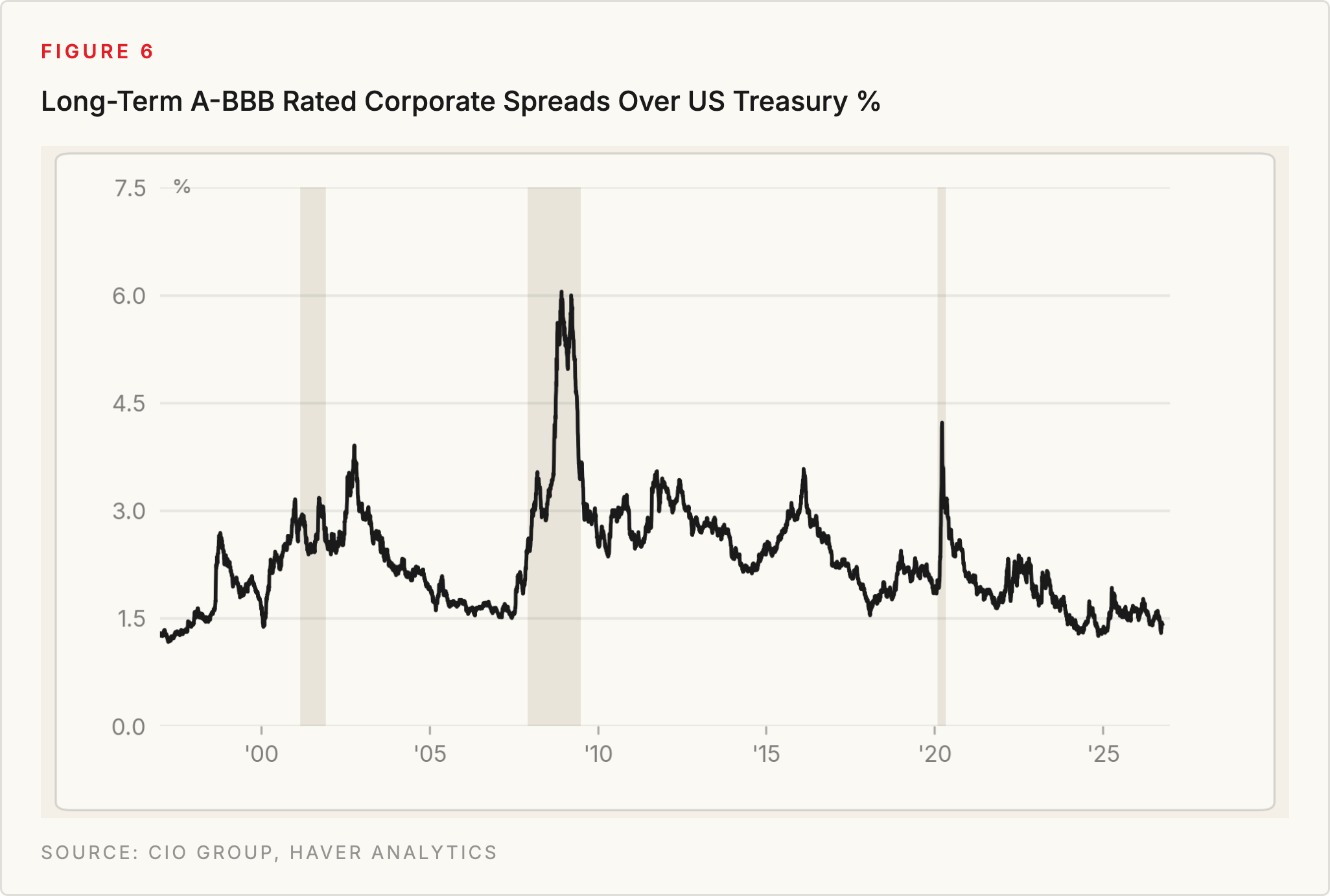
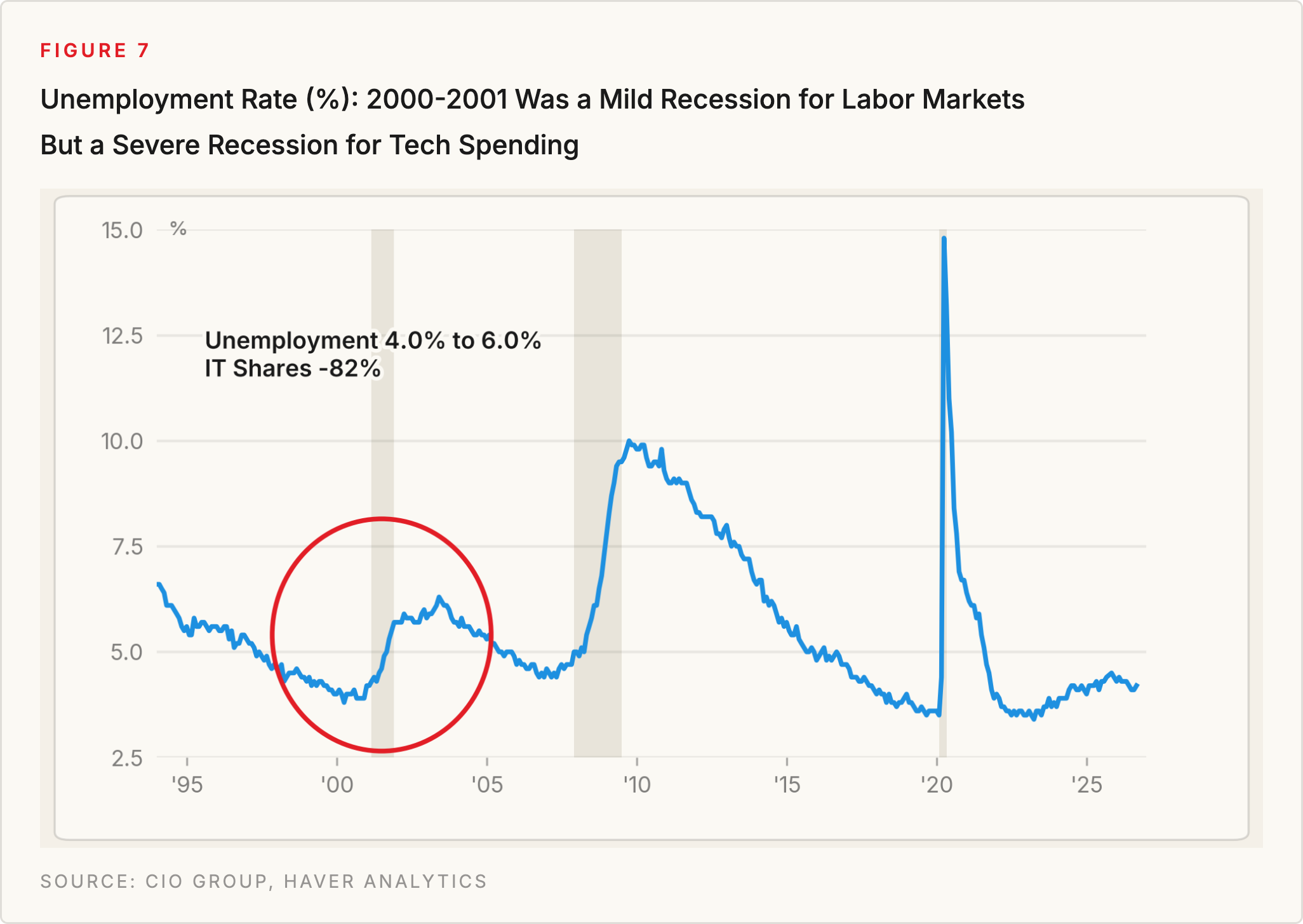
But the 2001 recession is still highly instructive. Today’s business spending on data centers slightly eclipses the spending during the internet boom. Neither today’s spending, nor the 1990s case, was as profound as the housing bubble and its impact on the economy and banking system. Yet even the mild recession of 2001 was coincident with a 50% decline in US share prices and 80% decline in IT sector shares over two years (see figure 7).
This is what we must prepare for. While we do not know the extent to which equities will retrench, we believe a contraction is inevitable.
Equity Risk Absorber
AI booms end. And there is no way the infrastructure buildout of AI has been planned with precision.
Even if hyperscalers have made highly prescient and economically efficient investments in data centers and the industry rewards centralized data processors, the leap of the past few years does not need to repeat in full. This is even as we expect all the microprocessors now filling data centers to be obsolete (needing replacement if in operation) in 3-5 years.
Bonds are An Equity Opportunity Cost, But Also a Hedge That Pays You
We do not know how far markets may dip, nor do we know the start of that dip. US equities have fallen about 50% three times in the last 53 years. Subsequently, equities went on to generate the world’s strongest asset class returns while taking seven years (in all three cases) to return to their prior peak price level.
Do not be surprised if this pattern holds.
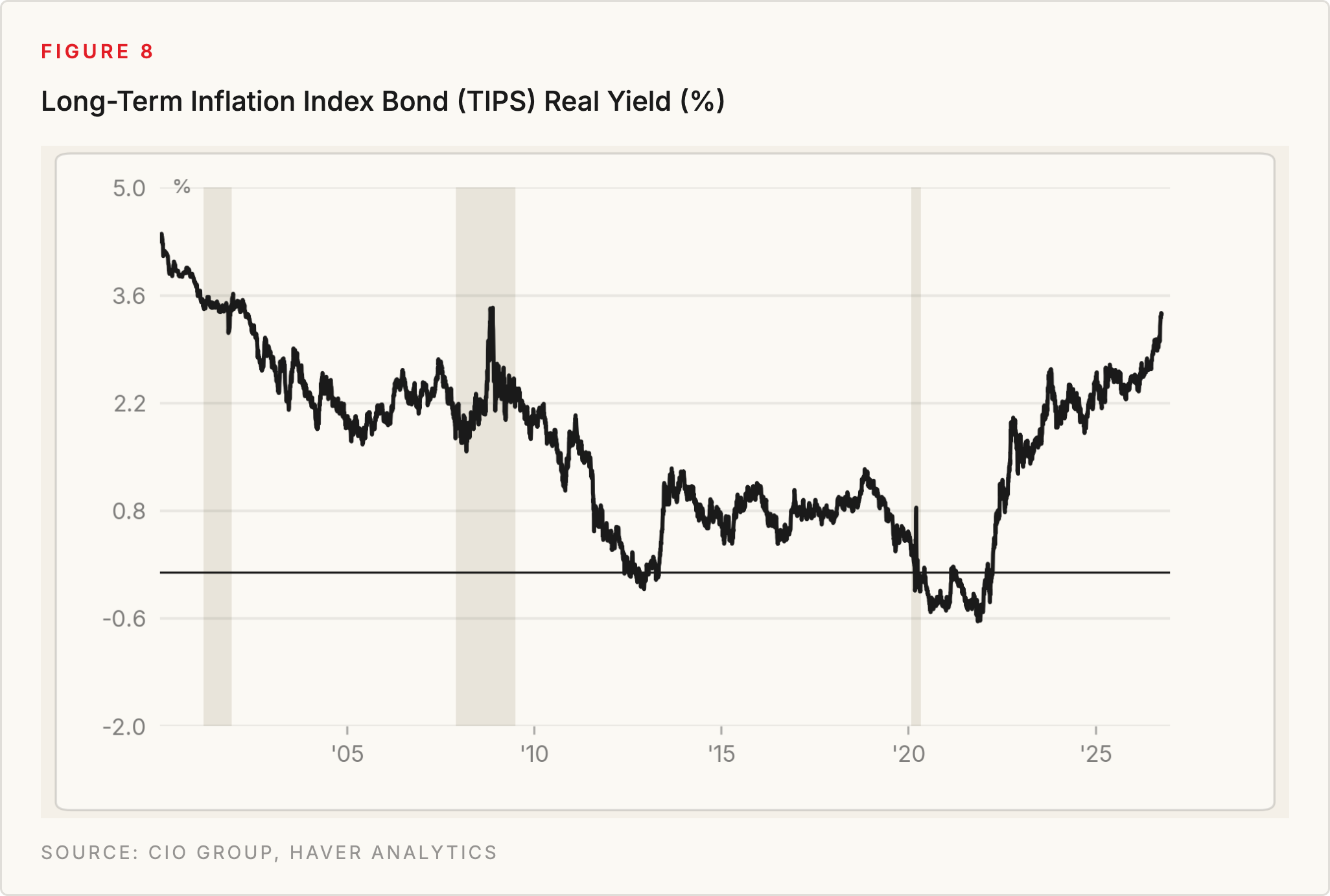
Today, we believe investors fail to see how much better positioned the bond market is to act as a risk absorber when the next equity bear market unfolds. As figure 8 shows, today’s bond yields again most closely resemble those of the late 1990s period. Yields are rising in part because of the strength of business borrowing/investment.
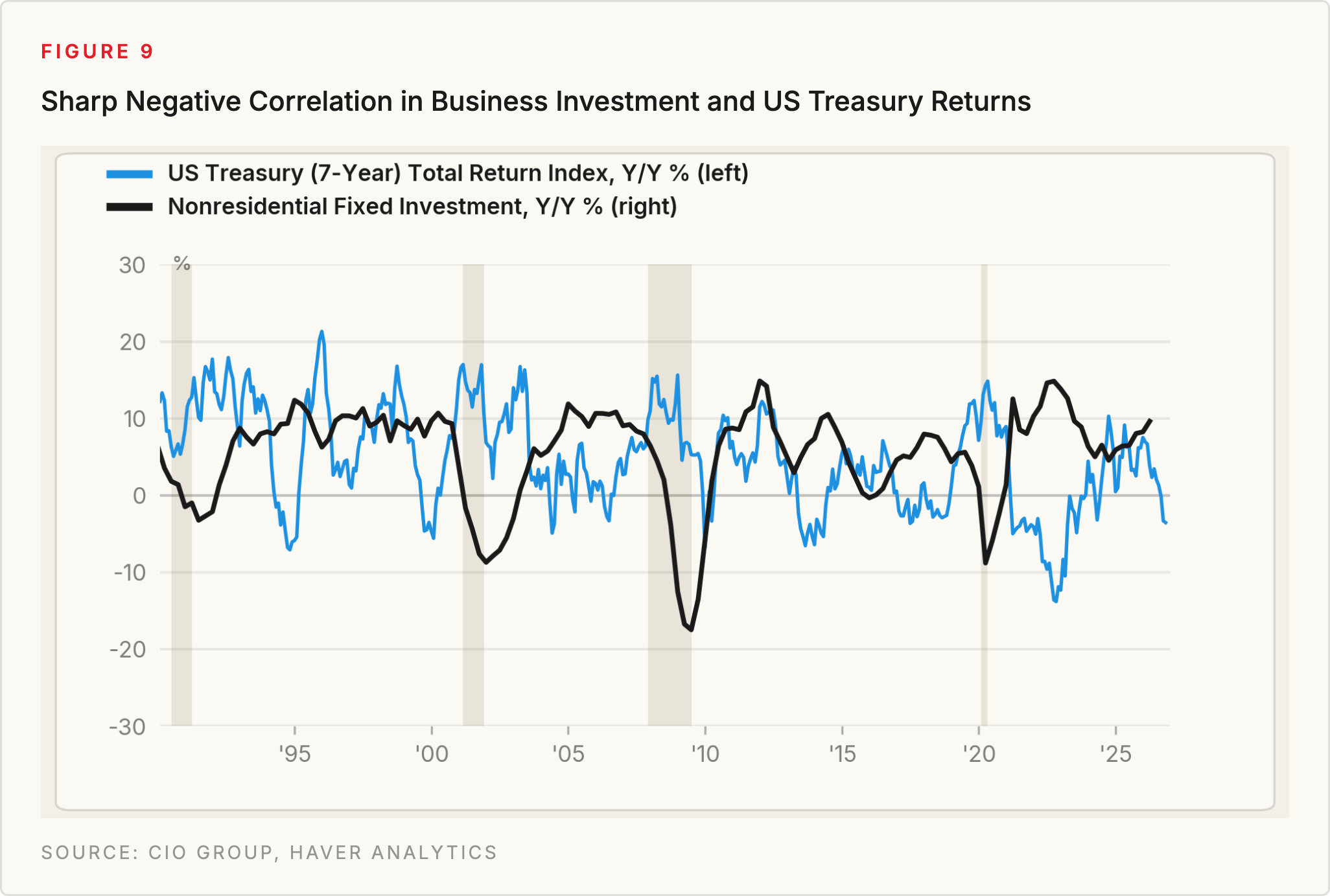
History shows the periodic retrenchments in business investment drive plunging bond yields and soaring prices for the highest quality bonds (see figure 9). This may not happen over coming months. But this is exactly what portfolios will need when the time comes.
Important Information
This material has been prepared by CIO Capital Group, LLC (“CIO Group”) for informational purposes only and does not constitute investment advice or an offer to buy or sell any security or the solicitation of an offer to buy any security or investment advisory service. All opinions are subject to change without notice. Past performance is not indicative of future results. Investment returns may vary significantly over time. Indexes are unmanaged, are not available for direct investment, and do not reflect the deduction of fees or expenses. This material has been prepared without regard to the specific investment objectives, financial situation, or particular needs of any individual investor.
CIO Group believes that the information obtained from third party sources contained herein is reliable, but no representation or warranty is made regarding its accuracy or completeness. CIO Group accepts no responsibility or liability (including for indirect, consequential, or incidental damages) for any error, omission, or inaccuracy in such information and for results obtained from its use.
Certain information contained herein constitutes ‘forward-looking statements’ which are based on current expectations, estimates, projections, and beliefs. Forward-looking statements are subject to risks and uncertainties that could cause actual results to differ materially. Any forecasts, projections, estimates, or market expectations are based on current assumption and should not be considered guarantees of future events or investment results.
References to portfolio positioning, asset allocation, sectors, or investment strategies reflect CIO Group's views as of the date of publication and should not be interpreted as recommendations to purchase or sell any particular security or investment strategy.
CIO Group is an investment adviser registered with the SEC. Copyright ©2026 CIO Group. All rights reserved.