
Jensen Huang is gone, and with him, the leadership of the most important sector in the global stock market is forever changed. Nvidia’s numerous acquisitions, ownership interests, financing commitments and cumulative power to force companies to make decisions favorable to Nvidia will create conflicts and complexities for the whole industry.
Nvidia stock opened down 13.1% on Thursday and is down 33.1% since its peak. The SOXX semiconductor index opened down 3.3% on Thursday and is 32.9% below its June peak (prices as of 10:52 ET, November 13).
The Spy’s Take Down
CIO Group hates idiosyncratic single-company risk. Why? According to Standard and Poor’s, over a 35-year span, 94% of active US equity managers failed to beat their benchmark. These managers invest enormous time researching companies, meeting executives and understanding industry dynamics to choose stocks, to pick winners and losers. Yet, they fail to beat their chosen benchmark or index.
It is possible, in our view, to generate incremental portfolio returns by over and underweighting portfolio elements. Single companies taken together can form an industry or sector. At CIO Group, we allocate more or less of our clients’ capital to industries that have stronger or weaker growth characteristics. We calibrate these choices using valuation as a primary guide. Valuation is one assessment of whether investors are overly optimistic for the industry’s prospects or too pessimistic.
Jensen Huang’s Ballroom
Industry concentration risk is a particularly thorny issue, as within semiconductors there are two compounding risks. The latest news about Nvidia CEO Jensen Huang’s resignation highlights this. At its peak, Nvidia was worth about 5.3% of the entire global equity market. Nvidia’s market cap was larger than many significant country markets including the UK or Canada. Along with Microsoft and Apple, the trio was worth more than all the shares of companies listed in either Asia or Europe.
The fact that the three firms’ profits represent an unusually high share of total world profits makes the “industry risk” greater. As we’ve highlighted (see EP 56), the correlation of many industrial and energy businesses to the buildout of AI infrastructure effectively means that the US equity market is presently behaving as a “tech bet” overall.
King, No King
Jensen Huang’s paramount importance to Nvidia and the AI industry beyond Nvidia is indisputable. He’s been called “the Sorcerer of Silicon” by The Economist for both leading the market in AI chip penetration and for enabling the wider ecosystem that will bring AI to the world. Jensen Huang’s lobbying for relaxed export controls on AI chip sales to China will now become a political factor that could influence US/China relations and trade. It has already drawn the scrutiny of key members of the Trump administration. In our view, the industry and political dynamics have shifted meaningfully and perhaps forever.
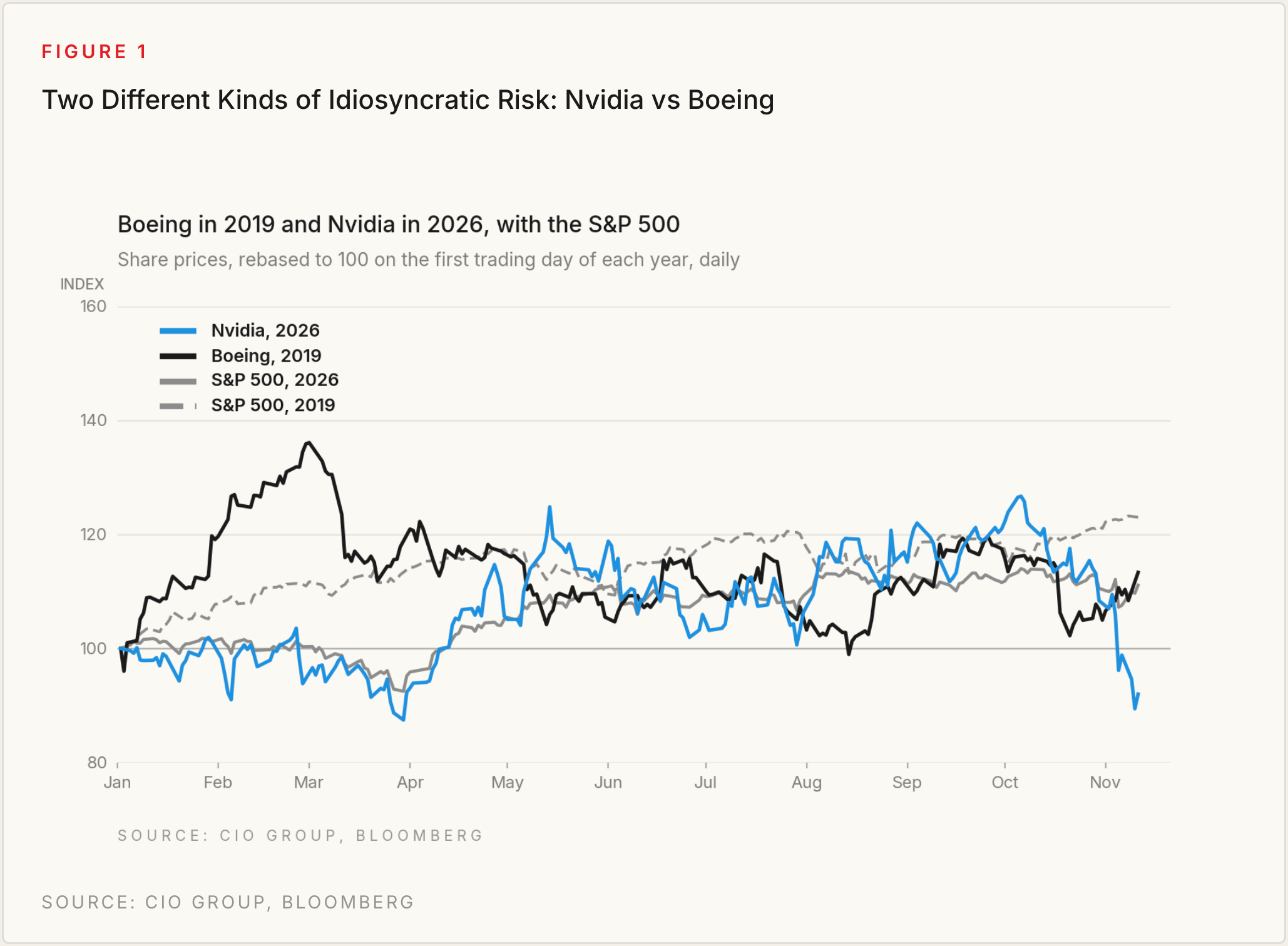
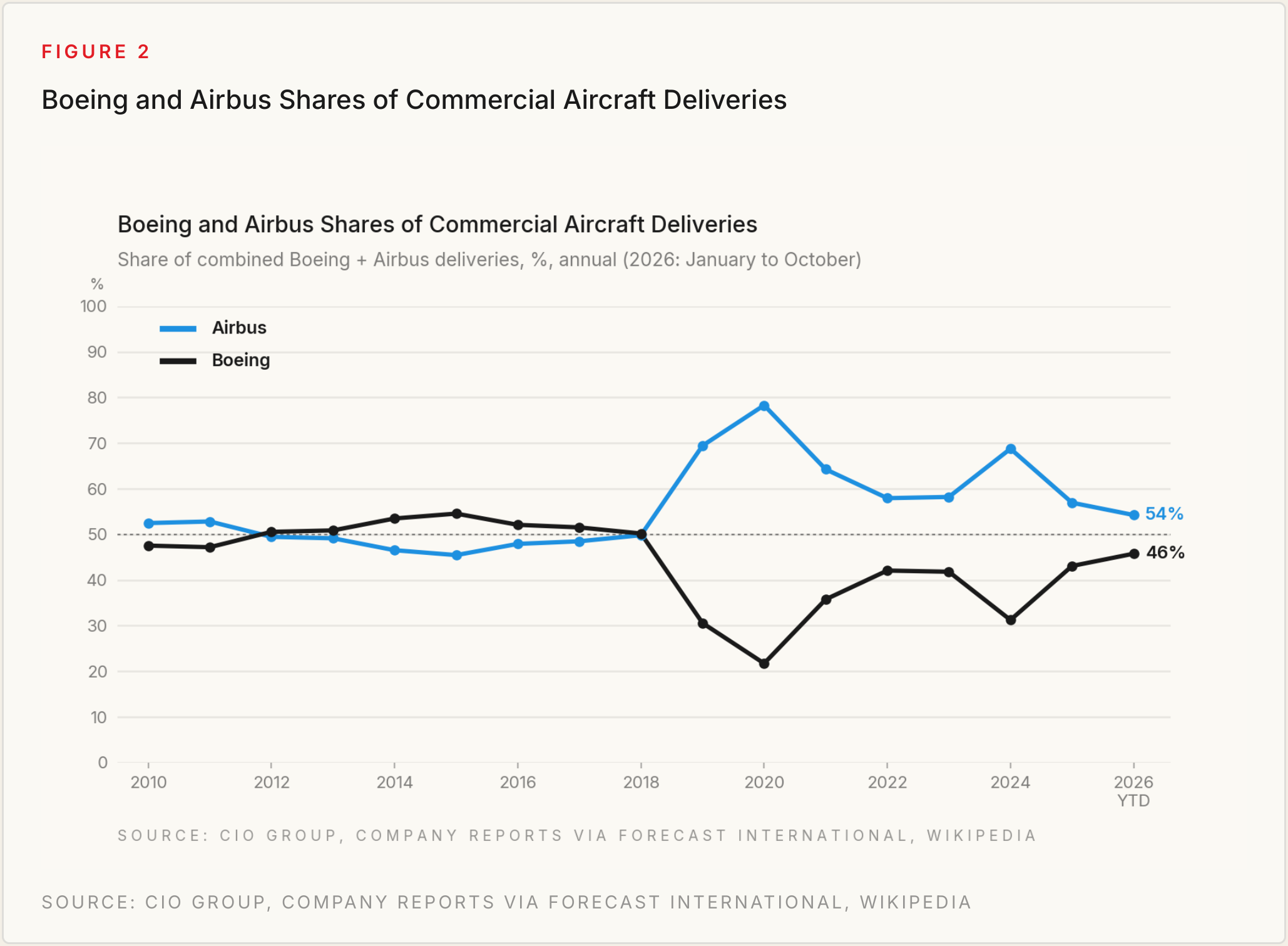
Boeing’s share of commercial aircraft deliveries fell from 50% in 2018 to 22% in 2020, and it’s only 46% this year (see figures 1–2). That’s a different kind of idiosyncratic risk. Boeing’s product failed: the crash of two 737 MAX passenger jets in 2018 and 2019 – and further in-flight defects in 2024 – drove US fines and prosecution for conspiracy to defraud, and Boeing restrained production sharply in the interest of safety, reducing its profits for several years. No one is doubting the effectiveness of Nvidia’s chips or its capacity to deliver them. So Nvidia’s risk is the loss of the person who shaped the industry, not a broken product.
Competitive Dynamics: Why We Own the Index
In recent days, Nvidia’s direct competitors, such as Broadcom and AMD, have outperformed. But in our view, it would take a great deal to unseat Nvidia as the most dominant higher-end AI chip maker. Jensen’s departure will not materially slow technological advances or public demand for AI.
Recently, the US equity market has been roiled with unusual volatility for reasons including US election results and security in the Persian Gulf. Yet as figure 3 shows, markets are treating Jensen Huang’s Nvidia as a highly idiosyncratic issue. In our view, it largely is.
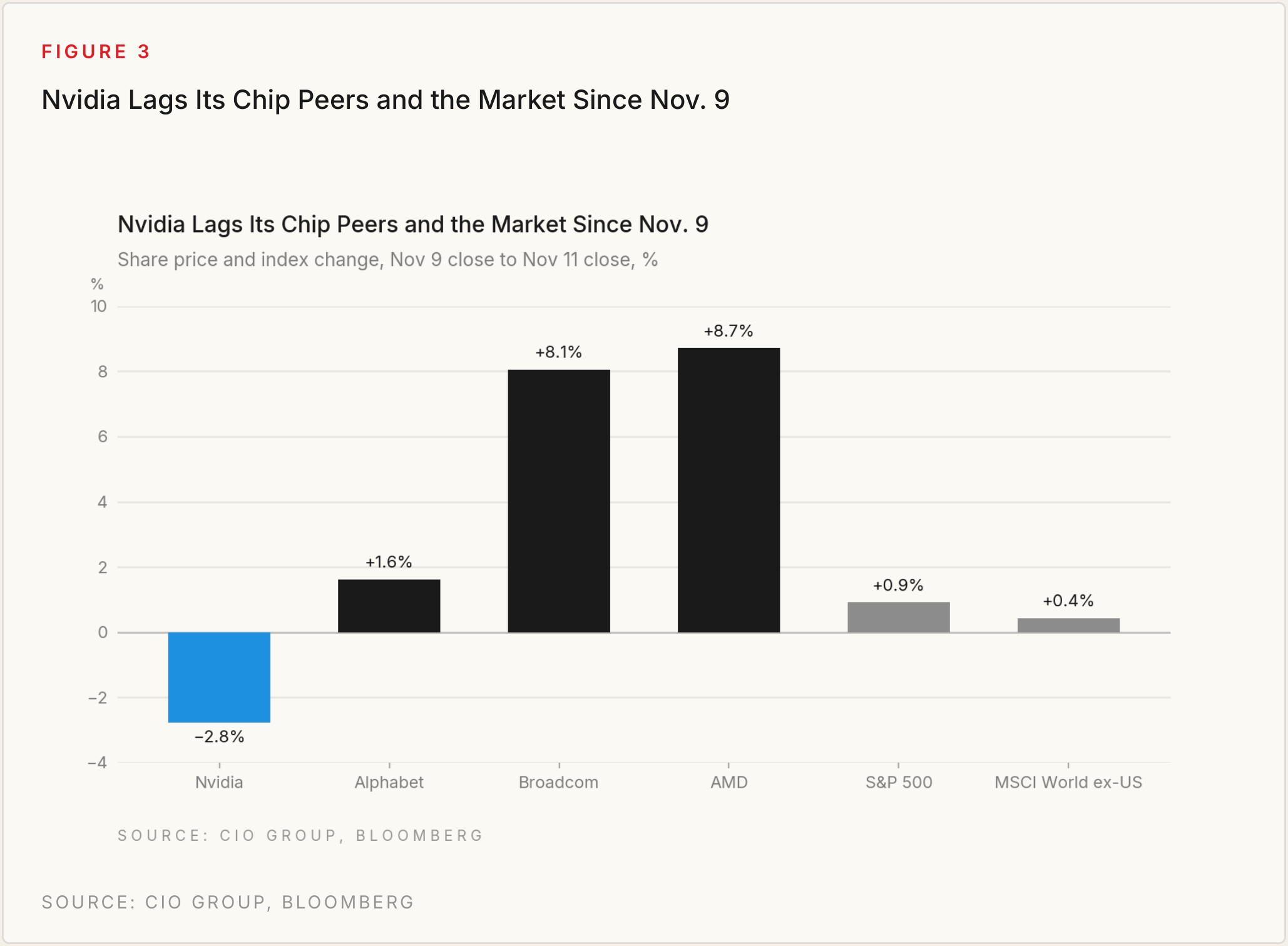
Nvidia opened 13.1% lower on Thursday, while Broadcom and AMD have outperformed since Monday. We believe that’s the start of a lasting shift, not a one-week trade. Nvidia’s leadership change opens up the competitive landscape. We expect faster deployment of other companies’ chips and lower sales for Nvidia than it would otherwise have had. That’s good for the users of AI and for the pace of its adoption. It’s bad for anyone concentrated in a single chip maker. And it’s why we own the industry through the index rather than its leader alone.
Important Information
This material has been prepared by CIO Capital Group, LLC (“CIO Group”) for informational purposes only and does not constitute investment advice or an offer to buy or sell any security or the solicitation of an offer to buy any security or investment advisory service. All opinions are subject to change without notice. Past performance is not indicative of future results. Investment returns may vary significantly over time. Indexes are unmanaged, are not available for direct investment, and do not reflect the deduction of fees or expenses. This material has been prepared without regard to the specific investment objectives, financial situation, or particular needs of any individual investor.
CIO Group believes that the information obtained from third party sources contained herein is reliable, but no representation or warranty is made regarding its accuracy or completeness. CIO Group accepts no responsibility or liability (including for indirect, consequential, or incidental damages) for any error, omission, or inaccuracy in such information and for results obtained from its use.
Certain information contained herein constitutes ‘forward-looking statements’ which are based on current expectations, estimates, projections, and beliefs. Forward-looking statements are subject to risks and uncertainties that could cause actual results to differ materially. Any forecasts, projections, estimates, or market expectations are based on current assumption and should not be considered guarantees of future events or investment results.
References to portfolio positioning, asset allocation, sectors, or investment strategies reflect CIO Group's views as of the date of publication and should not be interpreted as recommendations to purchase or sell any particular security or investment strategy.
CIO Group is an investment adviser registered with the SEC. Copyright ©2026 CIO Group. All rights reserved.