Changing World Leadership, Changing CIO Portfolios
Beyond the Safety of the Dollar, Global Investors Care How the US Treats Its Allies
When President Trump ended months of speculation and selected former Fed Governor Kevin Warsh as Fed Chairman designee, global financial markets behaved as if the Fed had delivered an unexpected tightening. The US dollar rebounded after two weeks of unrelenting declines. US Treasury yields firmed across the curve. Equities fell.
Among Trump’s Fed Chair candidates, Warsh was not the obvious winner. Trump has repeatedly suggested that the Fed should act to make life easier for the US Treasury by lowering yields. Warsh is known as a “hard money” man. His historic commentary emphasizes the preeminence of price stability as the central bank’s goal. He has admonished the Fed for expanding beyond its purpose and acting to enable fiscal irresponsibility. For those worried about inflation and the international value of the dollar, this should be reassuring.
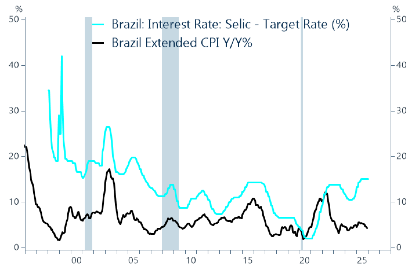
Prior to Warsh’s selection, we warned that much more US dollar depreciation would follow if the Fed cut interest rates in a way that ignored its inflation mandate. That’s because the transmission mechanisms across global markets are much faster now than in the past. Rapid capital mobility means that grossly-irresponsible monetary policy will be punished, even for the world’s reserve currency (please see our in Episode 14). As a counter-example, high real interest rates in Brazil and Mexico are strengthening local currencies.
No Coincidence: The End of a Speculative Bubble and A Loss of Market Leadership
All That Glitters…
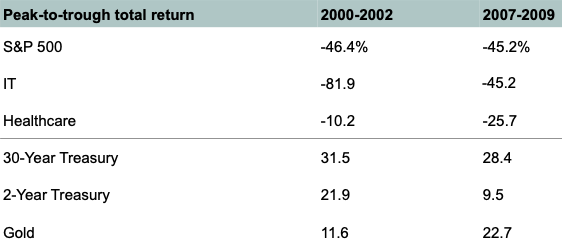
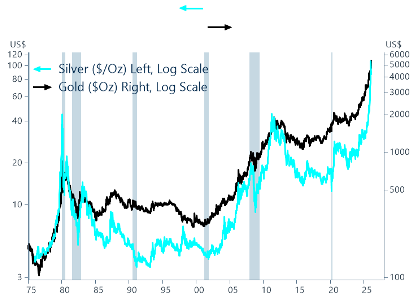
Gold has served as a useful portfolio hedge for various risks through time (see figure 1). Yet in 2025, gold prices transformed from hedge to momentum trade. And in 2026, gold, silver and other metals entered parabolic frenzy territory (see figure 2).
Precious and industrial metal prices collapsed just after the Warsh announcement. Gold posted its largest drop since 2013. Silver dropped 31% in three sessions. Short-term, leveraged investors had focused their attention on these assets as the key US dollar “debasement” trades. They had positioned for the next Fed Chairman to act irresponsibly.
The last spike higher for precious metals was driven by "FOMO” traders, including many small, US and Asian individual investors. This follows a similar burst in crypto markets that has accelerated after a systemic failure of key market platforms on October 10, 2025. Both the metals and crypto markets have become more leveraged over time, with derivatives and perpetual futures multiplying the impact of retail traders and systematic programs alike.
Is Not AI…
Over the last eight trading days to February 5, 2026, the software complex was struck by lightning. IGV, the iShares Expanded Tech-Software ETF lost 19%, -5% on Feb 5th alone. The proximate cause has been a market grappling with substitution risk; fear that AI will replace software rather than serving as an “add-on” feature.
Anthropic’s release of Claude Opus 4.6 - positioned for enterprise/knowledge work with specific finance/law integrations - sparked a moment akin to “DeepSeek” for semiconductors in early 2025. In that episode, a Chinese AI platform showed that key tasks could be accomplished with substantially less computing power, causing investors to fear a crash in Nvidia chip sales. Instead, it just raised the effectiveness of AI, making the case for adoption stronger. Despite a “flat” stock for months at an enormous $5 trillion market cap, there is no slowdown in Nvidia chip demand.
There are reasons to fear that the situation for software is somewhat different. Tech shares have greater dispersion and disruption than other sectors. Like chips, the “second best” software solution is often a failure. For public market investors, the challenge is amplified because the winning application may come from a company that is still private. Nonetheless, many software developers are likely to benefit from AI in developing better applications themselves. In our view, investors are again hit the sell button in an indiscriminate way.
Underneath the Anthropic shock was a second, equally destabilizing theme, a collision the between AI Capex and ROIC math. Along with exceptional earnings from Google and Amazon came huge, upward capital spending plan revisions (Amazon +$200B in 2026 and Google +$175B). Investors rightly wonder about funding and payback periods. The collapse of the $100B Nvidia–OpenAI investment plan then punctured the idea that the financing flywheel was certain.
If software pricing power could erode far faster than expected and infrastructure spending could be curtailed due to ROIC uncertainties and eroding business alliances, then tech market leadership would peak. On these fears, even defensive tech such as cybersecurity was hit, with leaders like Palo Alto Networks down 7.2% in a day.
If tech leadership cracks while the healthcare sector is weighed down by policy/regulatory uncertainty, then capital flows can accelerate to safe havens. Gold and silver don’t look as safe anymore. Long-term investors may once again benefit from “yield assets” that they have often looked at as a mere portfolio drag (see our updated asset allocation below).
The Story Behind the Story
“The concept at the heart of money is trust – a trust which is hard won but easily lost.” — Bank of England, July 30, 2024, from a paper on innovation in money and payments.
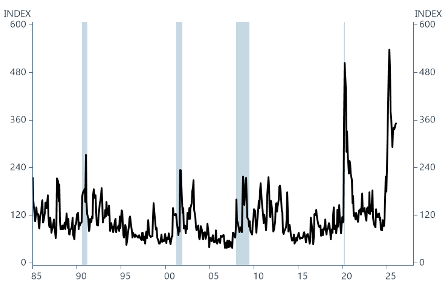
For domestic US asset holders and those in Canada, the EU and UK, US economic and regulatory policy has become far less predictable. Tariff agreements and security arrangements have been questioned repeatedly at the sole discretion of President Trump (Figure 3). “Liberation day” tariffs in April 2025 drove the largest declines in the US dollar last year. And in 2026, new tariff threats, territorial claims, and other issues have driven up a modest US risk premium this year.
The US dollar resumed a slow depreciation trend after the Warsh announcement revealing a critical observation: monetary policy is not the most important driver of diversification away from US assets.
Dollar Pressures Continue
A second US government shutdown in three months, driven by immigration enforcement disputes, delayed the release of US employment data for January. Government uncertainty and dysfunction is accelerating dollar selling by global investors, countering US leadership in innovation and technology.
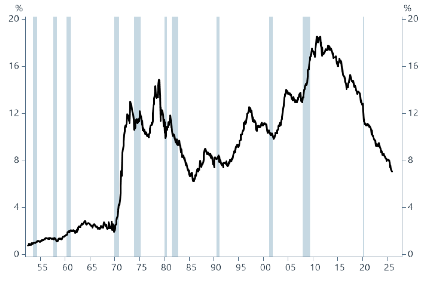
While the majority of the world’s foreign reserves are held in dollars, certain non-US central banks began to diversify more than a decade ago. Russia eliminated nearly all of its US Treasury holdings in early 2018. Unilateral US actions to impound Russia’s foreign assets after it attacks Ukraine added to perceived risks for others who might not agree with US policies. China’s holdings of $683 billion in US Treasuries are 46% over the past 10 years. And US Treasury outstanding debt has increased 113% over the same period (Figure 4)
The combination of greater policy uncertainty and lower rates ahead could generate further dollar liquidation. We’ve long made the case that slowing US employment growth will eventually drive the Fed to some further easing actions in 2026. We do not believe this is highly dependent on FOMC membership. The Fed’s charter requires majority approval for policy changes with the Fed Chair and FOMC Vice Chair having a single vote.
The CIO Group Point of View
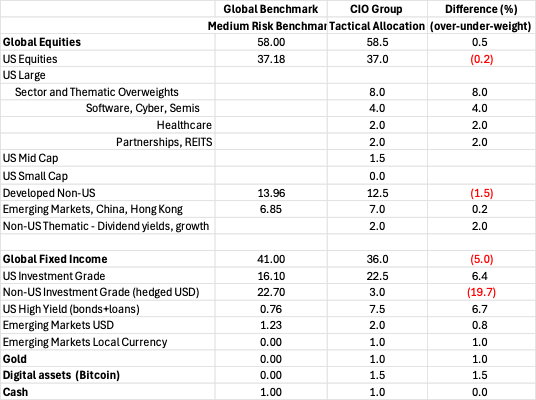
Adapting Our Global Asset Allocation
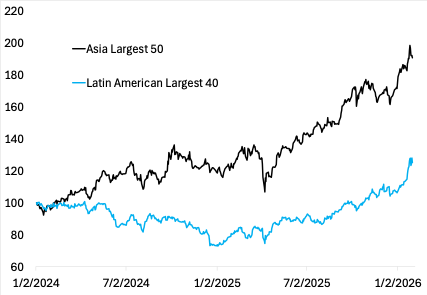
Presently, trades that amplify the dollar’s decline (gold and silver) are distorting wider global asset prices. Of late, Latin America shares have also rallied with commodities in a way that seems suspiciously “momentum” driven (see figure 5). With this said, the high real interest rates in Brazil and Mexico, the largest economies of the region, make local assets attractive (Figure 6). In fact, the macroeconomic policies and political developments in Latin America seem less erratic in contrast to US’s policies. We hold local emerging markets debt overweight and add some modest additional exposure in our updated asset allocation (see below).
Elsewhere in fixed income, as we’ve highlighted previously, the 175 basis points of Fed rate cuts since 2024 have been passed on to variable rate securities. High yield bank loans have seen yields fall from a cycle high of 9.0% to prospectively 6.25%.
While zero-duration loans are a remarkably stable, higher yielding asset in all but the worst credit markets, intermediate duration high yield bonds now offer more value with yields closer to 7.0%. While we still favor both high yield loans and bonds, we’ve reduced our allocation to loans. This downshift also allows us to add a small position in volatile, leveraged mortgage REITS with an attractive near-14% yield. This premium yield compares to just 4.2% for high grade US mortgage securities where we have reduced our allocation.
Equities – Leadership Takes a Hit
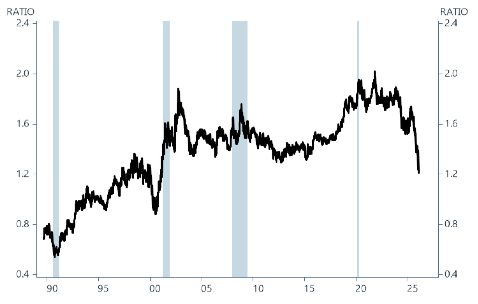
Software is the industry with the strongest long-term track record of market leadership. Breakthroughs in AI functionality and intense competition in the industry – perhaps emblematic of a “capital glut” in AI – has resulted in the worst relative performance for the group on record (Figure 7) We see software’s downshift as an exaggeration with room for recovery. We continue to hold small overweights in areas such as cybersecurity.
Conversely, we have taken profits in Aerospace and Defense with shares rising 55% over the past year. We would look to add back this position on any sharp correction. However, we see a stronger near-tern opportunity in a less bullish broad market. The buildout of the US energy sector for both AI and gas exports is backed by an 8.0% yield in midstream gas transmission/distribution partnerships. We have added a small position in Master Limited Partnerships. For certain US investors, ownership of individual partnerships may derive tax benefits.
Be Grateful to be Global
As we noted back in November 2025, the excesses in tech and surge in gold were warnings of volatility to come. We added to some “less exciting” assets in healthcare and followed this with higher allocations to high quality non-US equities with solid dividends this year. In the young year-to-date, non-US equity returns measured in US dollars have exceeded US returns by nearly 6 percentage points.
While still optimists on the US economy, we believe the trend of diversification from US assets is likely to remain in place for the foreseeable future. There is a chance that momentum wanes and the US dollar bounces back in a counter-trend rally (please see Point of December 12). Yet our new asset allocation broadens our international holdings somewhat further. We believe this is in the long-term interest of most investors, as many of which have too much US concentration risk.
Even after last year’s underperformance, US equities account for about 63% of global traded market capitalization. The US trade weighted dollar remains more than 12% above its long-term average level in inflation-adjusted terms.
We are less bullish than the consensus of sell-side Wall Street strategists on S&P 500 targets for this year. We see a volatile year with a 10% return despite double-digit profit growth. We see strong AI spending growth continuing. Yet this adds disruptive, competitive pressures for many firms. As such, we believe that adding further to non-US holdings in fixed income and to segments of the US equity market with yields averaging 10.9% adds both diversification and solid return potential for portfolios (see figure 8).