Should Investors Buy the Dip? Tariffs 2025 vs. Iran War 2026
Introduction
In 2025, investors panicked about tariffs. President Trump’s “liberation day” appeared to be the largest US tax increase since World War II. The S&P fell 19% from February 19 to April 8th. But the headlines were misleading and tariff collections were 70% less than expected. Markets rallied 37% from their lows to the end of 2025.
Over the past 15 years, investors have been rewarded for buying dips. It has become a habit. The latest conflict in the Persian Gulf is hardly representative of a dangerous boom or misalignment in the economy, so “dip buying” could well pay off again. Yet the “fog of war” is thick. For the moment, the productive capacity of Persian Gulf oil producers has been maintained. But this does not mean energy supplies are secure.
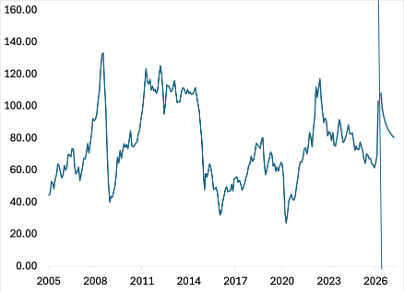
The Iran War caused a 9% drop in the S&P 500 from Jan 27 to March 30. Unlike the exaggerated tariff fears, investors may be underestimating the severity and duration of the Iran energy shock. Energy traders assume a rapid return to normal energy costs, but we believe that meaningful risks remain underpriced (See Figure 1.)
Should investors buy this dip? Could US equities still rally 12%-15% by the end of 2026 and non-US equities even more?
Here is our thinking.
Early Spring Swoons 2025, 2026. How do They Differ?
In our Outlook for 2026, we noted that buying into market dislocations is one of our Active Asset Allocation principles. We believe in taking advantage of value created when asset prices drop for non-fundamental reasons. We do not believe in chasing assets, like oil and gas prices now, that have surged in value relating to a shock.
With a year’s data in hand, we can confirm and illustrate that analysts overstated the actual scope of tax increases that sent markets into fear of a recessionary collapse in February 2025. The scope of the actual tariff collections – an increase of $223 billion from US taxpayers -- was 70% less than the $750 billion estimate implied by the administration’s announcements. The exaggerated estimates of early 2025 didn’t take into account the highly specific application of particular tariffs and exemptions.
Today’s modest 9% S&P 500 decline is more proportional to the actual costs of the Iran War on the US economy. We estimate full-year energy cost increases in the US from the Middle East shock at $170 billion for 2026. It assumes their quick dissipation. However, the more sanguine market reaction in 2026 makes us less inclined to plunge more deeply into risk assets today.
While it is possible that the “shock” associated with the closure of the Hormuz Strait can dissipate via a rapid resumption of energy shipments through the Persian Gulf or through alternative shipment routes that are currently more costly or limited, there are other less sanguine possibilities.
Perhaps until US forces leave the Persian Gulf, the resumption of transit across the Strait will be a conflict zone. Iran continues to fire missiles at the energy assets of neighboring countries. It remains possible that one or more of these attacks will damage critical infrastructure or production capacity, impairing supply for a much longer period. And lastly, the President’s stated willingness to hit Iran “extremely hard” risks escalated retaliation from Iran.
Our investors and readers should still understand that if clarity and reduced energy supply risk comes about more quickly than higher share prices, we will allocate more to US and non-US equities. But the limited degree of risk priced into markets dissuades us from taking this step immediately.
The 2026 Economy is Less Shock Proof vs. 2025
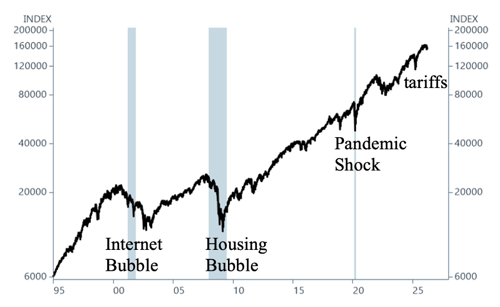
As we have written before, excesses in housing credit in the mid 2000s in the US and China in the 2010s were boom/bust cycles that inflicted lasting damage to economies. Shocks, in contrast, represent costs imposed on an economy that hold growth down temporarily. Even the 2020 pandemic, the first in a century, represented a shock rather than a deflationary bust (see Figure 2).
The big difference in 2026 vs. 2025 is the state of the economy. The resilience of the 2026 economy appears measurably less, as the possibility for income gains across important parts of the US economy has been reduced.
In the year through April 2025, US employment rose by 955,000. In the past 12 months, the gain has been just 260,000, or a paltry 22,000 per month. Folding in wage gains, hours worked, taxes and inflation, real disposable personal income (DPI) growth was 2.8% in the year through April 2025. Folding in the 2026 energy price increases, we estimate that real DPI growth will be near zero this month.
The economy’s ability to absorb cost increases was simply higher in 2025 when employment and income growth was stronger (Figure 3). But there is one significant offset, though not one large enough to prevent a near-term slowing in the economy overall: the boom in AI infrastructure spending.
AI spending is buoying the economy in 2026. As Figure 3 illustrates, this very narrow spending category accelerated through 2025 and accounted for 27% of real economic growth in the US last year -- about 0.5% of the 2.0% full year 2025 growth in US real GDP.
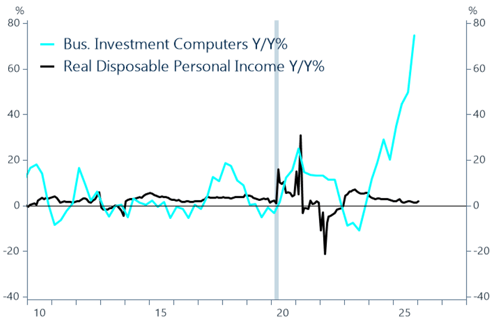
As we’ve discussed previously, public and private company data-center spending is well funded and projected to grow in excess of 50% in 2026. The AI spending base is at a higher level and should once again boost US economic growth by at least 0.5 percentage points in 2026. Chances are good that the AI spending boom will outlast today’s energy shock. But, no part of the US economy can outgrow the whole by a factor of 10-fold forever.
Buy the Dip 2026?
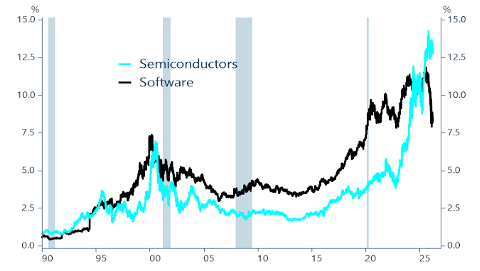
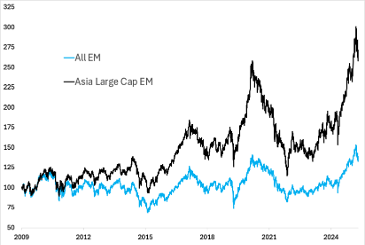
Where does all this leave investors? Unfortunately, still subject to war-related headlines driving most global asset prices for the time being. For those not inclined to “trade the war” we believe Asian equities and US software are attractive assets for when the war ends and the path to flowing energy becomes clear (see Figures 4-5).
As we discussed last week, energy traders see a peak in oil and energy product prices by next month, even after President Trump discussed an extension of the conflict in a national address. However, this requires limiting the severity and duration of the current shock to conform to the short-term disruption energy traders expect.
An “all clear” will incentivize CIO Group to raise its global equity allocation, but the positive scenario is hardly a certainty at this moment and the size of the dip in 2026 is not as large nor as hypothetical as were the possible tariff impacts of 2025.
Investors may be trained to buy dips, but the Iran War is not a typical dislocation.