
Is Warsh a Hero or Zero? The Real Test Lies Ahead
Is Inflation a Problem: Yes and No
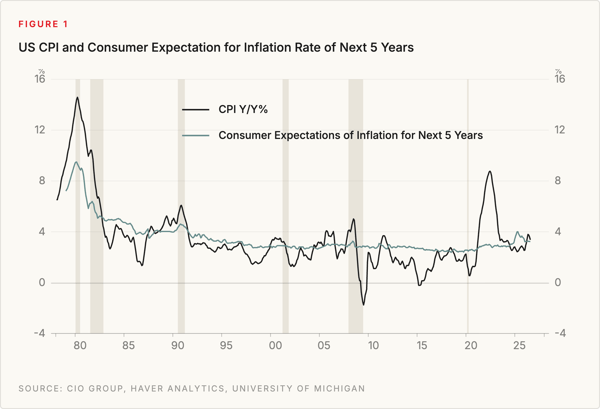
The “cost of living” is at the heart of US voter anxiety less than three months before US mid-term elections. When US consumers are asked what they believe the rate of inflation will be in the coming five years, they tell pollsters 3.3%. This is slightly below the actual pace of inflation the US has experienced since World War II (Figure 1). Over that time, central bankers in the US or elsewhere have never managed to force consumer prices down after supply shocks push them up.
Inflation in 1980 vs after the Pandemic
Consumers in 1980 expected 10% inflation to be persistent. After a decade of double-digit inflation, destabilizing price increases were “normalized.” That was the monetary challenge newly appointed Fed Chair Paul Volcker took on in August 1979.
The inflation surge during and after the pandemic period (especially after) was also caused by excessive monetary and fiscal easing. It surprised many who had not lived through any period of great macroeconomic instability. As the consumer price level rarely ever falls, the massive leap in prices and loss of purchasing power hurts consumers and businesses, even five years after the peak in the inflation rate. But the same Fed that enabled the pandemic inflation, also imposed a severe monetary tightening in 2022 which changed its course.
Mr. Outrage
Markets believed President Trump would choose a compliant dove to deliver the world’s lowest interest rates. This was the dominant market view even after Warsh was nominated on January 30. But when appointed Fed Chair, Kevin Warsh emitted a sense of outrage at the Fed’s performance on its inflation mandate. Warsh’s on-the-record assessment was the Fed was not tough enough in recent years. So, expectations for possible rate hikes surged.
Nothing Done
At his first post FOMC meeting press conference as Chair on June 17, Warsh cemented expectations that the Fed would finally get serious and put a period of “irresponsible” monetary policy behind it. But at Warsh’s first two Federal Open Market Committee meetings, he and the committee he leads delivered rhetoric with no action.
Catch-22
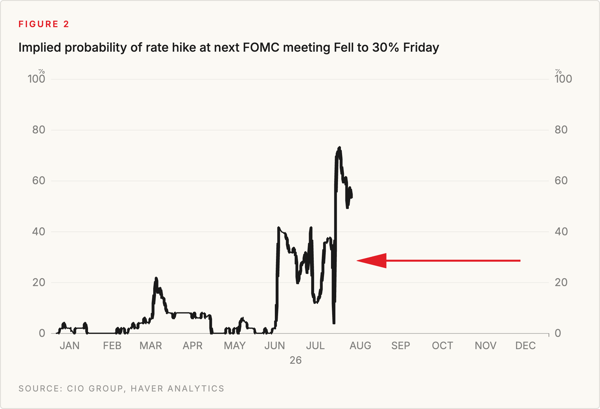
The first interest rate hike of a cycle is often momentous. After Warsh’s unqualified promise - “the Fed will deliver price stability” - a July rate hike seemed highly probable (see figure 2). Warsh pointed to five years of the Fed failing to meet its inflation target.
But the data got in the way. At the time of the July FOMC, Warsh downplayed the most tame core CPI reading since 2021. Then came the report last week which saw tame inflation as well. The core CPI’s 12 month pace in July fell to 2.5% year/year. This is likely to mean the Fed’s preferred formulation is near 2.2%.
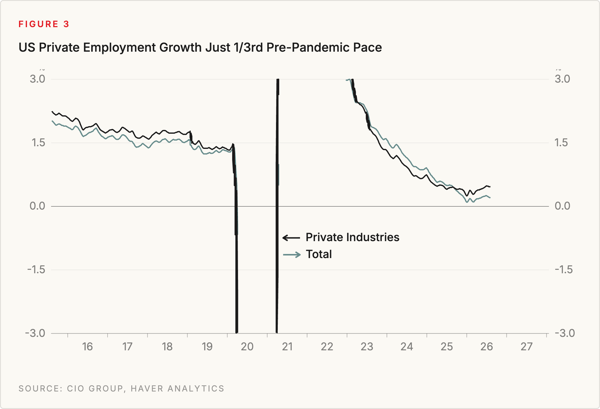
At a tepid growth pace well below pre-pandemic norms, US employment is not adding to inflation pressure (see figure 3). The combination of “tame” inflation and employment data cooled the urgency to hammer the economy down in the view of markets. While markets once priced a 75% probability of a 25 basis point rate hike, they now see action in September as a 30% chance.
Externalities: The Oil Shock
History’s largest global energy supply disruption has generated relatively little economic damage to date, with the US most insulated. After an initial major spike, crude oil has traded well below the peak of 2022’s Russia-driven surge during the entirety of conflict to date. The discrete rise in energy costs has not had a lasting impact in broad consumer prices or large losses in output and employment.
AI and the Economy - A Little Restraint May Be Best
In CIO Group’s view, the absence of sharply rising inflation doesn’t eliminate underlying economic risks. It is difficult to find the correct policy setting for today’s combination of a tepid labor market and exuberant financial markets. Yet if full employment and stable prices are the Fed’s dual mandates measured over the longer-run, the Fed should not be contributing to financial excesses.
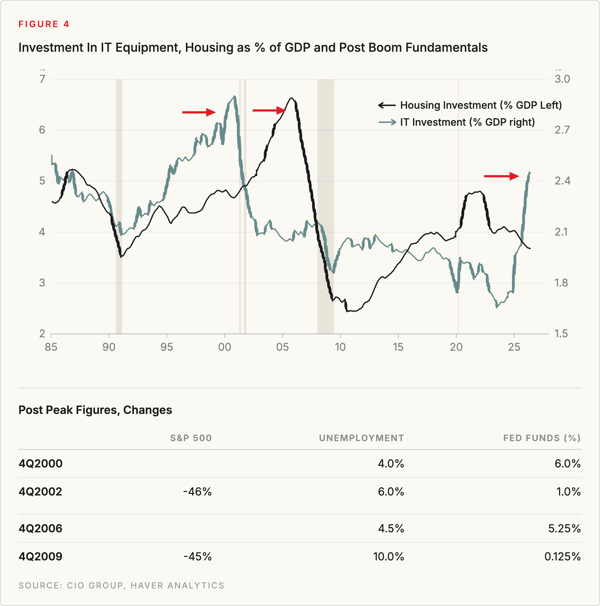
In the late 1990s and mid-2000s excess investment in IT equipment and housing proved to be economic vulnerabilities (see figure 4). This is the case even if there is legitimate optimism for technological change that will improve the productive capacity of the economy.
Today, no one can say with certainty how much further the period of rapid growth in investment spending on AI infrastructure will last. While we are optimistic in the near-term, the financial and economic consequences of today’s AI boom are increasingly looking similar in scope to the late 1990s. This will be felt at some point in the future.
We would remind our readers that the long period of Fed easing after the busts of 2000 and 2008 did not stop labor markets and financial markets from suffering losses for a significant time.
Warsh Himself is Still a Market Risk
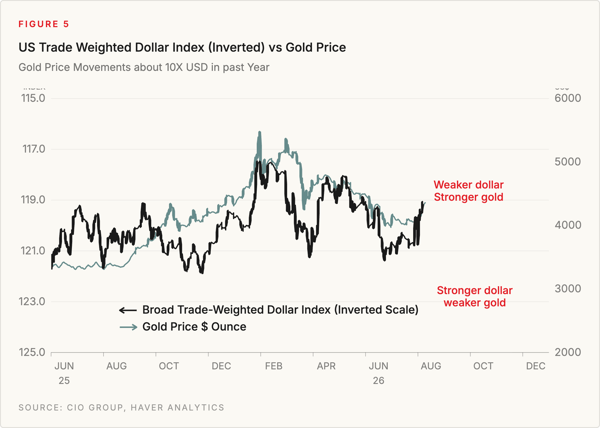
To date, speculation over the FOMC’s new leadership has generated sharp swings in significant corners of financial markets. We do not believe the impact is over. The US dollar and gold, foreign assets and US bonds, have all swung significantly on vacillation over the Fed’s approach. For example, we believe the bulk of the gold’s 25% early-year surge, subsequent 27% drop, and recent 10% rebound reflect perceptions over the conduct of US monetary policy (see figure 5). US bond yields, meanwhile, have generally gravitated higher on rate uncertainty.
As discussed last week, we have been and remain optimistic, tactical investors. But we also believe in preparing for risks. As such, the slight increases we’ve made in our portfolio bond duration and quality this year are unlikely to be our last.
What might be best for short-run returns may not be best for the economy in the long-run. Despite tame inflation data, we would argue that Warsh should build in some incremental monetary restraint and live up to his rhetoric. That appears uncertain, if not unlikely.
Important Information
This material has been prepared by CIO Capital Group, LLC (“CIO Group”) for informational purposes only and does not constitute investment advice or an offer to buy or sell any security or the solicitation of an offer to buy any security or investment advisory service. All opinions are subject to change without notice. Past performance is not indicative of future results. Investment returns may vary significantly over time. Indexes are unmanaged, are not available for direct investment, and do not reflect the deduction of fees or expenses. This material has been prepared without regard to the specific investment objectives, financial situation, or particular needs of any individual investor.
CIO Group believes that the information obtained from third party sources contained herein is reliable, but no representation or warranty is made regarding its accuracy or completeness. CIO Group accepts no responsibility or liability (including for indirect, consequential, or incidental damages) for any error, omission, or inaccuracy in such information and for results obtained from its use.
Certain information contained herein constitutes ‘forward-looking statements’ which are based on current expectations, estimates, projections, and beliefs. Forward-looking statements are subject to risks and uncertainties that could cause actual results to differ materially. Any forecasts, projections, estimates, or market expectations are based on current assumption and should not be considered guarantees of future events or investment results.
References to portfolio positioning, asset allocation, sectors, or investment strategies reflect CIO Group's views as of the date of publication and should not be interpreted as recommendations to purchase or sell any particular security or investment strategy.
CIO Group is an investment adviser registered with the SEC. Copyright ©2025 CIO Group. All rights reserved.